What This Document Is
This document comprises lecture notes from an advanced digital integrated circuits course, specifically focusing on the design and analysis of adders – a fundamental building block in digital systems. It delves into the complexities of high-speed arithmetic circuits, moving beyond basic adder implementations to explore advanced techniques for optimizing performance. The material originates from a course taught at the University of California, Berkeley.
Why This Document Matters
This resource is invaluable for electrical engineering students and professionals seeking a deep understanding of adder architectures and their impact on overall system speed and efficiency. It’s particularly useful for those studying computer architecture, VLSI design, or digital logic, and will be beneficial when tackling projects involving high-performance arithmetic units. It’s ideal for supplementing coursework, preparing for advanced studies, or refreshing knowledge on critical adder concepts.
Topics Covered
* Phase-Locked Loop (PLL) based clock generation and its relevance to adder timing.
* Various adder architectures, including mirror adders, dynamic logic adders, and carry-skip adders.
* Techniques for optimizing adder speed, such as carry chain design and sizing.
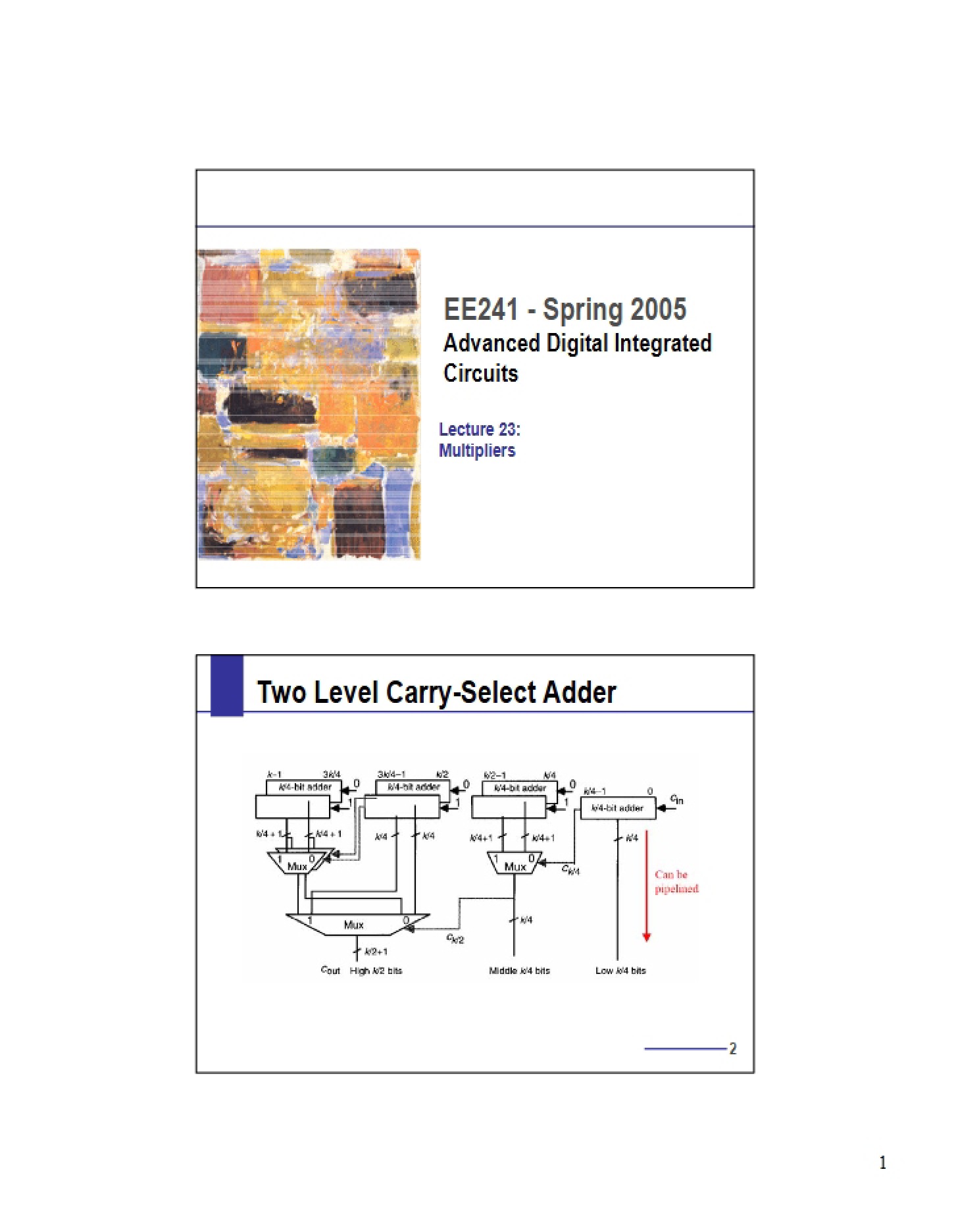
* Advanced adder structures like carry-select adders and their variations.
* Considerations for clock distribution and deskewing in high-speed adder implementations.
* A review of key literature and foundational texts in the field of computer arithmetic.
What This Document Provides
* A detailed exploration of different adder topologies and their trade-offs.
* Discussions on the challenges of designing for speed and area efficiency in adder circuits.
* Insights into the impact of process variations and device characteristics on adder performance.
* References to seminal research papers and publications in the field of high-speed arithmetic.
* Conceptual frameworks for understanding and analyzing adder delay and power consumption.