What This Document Is
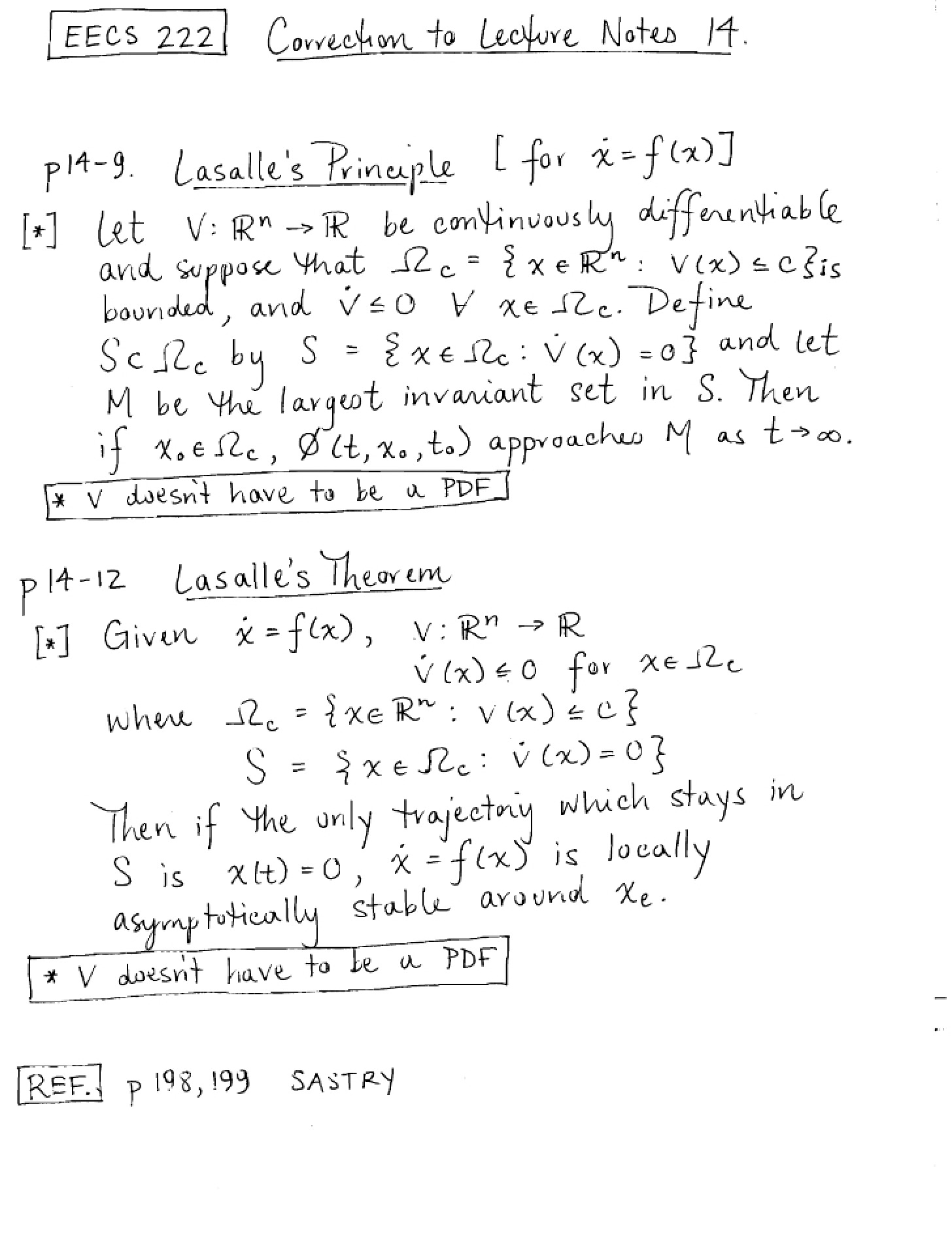
This document represents Lecture 4 from the Nonlinear Systems—Analysis, Stability and Control (ELENG 222) course at the University of California, Berkeley. It delves into the core principles governing the behavior of nonlinear dynamical systems, building upon foundational concepts introduced in prior lectures. The material focuses on analytical tools used to understand the long-term qualitative behavior of these systems, moving beyond simple equilibrium point analysis.
Why This Document Matters
This lecture is crucial for students seeking a deeper understanding of nonlinear system dynamics. It’s particularly valuable for those studying control systems, robotics, or any field where modeling complex, real-world phenomena is essential. Engineers and scientists will find this material helpful when analyzing systems where linear approximations are insufficient, and a more nuanced understanding of system trajectories and stability is required. It serves as a strong foundation for advanced coursework and research in nonlinear control and dynamical systems.
Topics Covered
* Fundamental theorems related to the behavior of planar dynamical systems.
* The concept of limit sets and their role in characterizing system dynamics.
* Analysis of invariant sets and their implications for system trajectories.
* Application of theoretical concepts to a classic biological model – the Lotka-Volterra predator-prey system.
* Equilibrium point analysis and stability considerations within nonlinear systems.
* Exploration of closed orbits and their relationship to system behavior.
What This Document Provides
* Formal definitions of key concepts like flows and omega-limit sets.
* A detailed examination of a specific planar dynamical system and its properties.
* Discussion of conditions under which invariant sets must contain equilibrium points or closed orbits.
* Illustrative examples demonstrating the application of theoretical results.
* Analysis of the Lotka-Volterra model under varying parameter conditions, revealing different qualitative behaviors.
* Insights into the limitations of certain analytical tools and the need for further investigation.