What This Document Is
This is a detailed lecture recap from Introduction to Microelectromechanical Systems (MEMS) – ELENG 247A at UC Berkeley, specifically focusing on the principles and practical considerations of Oversampled Analog-to-Digital Converters (ADCs). Spanning 34 pages, this resource consolidates key concepts discussed in a dedicated lecture session, offering a comprehensive overview of this crucial signal processing topic within the broader field of MEMS design. It’s designed to reinforce understanding and serve as a valuable reference point for students navigating the complexities of data conversion in microsystems.
Why This Document Matters
This recap is essential for students in ELENG 247A who are looking to solidify their grasp of oversampled ADC architectures. It’s particularly helpful for those seeking a structured review of the lecture material, preparing for assignments, or building a strong foundation for more advanced topics in data conversion and signal processing. Students will find this resource beneficial when revisiting challenging concepts or needing a concise yet thorough reference guide during project work. Access to the full document unlocks a deeper understanding of the nuances of ADC design.
Topics Covered
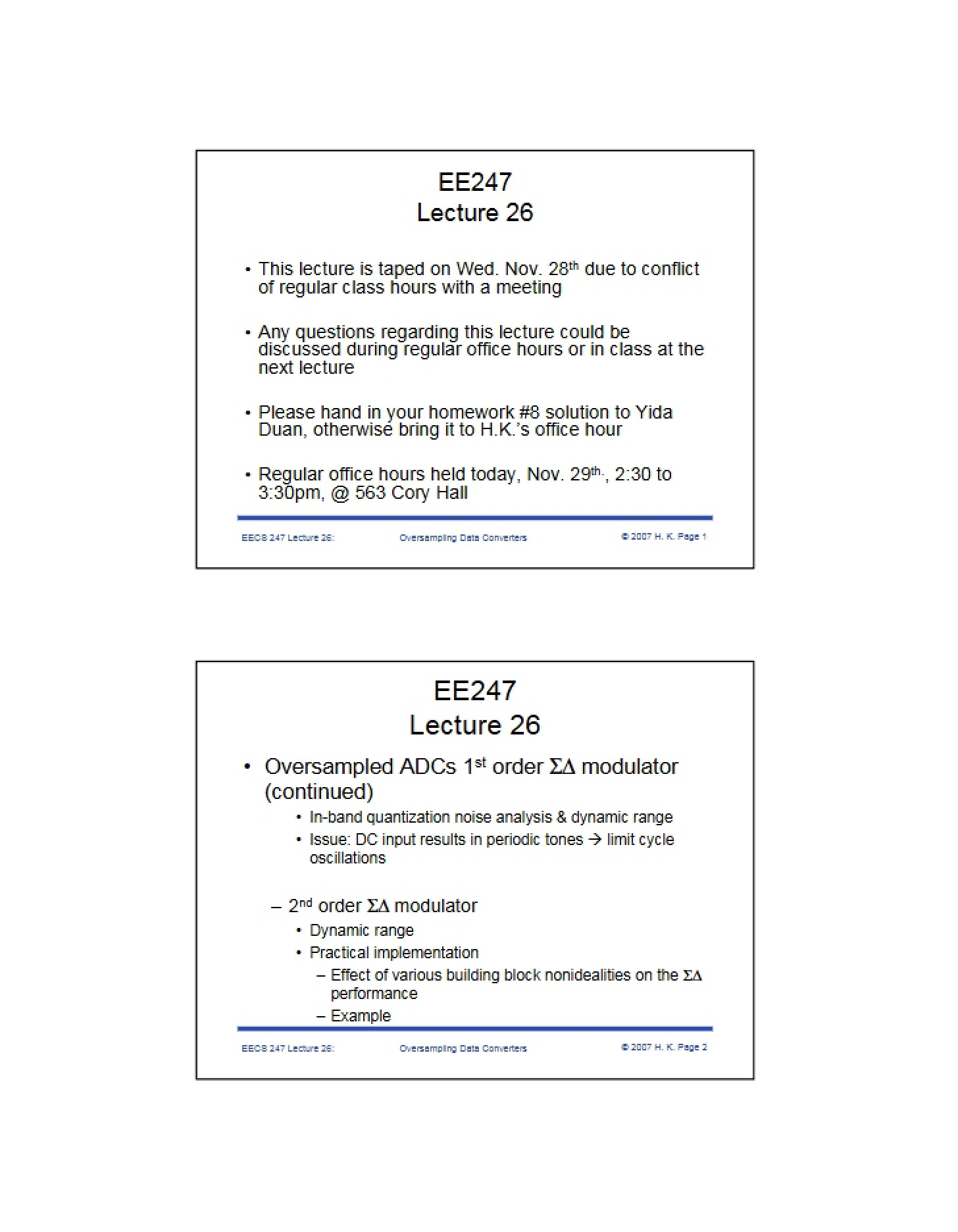
* Comparative analysis of different oversampling ADC architectures.
* Impact of non-ideal component characteristics on ADC performance.
* Techniques for maximizing signal handling capabilities within integrators.
* Detailed examination of limit cycle oscillations and mitigation strategies.
* Implementation considerations for higher-order sigma-delta modulators.
* Analysis of noise sources and their effect on ADC accuracy.
* Switched-capacitor implementation techniques for 2nd order ADCs.
What This Document Provides
* A focused exploration of the trade-offs involved in ADC design choices.
* Insights into the practical challenges of implementing high-performance ADCs.
* A detailed look at the behavior of key ADC building blocks.
* Discussion of techniques for optimizing ADC performance through careful component selection and circuit design.
* Reference to key academic papers in the field of sigma-delta modulation.
* Illustrative examples of switched-capacitor implementations.