What This Document Is
This document is a detailed lecture review for ELENG 247A, Introduction to Microelectromechanical Systems (MEMS), offered at the University of California, Berkeley. It focuses specifically on the principles and implementation of Switched-Capacitor Filters, a crucial component in many modern electronic systems. This review is designed to reinforce the concepts presented in Lecture 9 and provide a solid foundation for understanding more advanced filter designs. It delves into the theoretical underpinnings and practical considerations surrounding these filters.
Why This Document Matters
This review is invaluable for students enrolled in ELENG 247A who are looking to solidify their understanding of switched-capacitor filter technology. It’s particularly helpful for those preparing for quizzes, exams, or future coursework that builds upon these core concepts. It also serves as a useful reference for anyone interested in the design and analysis of analog and mixed-signal circuits, especially in the context of data conversion and signal processing. Accessing the full review will allow for a deeper comprehension of the material and improved performance in the course.
Topics Covered
* Fundamental principles of switched-capacitor filter operation
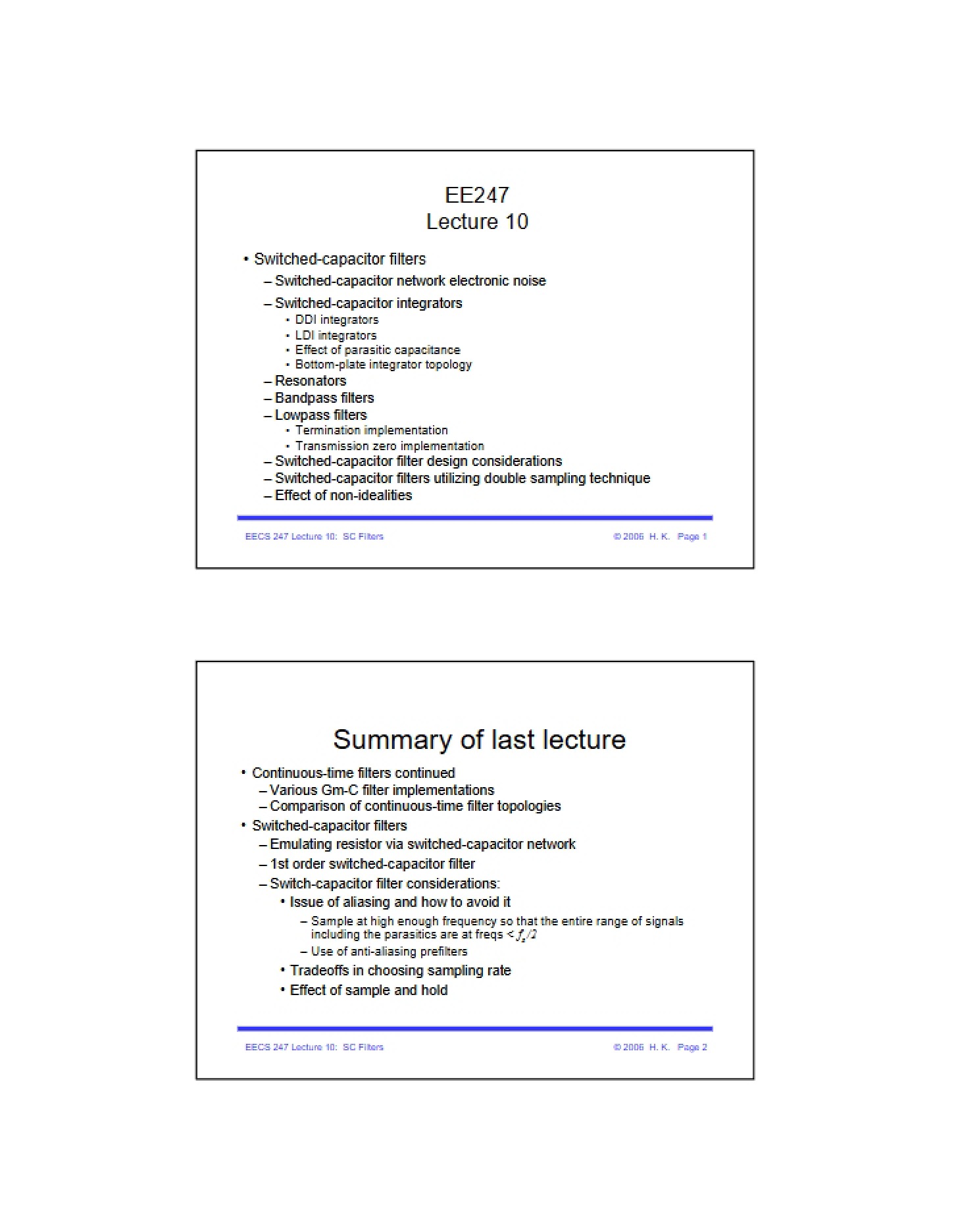
* Emulation of resistors using switched-capacitor networks
* Switched-capacitor integrator topologies and their characteristics
* The critical issue of aliasing and techniques for its prevention
* Tradeoffs involved in selecting appropriate sampling rates
* The impact of sample and hold circuits on filter performance
* Noise considerations in switched-capacitor filter design
* Comparison between switched-capacitor and continuous-time filters
* The sampling theorem and its implications for signal reconstruction
What This Document Provides
* A comprehensive overview of the theoretical basis for switched-capacitor filters.
* Detailed explanations of key concepts, such as charge transfer and equivalent resistance.
* Illustrative representations of filter topologies and their behavior.
* Discussion of practical design considerations, including anti-aliasing filter implementation.
* Insights into the advantages of using switched-capacitor filters over traditional continuous-time filters.
* A focused exploration of the sampling process and its impact on signal integrity.
* Examination of frequency domain interpretations related to sampling and aliasing.