What This Document Is
This document represents Lecture Twenty-One from the Physical Biochemistry (CHEM 156) course at the University of California, Los Angeles. It delves into the fundamental principles governing the speeds at which chemical reactions occur – a core concept in biochemistry. The lecture focuses on reaction kinetics, exploring how various factors influence reaction rates and how these rates can be mathematically described and experimentally determined. It builds a foundation for understanding the complexities of biochemical processes at a molecular level.
Why This Document Matters
This lecture is crucial for students seeking a deep understanding of how biological reactions proceed and are regulated. It’s particularly valuable for those studying enzyme kinetics, metabolic pathways, or any field requiring a quantitative understanding of chemical transformations within living systems. Students preparing for exams, working on problem sets, or needing a solid theoretical base for laboratory work will find this material exceptionally helpful. Accessing the full lecture content will provide a comprehensive understanding of these vital concepts.
Topics Covered
* Differential and overall reaction rates
* Empirical rate laws and reaction orders
* Methods for determining rate laws – initial rates and integrated rate laws
* First and second order reactions, including half-life calculations
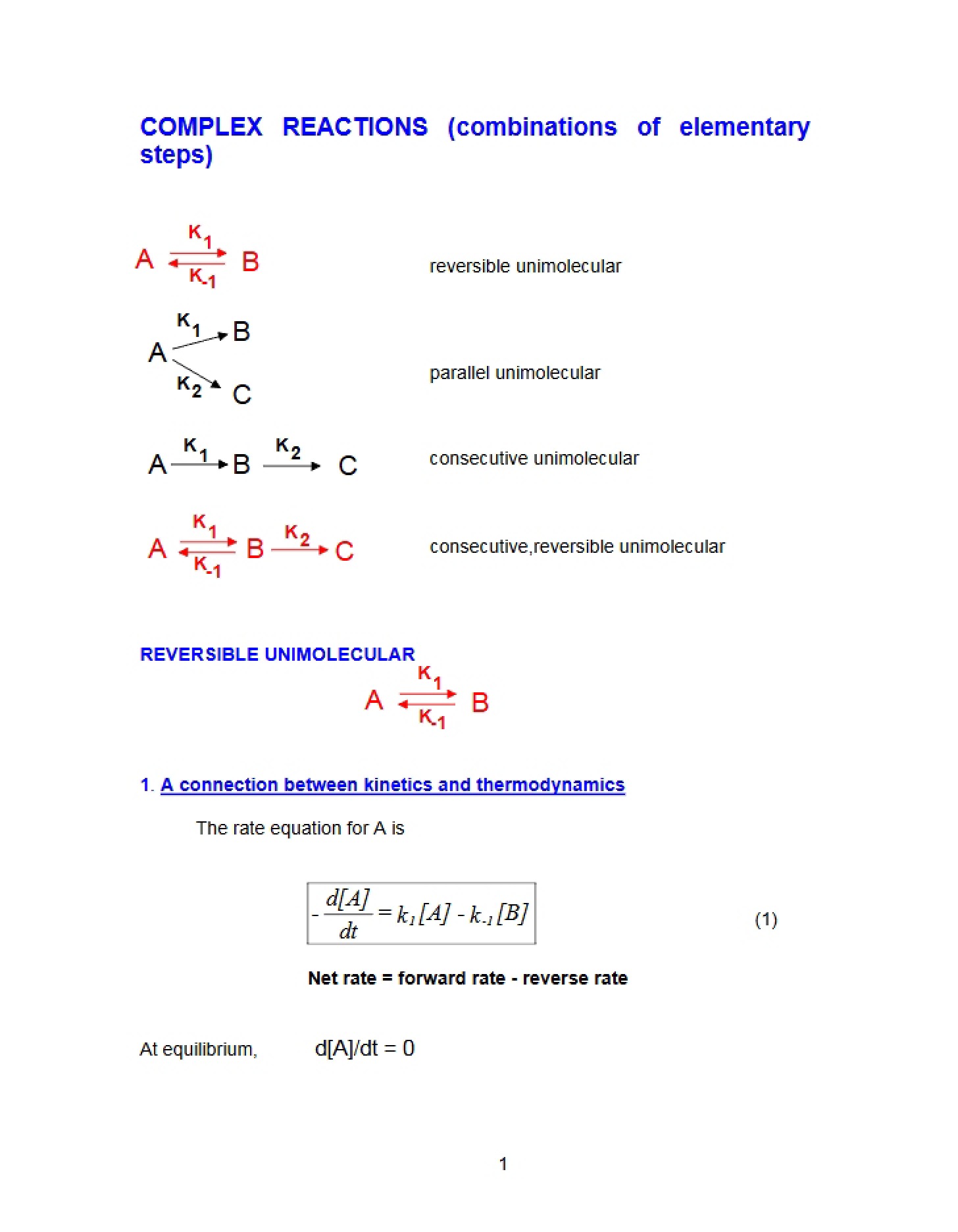
* Complex reaction kinetics involving multiple reactants
* The relationship between stoichiometry and reaction mechanisms
* Elementary reaction steps and molecularity
* Properties of elementary reactions
What This Document Provides
* A detailed exploration of the mathematical relationships used to express reaction rates.
* An overview of experimental techniques used to determine the rate laws of chemical reactions.
* A framework for understanding how reaction conditions affect the speed of biochemical processes.
* An introduction to the concept of reaction mechanisms and how they relate to observed reaction rates.
* A foundation for analyzing and predicting the behavior of complex biochemical systems.