What This Document Is
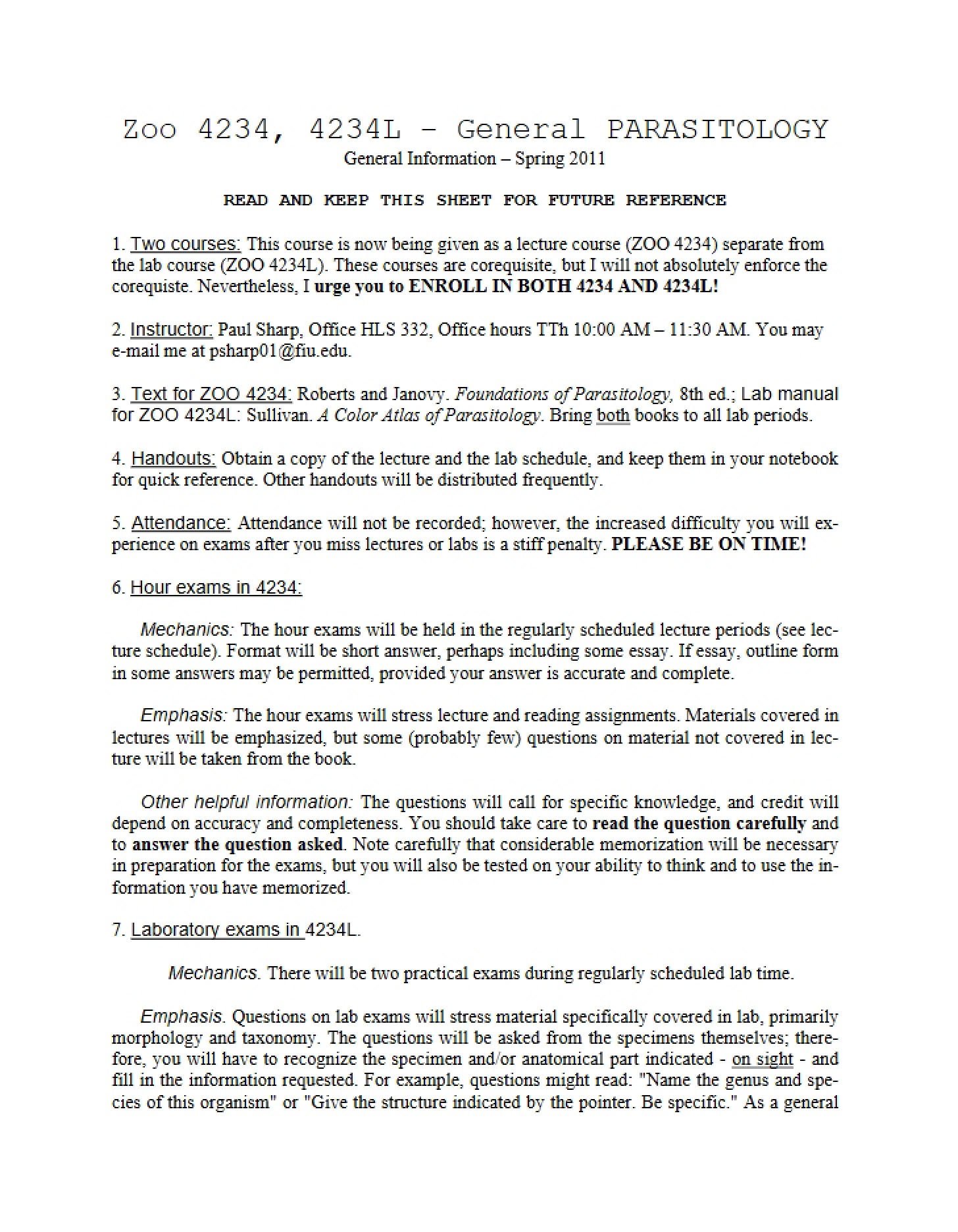
These are lecture notes from ZOO 4234: General Parasitology at Florida International University, covering symbiotic relationships between organisms. The material focuses on different types of symbiosis – mutualism, commensalism, and amensalism – and provides specific examples to illustrate each. It also introduces the related concept of predation and parasitism, highlighting how these interactions shape ecological dynamics.
Why This Document Matters
This document is essential for students in General Parasitology, or anyone studying ecology, zoology, or related biological fields. It provides a foundational understanding of how organisms interact, which is crucial for comprehending complex ecosystems and the roles parasites play within them. These lectures likely serve as a core component of the course, setting the stage for more detailed explorations of specific parasitic relationships. Understanding these relationships is also important for fields like public health and veterinary medicine.
Common Limitations or Challenges
This document provides an overview of symbiotic relationships and does *not* delve into the detailed life cycles, molecular mechanisms, or evolutionary histories of the organisms mentioned. It’s a conceptual introduction, not an exhaustive treatise. Users will still need to consult textbooks, research articles, and further course materials to gain a comprehensive understanding of these topics.
What This Document Provides
This set of lecture notes includes:
* Definitions and explanations of mutualism, commensalism, and amensalism, with examples like hermit crabs and anemones, ants and aphids, and barnacles on whales.
* Illustrations of predation and parasitism, including examples like a lion and impala, and human infection with guinea worm.
* Specific case studies, such as termites and their intestinal protozoans, and cleaning symbiosis involving cleaner wrasse.
* Brief mentions of other examples like lichens and mycorrhizae.
This preview *does not* include detailed diagrams, experimental data, or in-depth analyses of the physiological mechanisms underlying these symbiotic relationships. It is a snapshot of the lecture content, designed to provide a broad overview.