What This Document Is
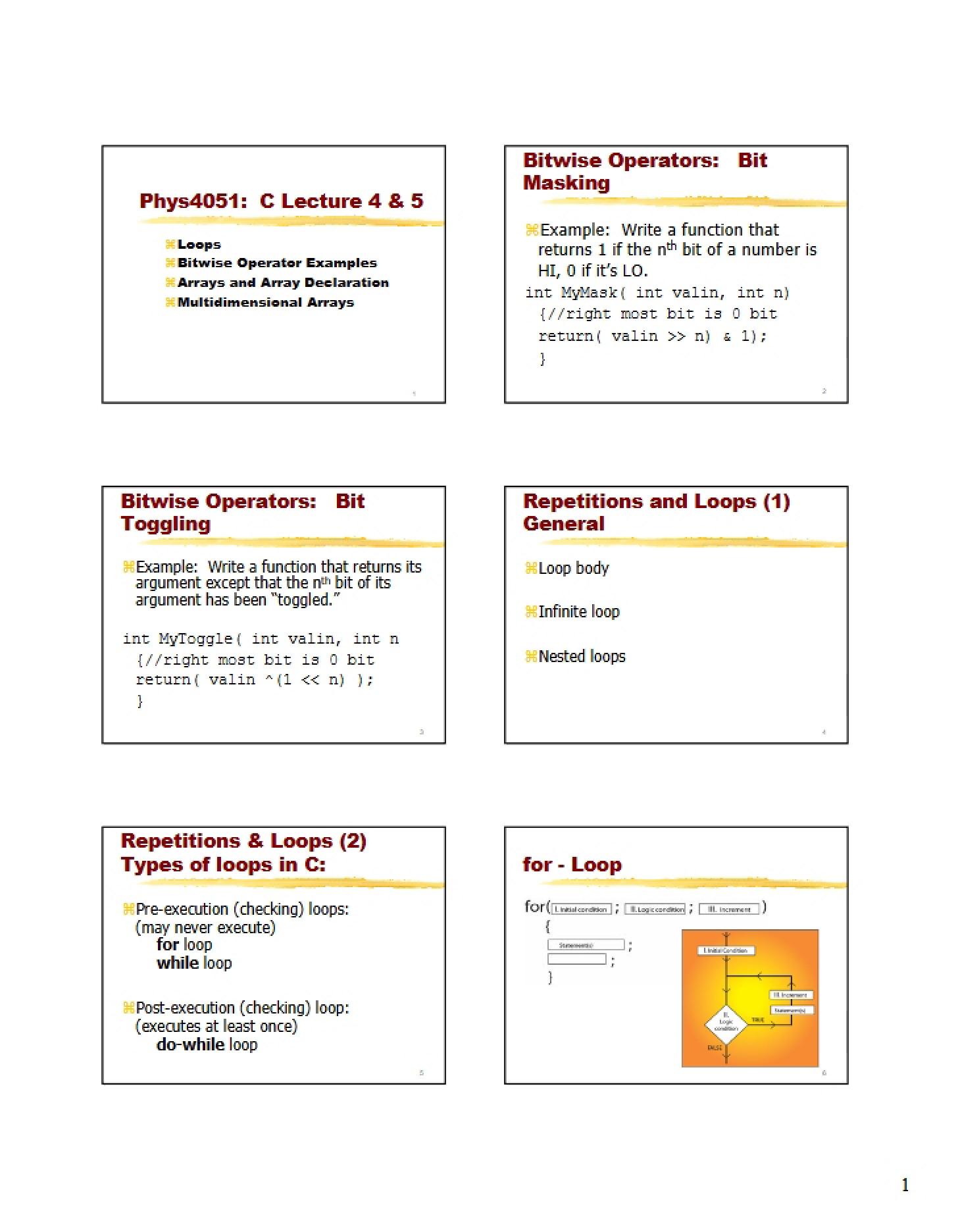
This document consists of lecture materials focused on the C programming language, specifically geared towards students in an advanced experimental physics course. It delves into fundamental concepts essential for utilizing C in a scientific computing context. The core focus is on understanding how C manages memory and how that impacts data manipulation and function calls – crucial skills for building efficient and reliable physics simulations and data analysis tools. It builds upon a foundational understanding of programming and introduces more sophisticated techniques.
Why This Document Matters
This resource is invaluable for physics students who need to implement algorithms and analyze experimental data using C. It’s particularly helpful for those preparing to write programs for data acquisition, instrument control, or complex calculations. Students struggling with the nuances of memory management, function arguments, and array handling will find this material particularly beneficial. It’s best used alongside hands-on coding exercises and a compiler to solidify understanding. Those aiming to optimize their code for performance in computationally intensive physics applications will also find this a strong foundation.
Common Limitations or Challenges
This material concentrates on the theoretical underpinnings of C programming as it relates to experimental physics. It does *not* provide a comprehensive introduction to the C language itself; prior programming experience is assumed. It also doesn’t include pre-written code libraries or complete program examples. The focus is on *understanding* the mechanisms of C, not simply copying and pasting solutions. Debugging techniques and advanced topics like dynamic memory allocation are not fully covered within these lectures.
What This Document Provides
* Detailed explanations of pointers and their relationship to memory addresses.
* Discussions on passing data to functions using both value and reference methods.
* Exploration of how pointers interact with arrays and array manipulation.
* Clarification of the address-of and indirection operators and their proper usage.
* Insights into how arrays are treated as pointers within the C language.
* Examination of pointer arithmetic and its implications for array indexing.
* Analysis of how arrays are passed to functions and the resulting behavior.
* Illustrative examples relating to array initialization and averaging functions.