What This Document Is
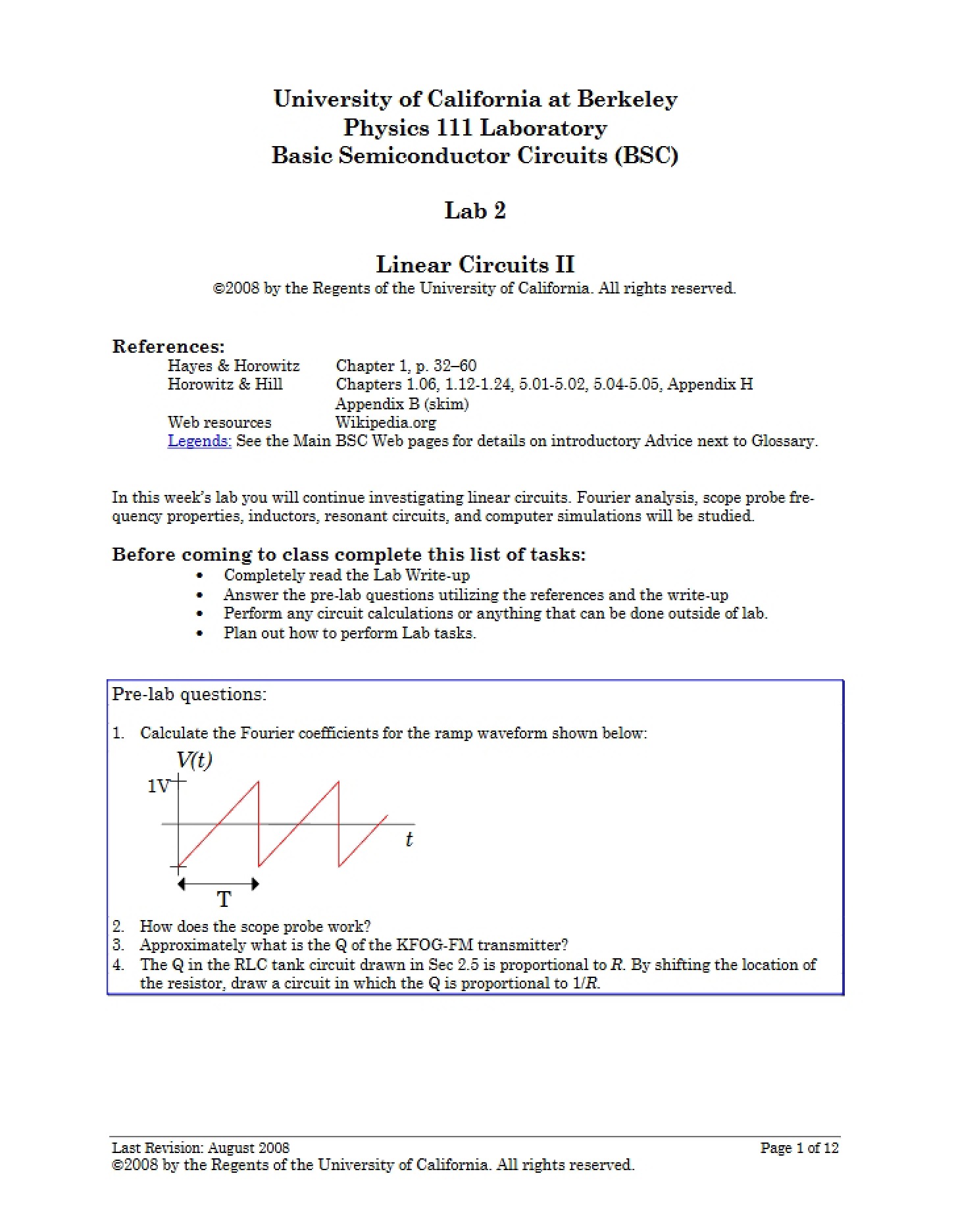
This document is a laboratory write-up for Physics 111 at the University of California, Berkeley, specifically focusing on the second part of a series exploring linear circuits. It’s designed to accompany hands-on experimentation within the Basic Semiconductor Circuits (BSC) laboratory setting. This material builds upon foundational circuit analysis principles and introduces more advanced concepts related to time-varying signals and circuit behavior. It serves as a comprehensive guide for students preparing for and completing laboratory exercises.
Why This Document Matters
This resource is essential for students enrolled in Modern Physics and Advanced Electrical Laboratory (PHYSICS 111) who are seeking a deeper understanding of linear circuit analysis. It’s particularly valuable *before* attending the lab session, as it outlines the necessary preparation and provides context for the experiments. Students will find it useful when analyzing experimental data and formulating conclusions. Access to the full document unlocks a detailed exploration of key concepts and prepares you for successful lab performance.
Topics Covered
* Analysis of time-dependent circuits and AC signals
* The concept of impedance and its relationship to resistance, reactance, and phase shifts
* Behavior of capacitors and inductors in AC circuits
* Application of impedance formulas to circuit analysis
* Frequency-dependent circuit characteristics
* Exploration of resonant circuits and Fourier analysis
* Techniques for utilizing computer simulations in circuit analysis
What This Document Provides
* A list of required references, including textbooks and online resources, to support your learning.
* A pre-lab assignment designed to assess your understanding of foundational concepts and prepare you for the experimental work.
* Guidance on planning and executing the laboratory tasks effectively.
* A framework for understanding the relationship between theoretical concepts and practical circuit behavior.
* Contextual information regarding scope probe characteristics and their impact on measurements.
* Discussion of quality factor (Q) in resonant circuits.