What This Document Is
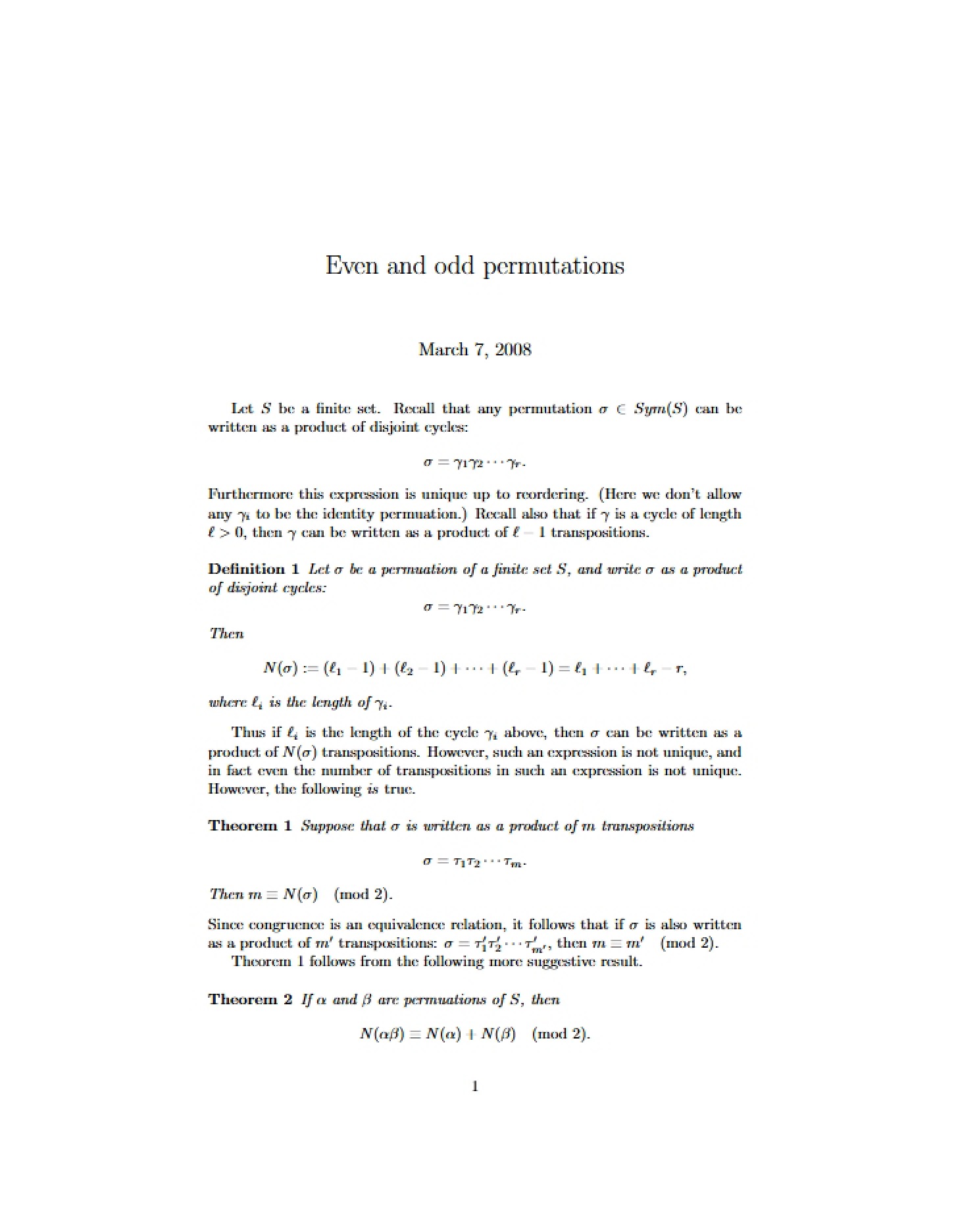
This is a homework assignment for Introduction to Abstract Algebra (MATH 113) at the University of California, Berkeley. It’s designed to reinforce your understanding of core concepts through problem-solving and proof construction. The assignment focuses on applying theoretical knowledge to practical exercises, building a strong foundation in abstract algebraic structures. It’s structured with a progression from computational exercises to more involved theoretical problems and culminates in creative exploration of group symmetries.
Why This Document Matters
This assignment is crucial for students enrolled in MATH 113 seeking to solidify their grasp of abstract algebra principles. Successfully completing these problems will demonstrate your ability to manipulate group elements, understand subgroup structures, and explore the properties of permutations. It’s particularly valuable for students preparing for exams or further study in advanced mathematical topics. Working through these exercises will enhance your problem-solving skills and deepen your intuitive understanding of the subject matter.
Topics Covered
* Permutation Groups and Cycle Notation
* Orders of Group Elements
* Subgroups and Subgroup Criteria
* Torsion Subgroups
* Alternating Groups (A<sub>n</sub>)
* Transpositions and Permutation Decomposition
* Group Symmetries and Isomorphisms
* Conjugacy and Normal Subgroups (implicitly explored)
What This Document Provides
* A series of problems designed to test your understanding of fundamental group theory concepts.
* Exercises involving computations with permutations, including cycle decomposition and order determination.
* Proof-based questions requiring you to demonstrate your understanding of subgroup properties and element orders.
* Exploratory problems encouraging you to investigate symmetries of different structures and formulate conjectures.
* Connections to textbook material (Judson’s Abstract Algebra) for focused practice.
* A blend of standard exercises and more challenging, creative problems to promote deeper learning.