What This Document Is
This document represents a lecture covering fundamental concepts within applied linear algebra, specifically focusing on matrix subspaces. It’s designed for students enrolled in an advanced engineering mathematics course (EE 441 at the University of Southern California) and delves into the theoretical underpinnings of vector spaces defined within the context of matrices. The material builds upon prior knowledge of matrix operations and systems of linear equations.
Why This Document Matters
This lecture is crucial for engineering students who need a strong grasp of linear algebra to succeed in fields like signal processing, control systems, and machine learning. Understanding subspaces allows for a deeper comprehension of solution spaces for linear systems, the properties of matrix transformations, and dimensionality reduction techniques. It’s most beneficial to review this material during initial learning of these concepts, when preparing for quizzes or exams, or as a reference when tackling complex engineering problems involving matrices.
Common Limitations or Challenges
This lecture focuses on the theoretical definitions and properties of matrix subspaces. It does *not* provide a comprehensive set of worked examples demonstrating how to calculate subspaces for various matrices. It also assumes a foundational understanding of linear systems and matrix operations; it won’t re-teach those basics. The material presented is a building block and requires further practice and application to fully master the concepts.
What This Document Provides
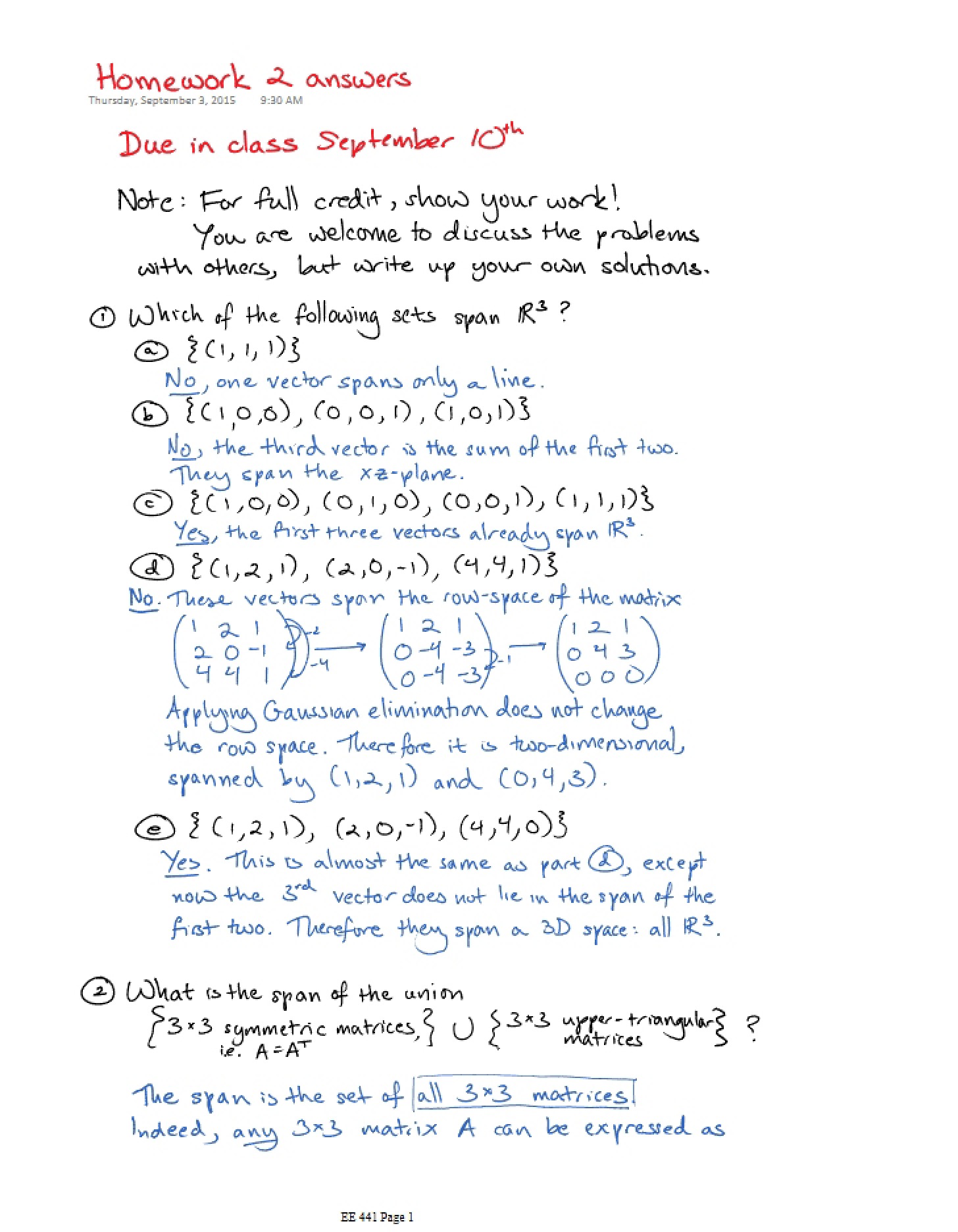
* Formal definitions of key subspace types related to matrices: null space, range (column space), and row space.
* An exploration of the relationship between these different subspaces.
* Discussion of the properties that define a subspace, including closure under addition and scalar multiplication.
* Insights into how row operations impact subspace characteristics.
* Connections between the existence of solutions to homogeneous and non-homogeneous systems of equations and the properties of the null space.
* An introduction to the concept of affine subspaces and their relation to solutions of linear systems.