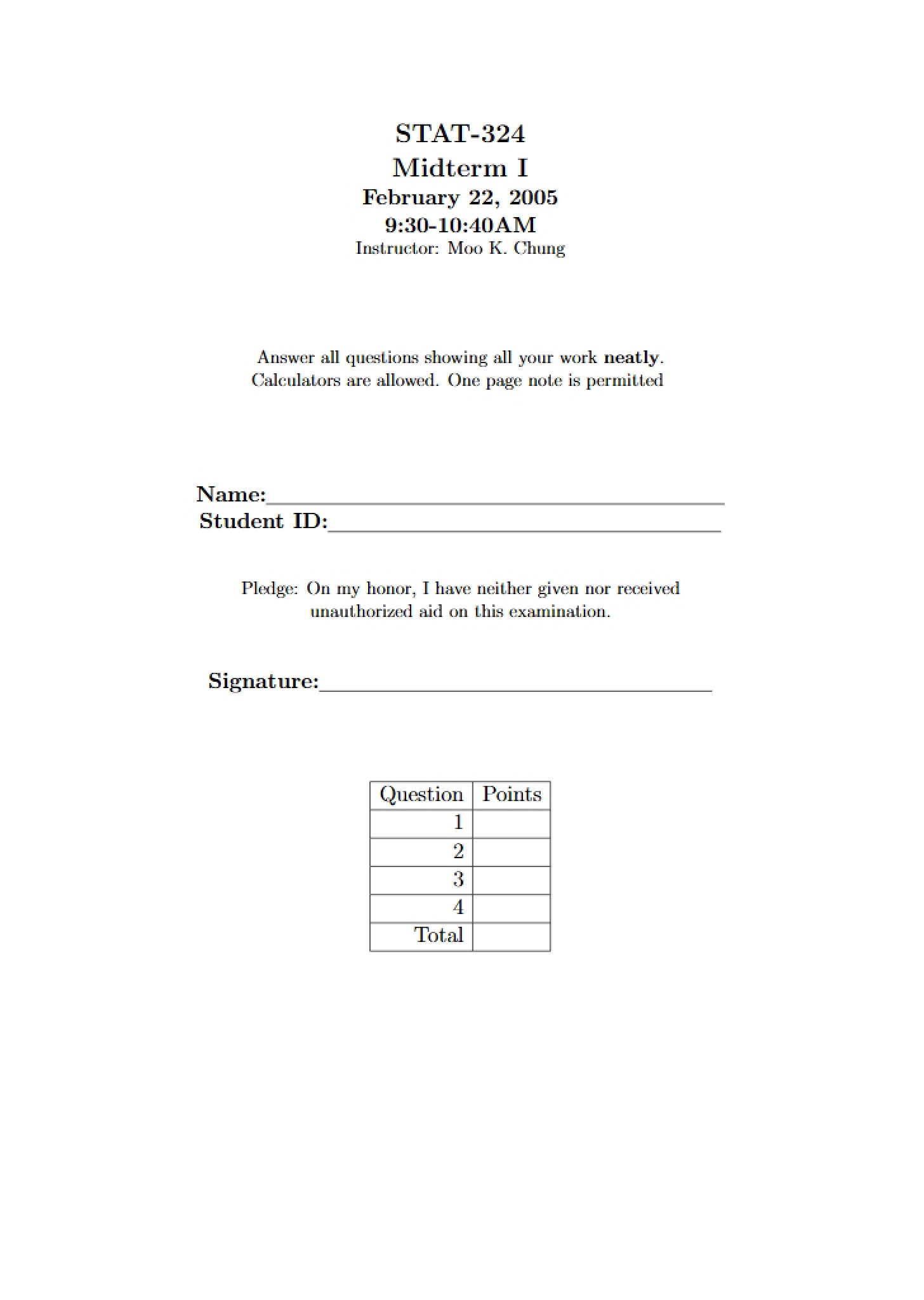
What This Document Is
This is a collection of practice problems designed to help you prepare for a midterm exam in STAT 324, Intro to Applied Statistics for Engineers, at the University of Wisconsin-Madison. It focuses on core statistical concepts and their application to engineering-related scenarios. The problems are structured to mirror the types of questions you can expect on the actual assessment, covering both theoretical understanding and practical calculation skills.
Why This Document Matters
This resource is invaluable for students looking to solidify their grasp of introductory applied statistics. It’s particularly useful for those who benefit from actively working through problems rather than passively reviewing notes. Utilizing these practice problems *before* your midterm can help identify areas where you need further study, build confidence, and improve your time management during the exam. It’s best used after you’ve completed relevant coursework and readings, as a way to test and refine your understanding.
Common Limitations or Challenges
This practice midterm is not a substitute for attending lectures, completing assigned homework, or thoroughly reviewing course materials. It represents a *sample* of potential questions and may not cover every single topic included on the official midterm. Furthermore, while the problems are representative of the exam’s difficulty, they do not include detailed step-by-step solutions – access to those requires a separate purchase. It’s designed to challenge your existing knowledge, not to provide a complete answer key.
What This Document Provides
* A series of problems covering probability distributions (including exponential and normal distributions).
* Exercises involving conditional probability and Bayes’ Theorem.
* Practice applying statistical concepts to real-world scenarios, such as component reliability.
* Problems related to cumulative distribution functions and probability density functions.
* Questions testing understanding of joint probability distributions and marginal distributions.
* Practice with estimation and variance calculations in the context of Bernoulli distributions.
* Problems focused on likelihood functions and maximum likelihood estimation.