What This Document Is
This is an answer key for Midterm Examination Three of Math 128, Calculus II, offered at Washington University in St. Louis. It details the expected solutions and approaches to a set of problems designed to assess student understanding of key concepts covered in the course up to that point in the semester. The exam focuses on applying calculus techniques to various functions and series.
Why This Document Matters
This resource is invaluable for students who have already taken Midterm Three and are looking to review their performance. It’s particularly helpful for identifying areas where understanding may be incomplete or where specific calculation errors occurred. It can also serve as a study aid for students preparing for future exams by illustrating the types of questions and the level of detail expected by the instructor. Access to this answer key allows for a deeper comprehension of the course material beyond simply knowing if an answer is right or wrong – it reveals *how* to arrive at the correct solution.
Common Limitations or Challenges
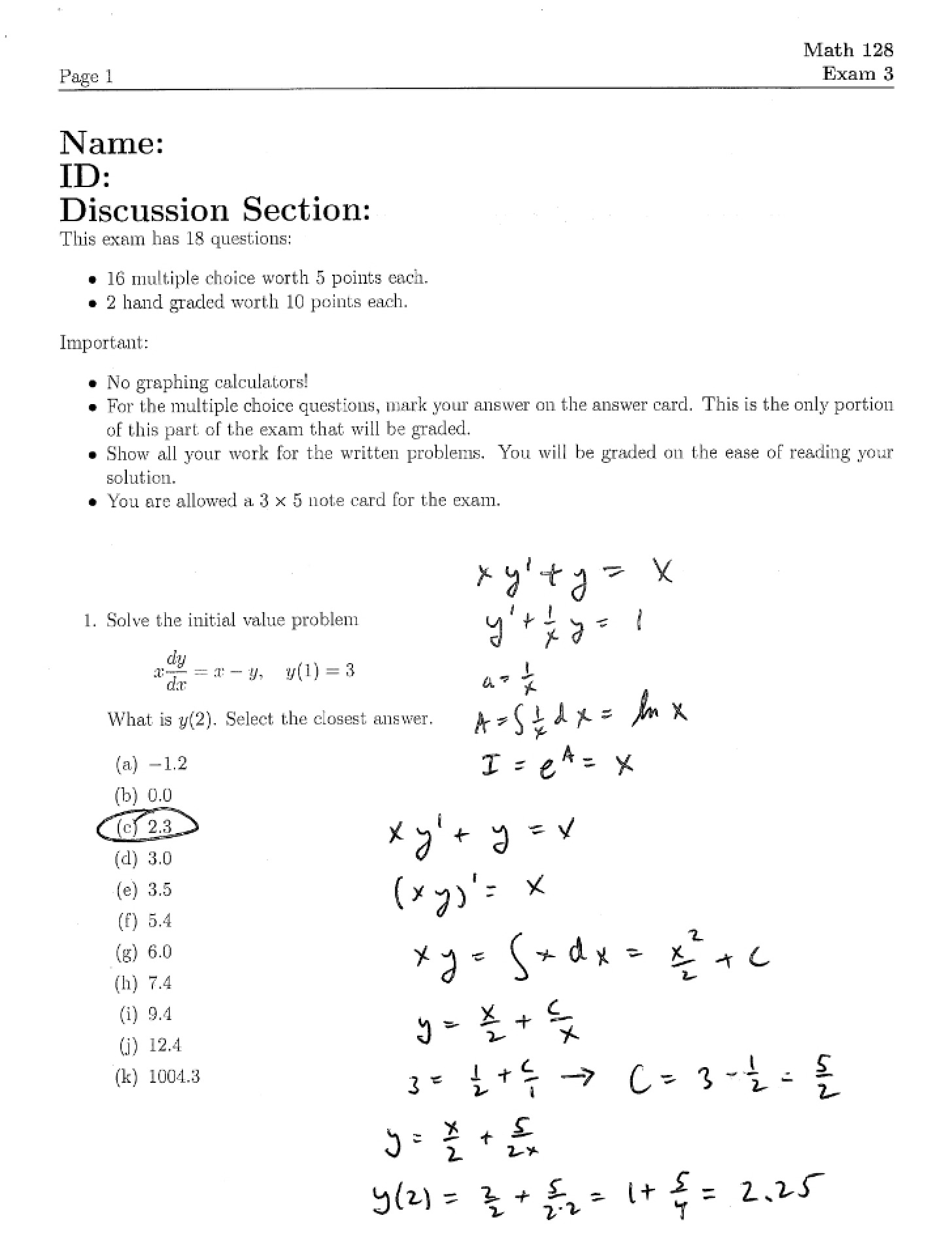
This document provides the answers to the exam questions, but it does *not* include the original exam questions themselves. It also doesn’t offer detailed step-by-step explanations for every single calculation. While work is shown, it assumes a base level of understanding of the underlying calculus principles. It is most effective when used in conjunction with your own completed exam and course notes. Simply reviewing the answers without attempting the problems first will likely be less beneficial.
What This Document Provides
* Detailed responses to six distinct calculus problems.
* Applications of techniques like Euler’s method for approximating solutions to differential equations.
* Examples involving Taylor polynomials and series, including finding polynomial approximations of functions.
* Evaluations of series, determining convergence and exact values where possible.
* Calculations involving trigonometric functions and their Taylor series representations.
* Insights into the expected format and level of detail for solutions in this Calculus II course.