What This Document Is
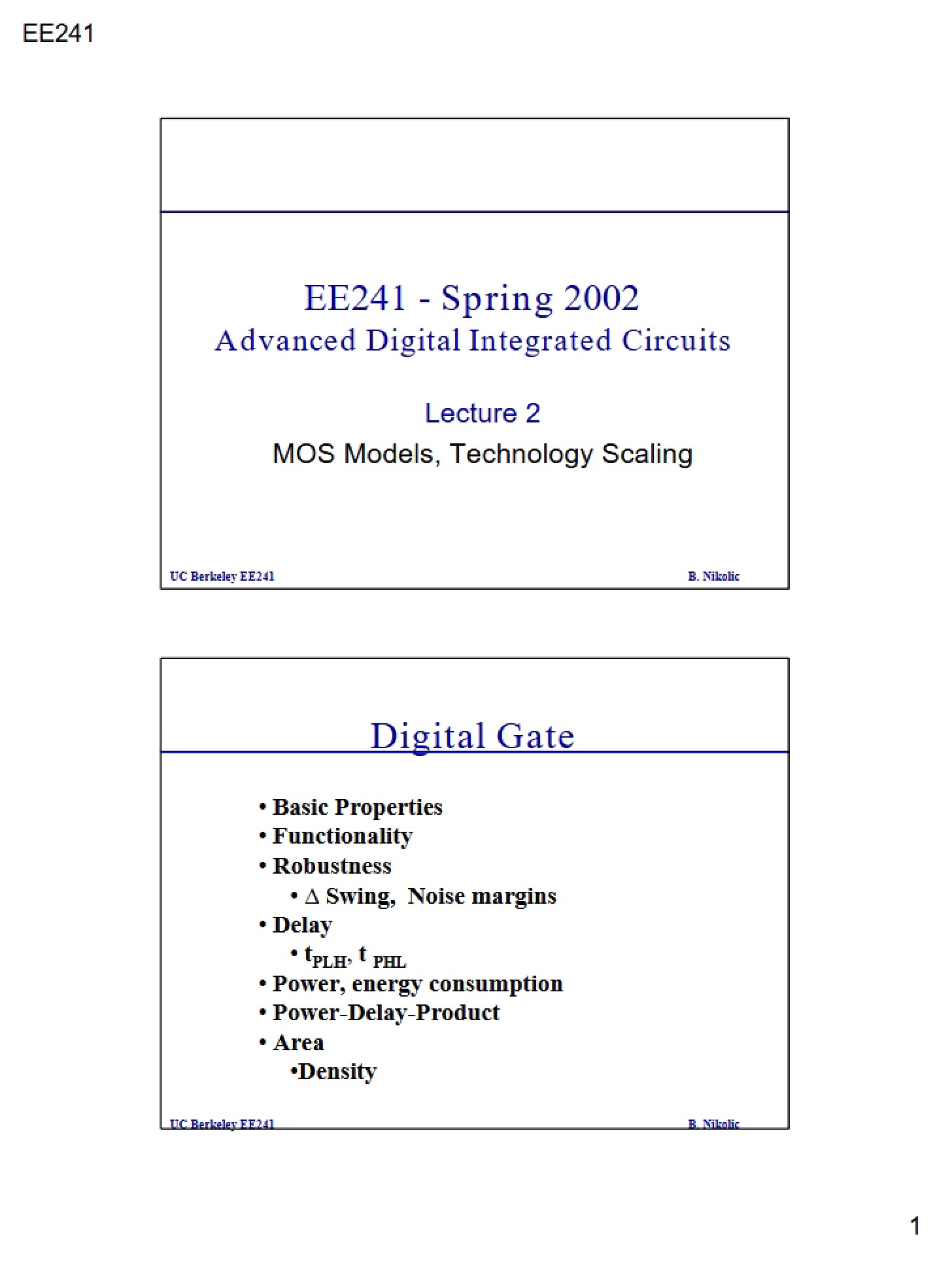
This document represents Lecture 2 from the Advanced Digital Integrated Circuits (ELENG 241B) course at UC Berkeley, focusing on the critical concepts of modeling and scaling in modern integrated circuit design. It delves into the foundational elements required for accurately representing and predicting the behavior of transistors within complex digital systems. This lecture builds upon core principles to explore how device characteristics change with technological advancements and scaling trends.
Why This Document Matters
This material is essential for students and professionals seeking a deep understanding of high-performance digital circuit design. It’s particularly valuable for those involved in the analysis, simulation, and optimization of integrated circuits. If you are tackling advanced coursework in VLSI design, or preparing for roles in the semiconductor industry, a firm grasp of these modeling techniques is crucial. This lecture provides a stepping stone to more complex circuit analysis and design methodologies.
Topics Covered
* Fundamental properties of CMOS gates and digital logic
* Various levels of transistor modeling, from hand analysis to circuit simulation
* The MOS transistor structure and its behavior
* Key parameters influencing transistor performance, including mobility and velocity saturation
* Unified MOS equations for comprehensive device characterization
* The impact of velocity saturation on transistor operation
* Channel length modulation and drain-induced barrier lowering (DIBL) effects
What This Document Provides
* A detailed exploration of different approaches to transistor modeling.
* A framework for selecting the appropriate model complexity based on analysis needs.
* Insights into the relationship between device physics and circuit behavior.
* A foundation for understanding the limitations of various modeling techniques.
* A comparative overview of simulation versus analytical modeling approaches.
* Discussion of key parameters affecting transistor performance and scalability.