What This Document Is
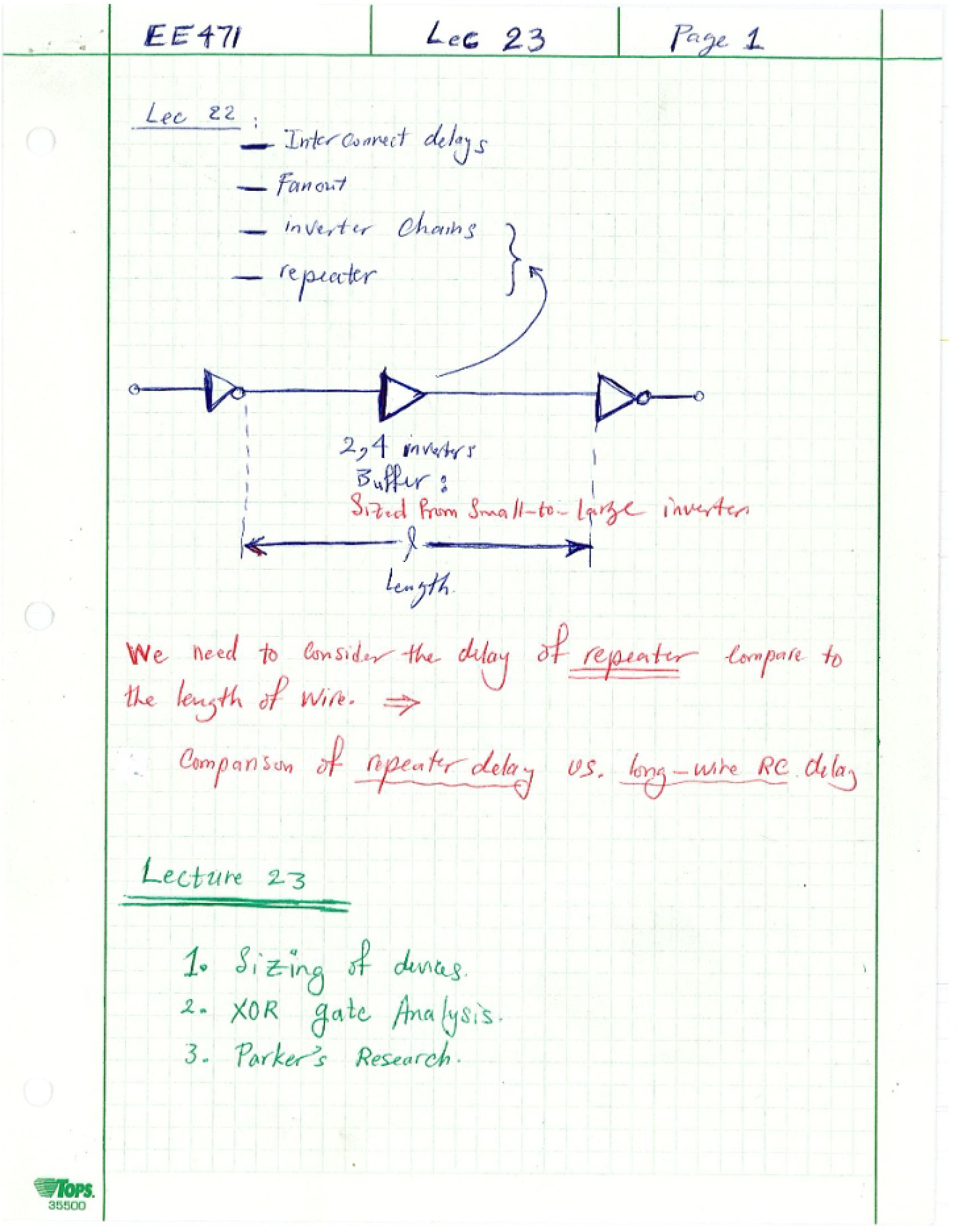
This document represents lecture notes from EE 477L, a VLSI Circuit Design course at the University of Southern California. Specifically, it focuses on the critical concept of network analysis within digital circuits, and delves into identifying and understanding the impact of the “critical path” – the longest signal propagation delay in a circuit. The material builds upon previous lectures concerning circuit delays and introduces methods for analyzing complex networks of logic gates. It appears to be presented in a lecture format, likely accompanied by handwritten notes and diagrams.
Why This Document Matters
This resource is invaluable for students enrolled in advanced VLSI design courses, or those seeking a deeper understanding of digital circuit timing analysis. It’s particularly useful when tackling complex circuit designs where timing constraints are paramount. Understanding the critical path is essential for optimizing circuit performance and ensuring reliable operation. Students preparing for lab assignments involving circuit simulation and analysis will find this material highly relevant. It’s best utilized *during* the study of combinational logic and delay calculations, and *before* attempting to design and simulate larger, more complex systems.
Common Limitations or Challenges
This document provides a focused exploration of network analysis and critical path identification. It does *not* offer a comprehensive introduction to VLSI design principles, nor does it cover all aspects of circuit optimization. It assumes a foundational understanding of transistor behavior, logic gate operation, and basic circuit analysis techniques. The material is presented as lecture notes, meaning it may require supplemental reading and independent study to fully grasp all concepts. It does not include solved problems or step-by-step design examples.
What This Document Provides
* Discussion of worst-case rise and fall times in digital circuits.
* Analysis of capacitance effects within interconnected logic gates.
* Exploration of techniques for identifying the longest delay path through a network.
* Consideration of transistor sizing and its impact on circuit performance.
* Introduction to methods for evaluating and comparing different circuit paths.
* Conceptual framework for understanding the relationship between gate delays and overall circuit speed.
* Discussion of Elmore Delay as an analytical technique.