What This Document Is
This document comprises lecture notes from Principles of Phylogenetics – Systematics (INTEGBI 200A) at the University of California, Berkeley. It represents a focused exploration of phylogenetic trees, moving beyond basic construction to a deeper examination of their underlying principles and potential limitations. The lecture delves into the relationship between data, analysis methods, and the resulting interpretations of evolutionary history. It’s designed to synthesize concepts previously covered in the course regarding character analysis and cladistic methods.
Why This Document Matters
This material is essential for students engaged in advanced study of evolutionary biology, systematics, and related fields. It’s particularly valuable when you’re seeking to solidify your understanding of the theoretical foundations of phylogenetic inference and critically evaluate the assumptions inherent in different analytical approaches. Use this resource to enhance your comprehension after initial exposure to character coding and tree-building techniques, and as preparation for more complex research or analytical projects.
Topics Covered
* The fundamental nature of phylogenetic trees and their interpretation.
* The interplay between characters, operational taxonomic units (OTUs), and levels of analysis.
* Sources of error and uncertainty in phylogenetic reconstruction, including homoplasy.
* A comparative overview of different phases in phylogenetic analysis – data matrix construction versus tree inference.
* The fractal nature of phylogenetic relationships and its implications for data analysis.
* Considerations for choosing appropriate data and methods for specific research questions.
What This Document Provides
* A synthesized overview of character analysis and cladistic analysis.
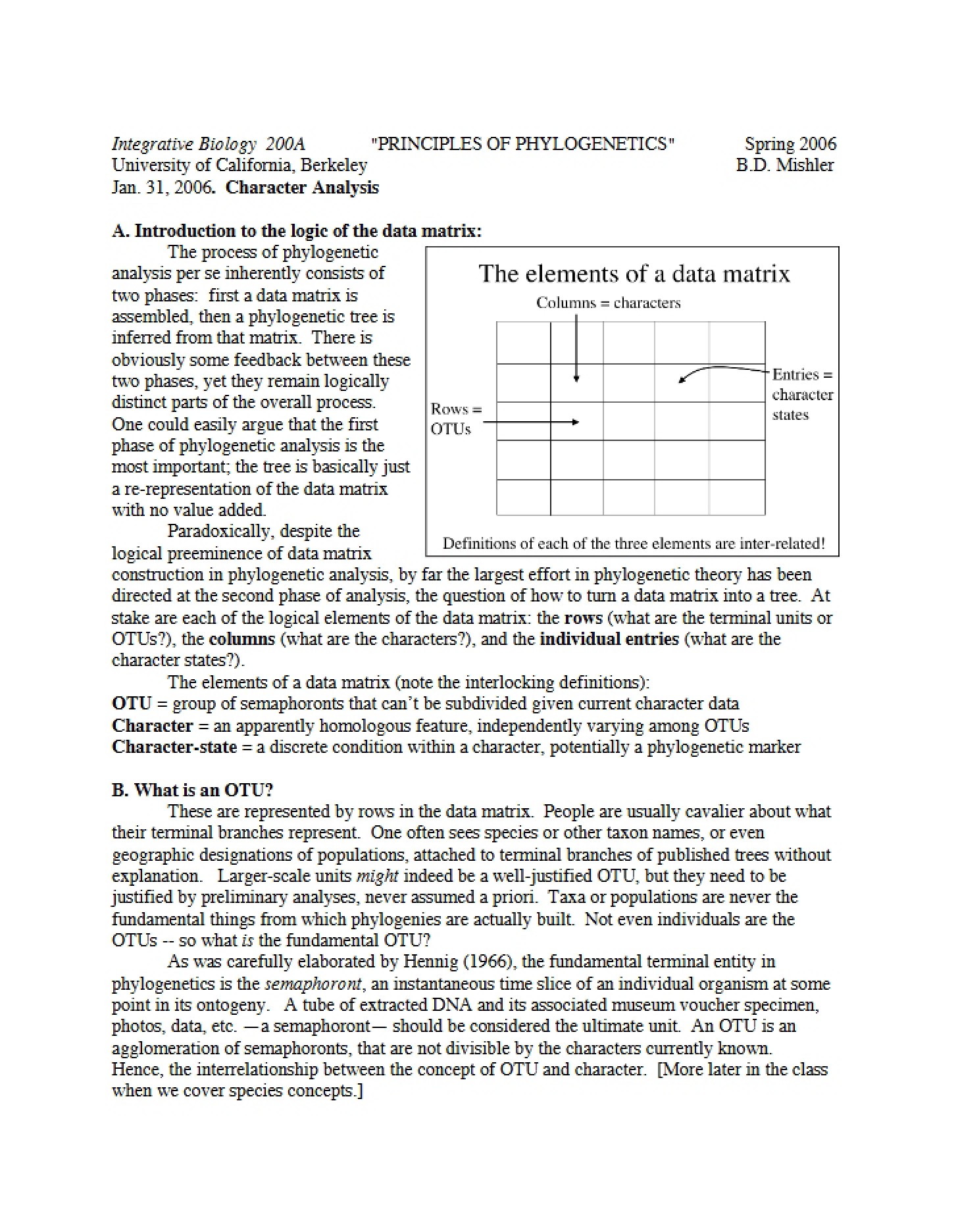
* A discussion of the logical elements within a phylogenetic data matrix (OTUs, characters, and character states).
* A framework for evaluating the relationship between data quality and the choice of tree-building methods.
* Insights into the potential pitfalls of relying solely on complex models when data are limited or questionable.
* A conceptual foundation for understanding the strengths and weaknesses of different phylogenetic approaches.