What This Document Is
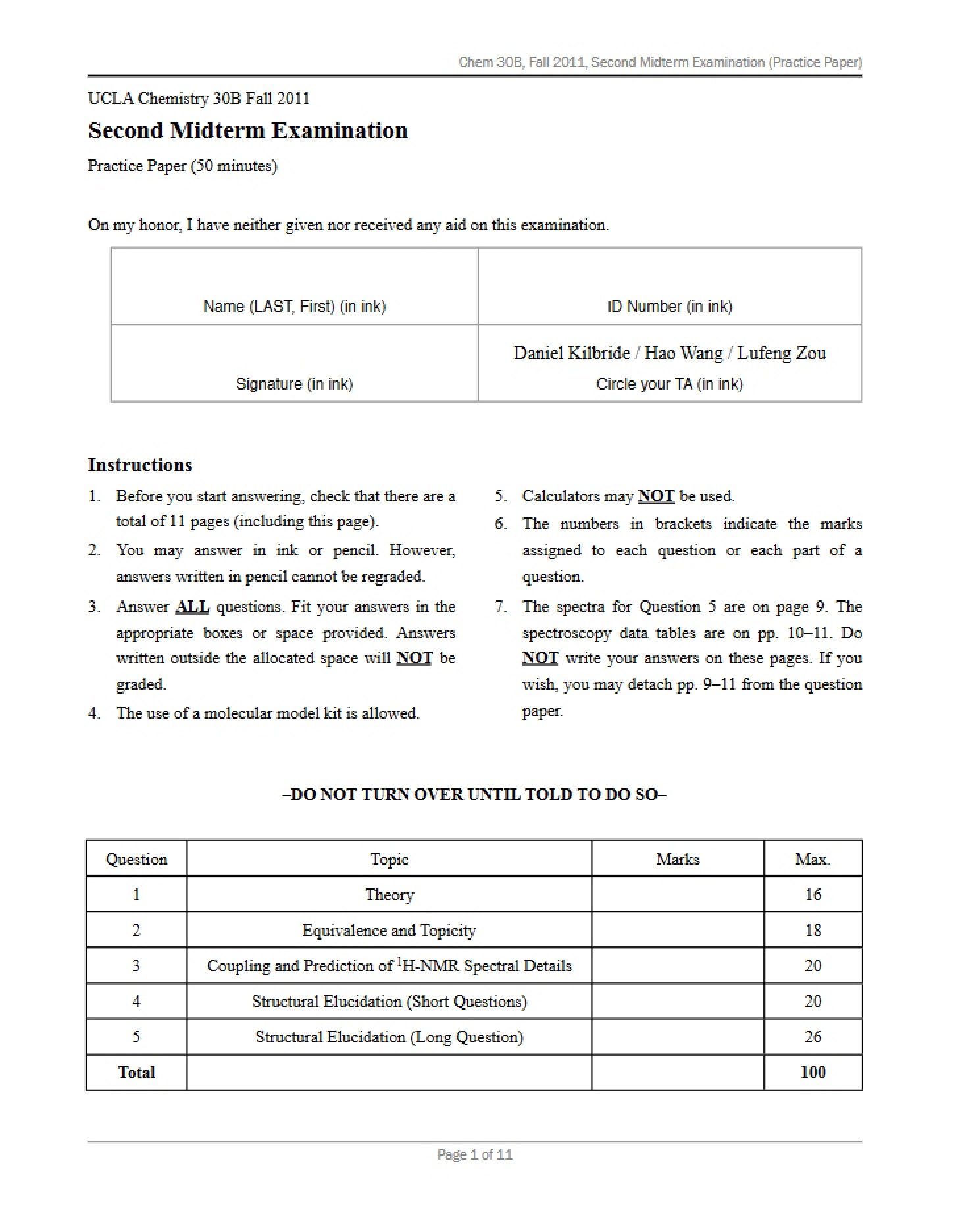
This document is a past midterm examination from Organic Chemistry II (CHEM 30B) at the University of California, Los Angeles. It focuses on assessing student understanding of key concepts related to spectroscopic analysis, specifically Nuclear Magnetic Resonance (NMR) spectroscopy, alongside reactivity and synthesis principles. The exam is designed to test the application of these concepts to predict and interpret molecular structures.
Why This Document Matters
This resource is invaluable for students currently enrolled in, or preparing for, a similar Organic Chemistry II course. It’s particularly helpful for those seeking to gauge the exam style, question format, and depth of knowledge expected by instructors at a rigorous university like UCLA. Working through practice problems – even without the solutions initially – is a proven method for solidifying understanding and identifying areas needing further review. This exam provides a realistic assessment opportunity and can build confidence before a high-stakes evaluation.
Topics Covered
* Interpretation of 1H-Decoupled 13C-NMR spectra
* Molecular Formula Determination from Spectroscopic Data
* Structure Elucidation using IR, Mass Spectrometry, and NMR data
* Fragment Analysis in Mass Spectrometry
* Isomer Identification using NMR Spectroscopy (including DEPT)
* Stereochemistry and Diastereomer Analysis
* Cyclic Ketal Formation and NMR Prediction
What This Document Provides
* A complete, previously administered midterm exam.
* A variety of problem types requiring application of spectroscopic techniques.
* Questions designed to test analytical and problem-solving skills.
* Examples of how spectroscopic data (IR, Mass Spec, 1H-NMR, 13C-NMR) are integrated to determine molecular structures.
* Problems involving isomeric compounds and stereochemical considerations.
* A bonus question exploring temperature effects on NMR spectra.