What This Document Is
This study guide delves into the foundational concepts of binomial and normal distributions, essential components of applied statistical methods. Developed for students in CPSC 440 at the University of Illinois at Urbana-Champaign, it’s designed to reinforce understanding of probability and its application to real-world scenarios. The material builds upon core statistical terminology and notation, preparing you to analyze and interpret data distributions.
Why This Document Matters
This resource is ideal for students seeking to solidify their grasp of probability distributions – a cornerstone of statistical analysis. It’s particularly helpful when tackling problems involving discrete and continuous data, and understanding how to model and predict outcomes based on probabilistic frameworks. If you're preparing for assignments, quizzes, or exams related to binomial and normal distributions, this guide offers a focused review of key principles.
Topics Covered
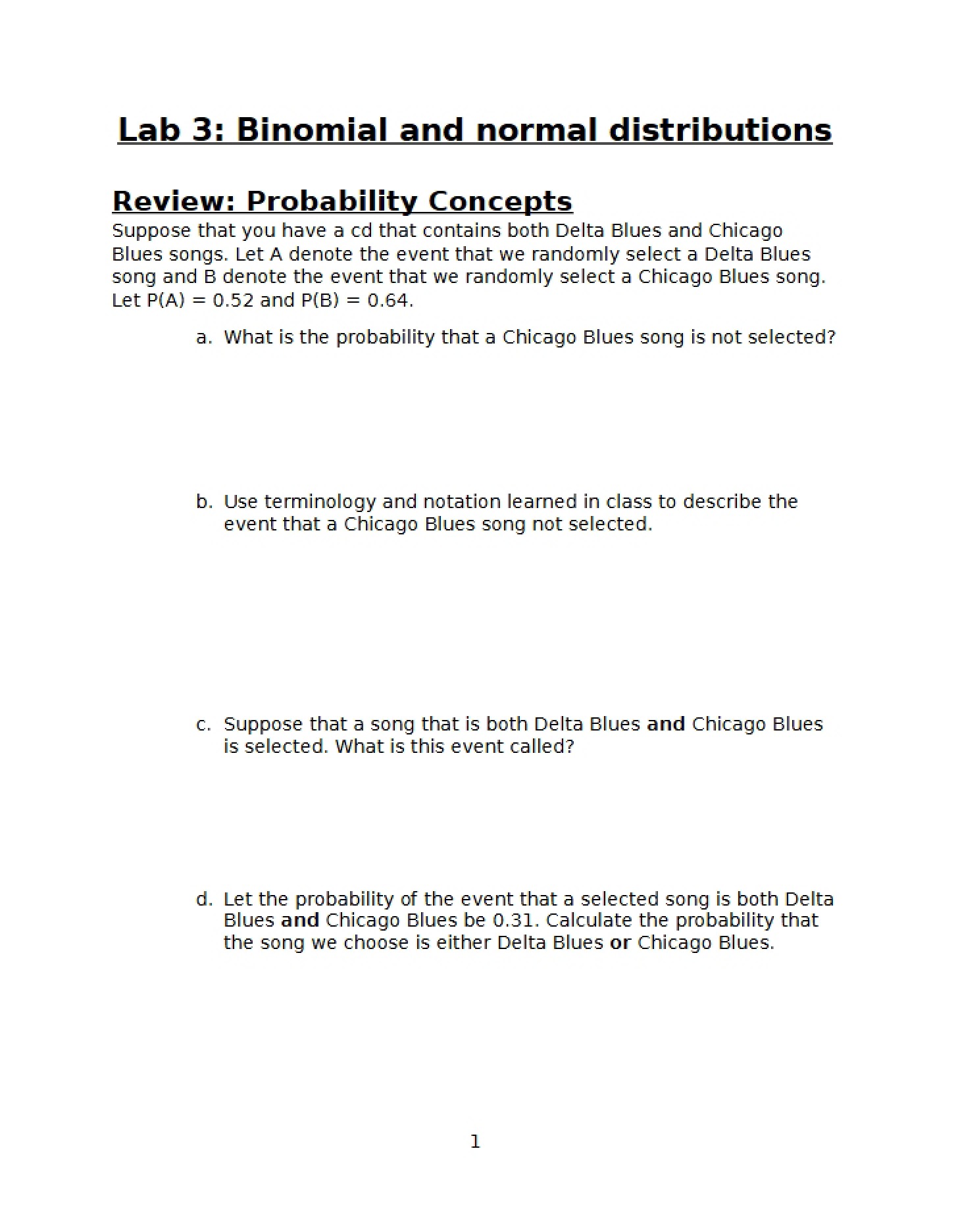
* Probability fundamentals: complements, intersections, and mutually exclusive events.
* Identifying and applying binomial distribution scenarios.
* Binomial probability calculations and interpretations.
* Understanding the characteristics of normal distributions.
* Calculating and interpreting z-scores.
* Applying distributions to practical exercises and data analysis.
What This Document Provides
* Illustrative examples to demonstrate the application of probability concepts.
* A structured approach to identifying appropriate distribution models for given problems.
* Guidance on utilizing both manual calculations and statistical software (R) for solving distribution-related problems.
* Exercises designed to test your understanding of binomial and normal distributions.
* A review of the conditions necessary for a problem to be classified as a binomial distribution.