What This Document Is
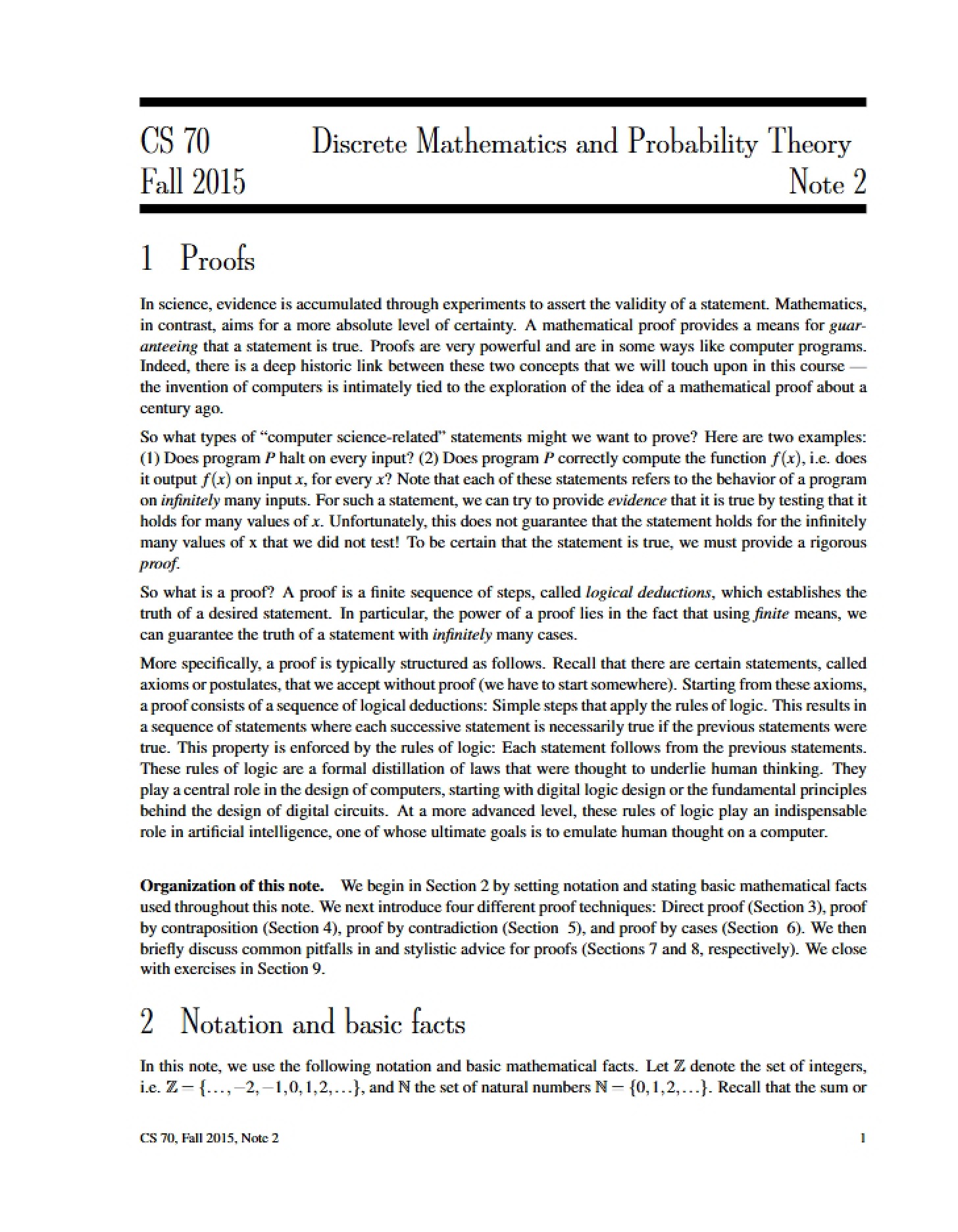
This document, Note 6 from CS 70 Discrete Mathematics and Probability at UC Berkeley, provides a foundational exploration of modular arithmetic. It delves into a system of arithmetic where calculations are performed within a defined range, often referred to as a modulus. This note serves as a building block for understanding more complex concepts in computer science and mathematics. It’s designed to establish a strong conceptual understanding before applying these principles to advanced topics.
Why This Document Matters
This resource is invaluable for students enrolled in a discrete mathematics or probability course, particularly those seeking to solidify their grasp of number theory. It’s especially helpful when encountering topics like cryptography, error-correcting codes, or algorithmic analysis where modular arithmetic plays a crucial role. Students preparing for exams or working through problem sets involving these areas will find this note to be a significant aid in developing their problem-solving skills. It’s best utilized *before* tackling complex applications of modular arithmetic.
Topics Covered
* The fundamental principles of modular arithmetic
* Congruence relations and their properties
* Arithmetic operations (addition, subtraction, multiplication) within modular systems
* The concept of a modulus and its impact on calculations
* Real-world applications of modular arithmetic (e.g., clock systems, calendars)
* The relationship between remainders and modular equivalence
What This Document Provides
* A clear introduction to the core ideas behind modular arithmetic.
* Explanations of how to interpret and work with numbers in a modular context.
* Illustrative examples demonstrating the behavior of arithmetic operations modulo n.
* A formal definition of congruence and its connection to divisibility.
* A framework for understanding why modular arithmetic provides consistent results, regardless of the order of operations or intermediate reductions.
* A foundation for further study in areas like cryptography and coding theory.