What This Document Is
These notes cover foundational concepts from the first chapter of a General Chemistry course (CHEM 105) at the University of Southern California. They represent a compilation of lecture material, designed to introduce core principles and terminology essential for success in the course. The focus is on establishing a strong base understanding of matter, its properties, and how we quantify it. This resource aims to clarify the distinctions between different types of scientific explanations and the fundamental units used in chemical measurements.
Why This Document Matters
This study guide is invaluable for students beginning their journey in General Chemistry. It’s particularly helpful for those who benefit from having a written record of key ideas presented in lectures. Use these notes to reinforce your understanding *during* lectures, as a reference while completing homework assignments, or as a starting point for more in-depth study before quizzes and exams. Students who proactively review these concepts will find subsequent topics in the course much easier to grasp.
Common Limitations or Challenges
While these notes provide a comprehensive overview of introductory chemistry topics, they are not a substitute for attending lectures or completing assigned readings. The notes are designed to *supplement* – not replace – active learning. They do not include detailed worked examples or practice problems with solutions. Furthermore, the notes represent a specific interpretation of the course material as of a particular date and may not reflect all nuances discussed in class.
What This Document Provides
* An overview of the relationship between scientific laws and theories.
* A classification of different states of matter and their defining characteristics.
* Definitions and distinctions between pure substances (elements and compounds) and mixtures (homogeneous and heterogeneous).
* A presentation of the fundamental SI units used for measurement in chemistry.
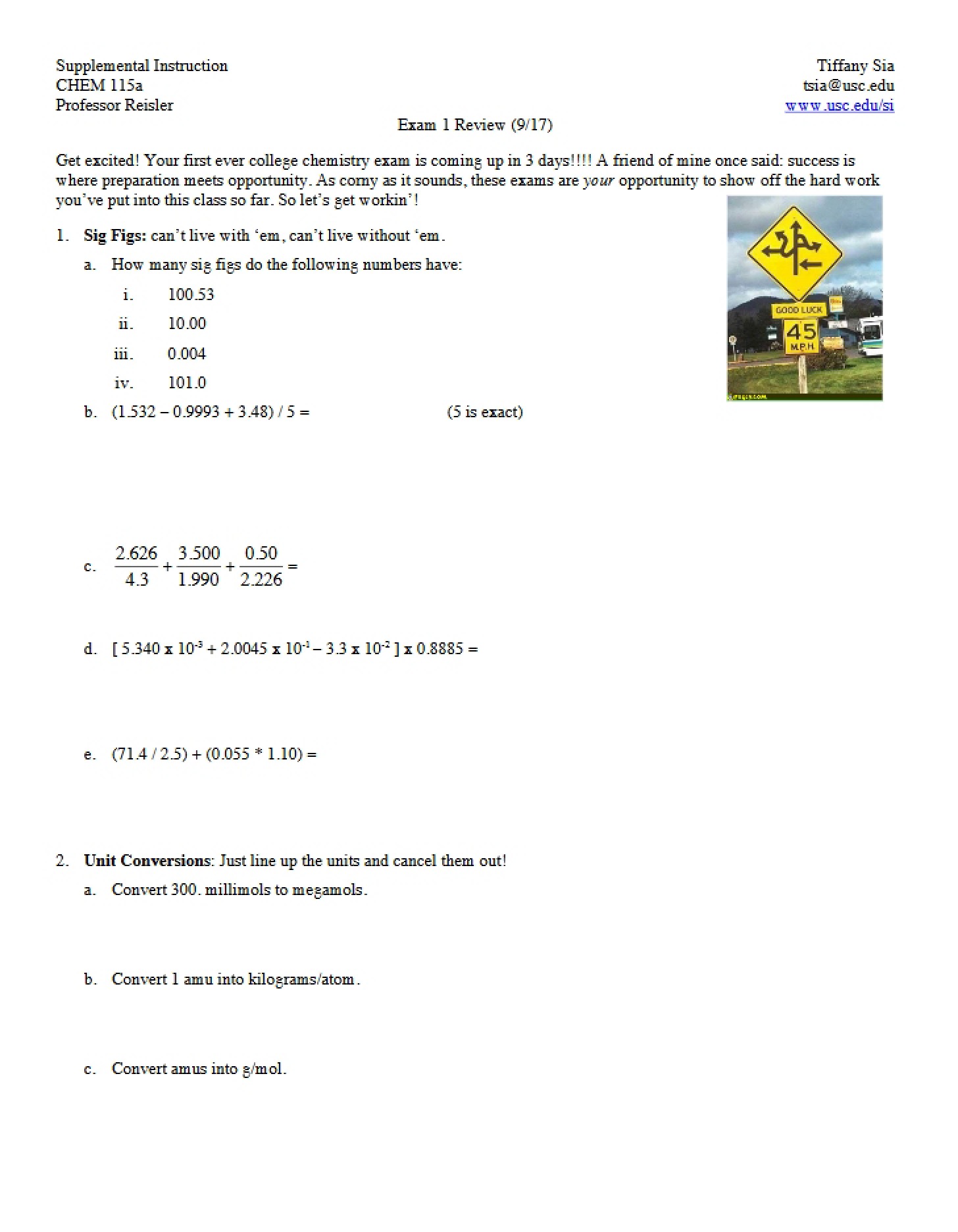
* Discussion of the importance of significant figures in scientific measurements and calculations.
* Guidance on rules for determining significant figures in various numerical values.
* Principles governing how to handle significant figures during mathematical operations like addition and subtraction.