What This Document Is
This material represents lecture notes from a graduate-level course focusing on the theoretical underpinnings of intelligent systems. Specifically, Session 19 delves into the core concepts of logical reasoning – the mechanisms by which systems can derive conclusions from available information. It explores various approaches to building reasoning capabilities within computational frameworks, moving beyond simple data storage and retrieval to encompass deduction and inference. The notes cover a range of techniques used to represent knowledge and implement reasoning processes.
Why This Document Matters
These notes are invaluable for students seeking a deeper understanding of how intelligent systems “think” and arrive at conclusions. They are particularly helpful for those studying computer science, particularly those specializing in areas like knowledge representation, automated reasoning, or expert systems. Reviewing this material will strengthen your foundational knowledge before tackling more advanced topics in the field. It’s best used as a companion to lectures and readings, aiding in comprehension and retention of complex ideas. Students preparing to design and implement reasoning systems will find the overview of different approaches particularly useful.
Common Limitations or Challenges
This session’s notes provide a high-level overview of several logical reasoning systems. It does *not* offer detailed code examples or step-by-step implementation guides. The material assumes a pre-existing understanding of formal logic and basic programming concepts. It also focuses on the theoretical aspects of these systems, and doesn’t cover practical considerations like scalability or real-world performance optimization in detail. It’s a starting point for further exploration, not a complete, self-contained tutorial.
What This Document Provides
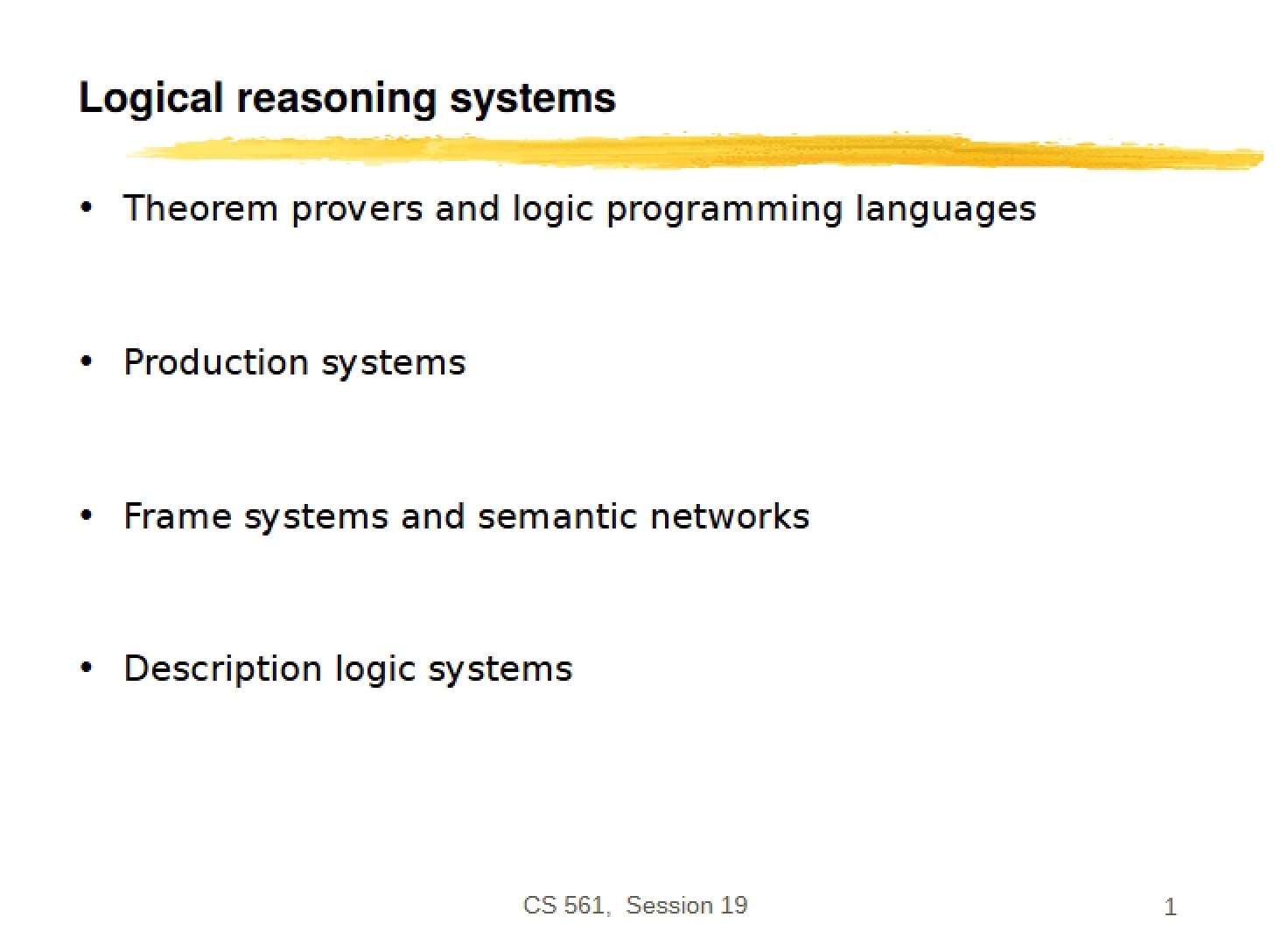
* An overview of different logical reasoning system types, including theorem provers, production systems, and description logic systems.
* A discussion of fundamental tasks associated with knowledge-based systems, such as adding facts, querying information, and updating knowledge bases.
* An exploration of indexing and retrieval techniques used to efficiently manage and access information within these systems.
* Considerations regarding the computational complexity of various reasoning operations.
* An introduction to the principles of logic programming and its relationship to traditional programming paradigms.
* A brief overview of logic programming systems, including key characteristics and limitations.