What This Document Is
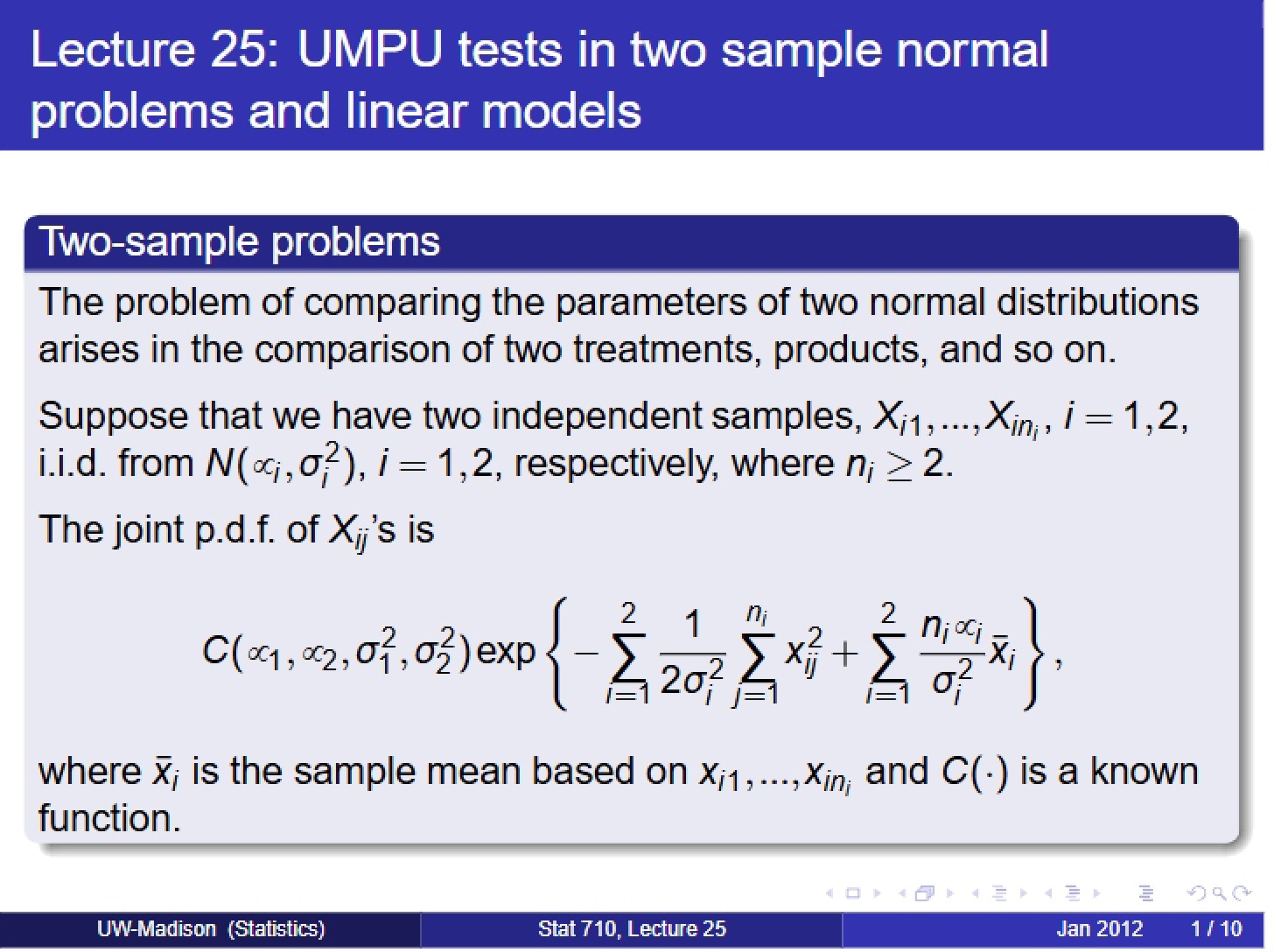
These are lecture notes from STAT 710: Mathematical Statistics, taught at the University of Wisconsin-Madison by Jun Shao. Specifically, this installment covers Lecture 23, focusing on advanced statistical testing methodologies. The core topic revolves around the development and application of Uniformly Most Powerful (UMP) tests, particularly in the context of two-sided statistical hypotheses and the concept of unbiased tests. The notes delve into theoretical foundations and properties related to optimal test construction.
Why This Document Matters
This resource is invaluable for graduate students specializing in statistics, mathematics, or related quantitative fields. It’s particularly helpful for those enrolled in a rigorous mathematical statistics course. These notes would be most beneficial when studying for exams, preparing for research projects involving hypothesis testing, or seeking a deeper understanding of the theoretical underpinnings of statistical inference. Students grappling with complex test design and optimality criteria will find this material especially relevant.
Common Limitations or Challenges
These notes represent a specific lecture’s content and assume a strong foundation in probability theory, statistical inference, and measure-theoretic probability. They do *not* provide a comprehensive introduction to hypothesis testing; rather, they build upon previously established concepts. The notes are highly theoretical and do not include step-by-step calculations or applied examples. Access to the full material is required to fully grasp the detailed derivations and proofs presented.
What This Document Provides
* A detailed exploration of the Generalized Neyman-Pearson Lemma and its implications.
* Discussion of conditions for the existence of constants crucial for optimal test construction.
* Formal definitions of various two-sided hypotheses commonly encountered in statistical practice.
* A theorem outlining UMP tests for two-sided hypotheses within the framework of one-parameter exponential families.
* Considerations regarding the properties and comparisons of different UMP tests.