What This Document Is
This document contains lecture notes from a Chemical Structure (CHEM 20A) course at UCLA, specifically covering a session held on November 9th. It delves into the theoretical foundations of molecular orbital (MO) theory, building upon concepts related to atomic orbitals and their interactions within molecules. The notes focus on applying the Linear Combination of Atomic Orbitals (LCAO) method to understand bonding and electronic structure. It’s a detailed exploration of how atomic orbitals combine to form molecular orbitals, and the principles governing their arrangement and filling.
Why This Document Matters
These notes are invaluable for students enrolled in a foundational chemistry course like CHEM 20A. They are particularly helpful for those seeking a deeper understanding of bonding theories beyond simple Lewis structures. This material is crucial for predicting molecular properties, understanding spectroscopic data, and ultimately, grasping the behavior of chemical species. Reviewing these notes alongside textbook readings and problem sets will solidify your understanding of molecular orbital theory and its applications. It’s best utilized during exam preparation or when needing a focused review of bonding concepts.
Topics Covered
* The LCAO method for constructing molecular orbitals
* Approximations and considerations when applying LCAO to second-period diatomics
* Energy level considerations for atomic orbital mixing
* Symmetry and its role in orbital overlap
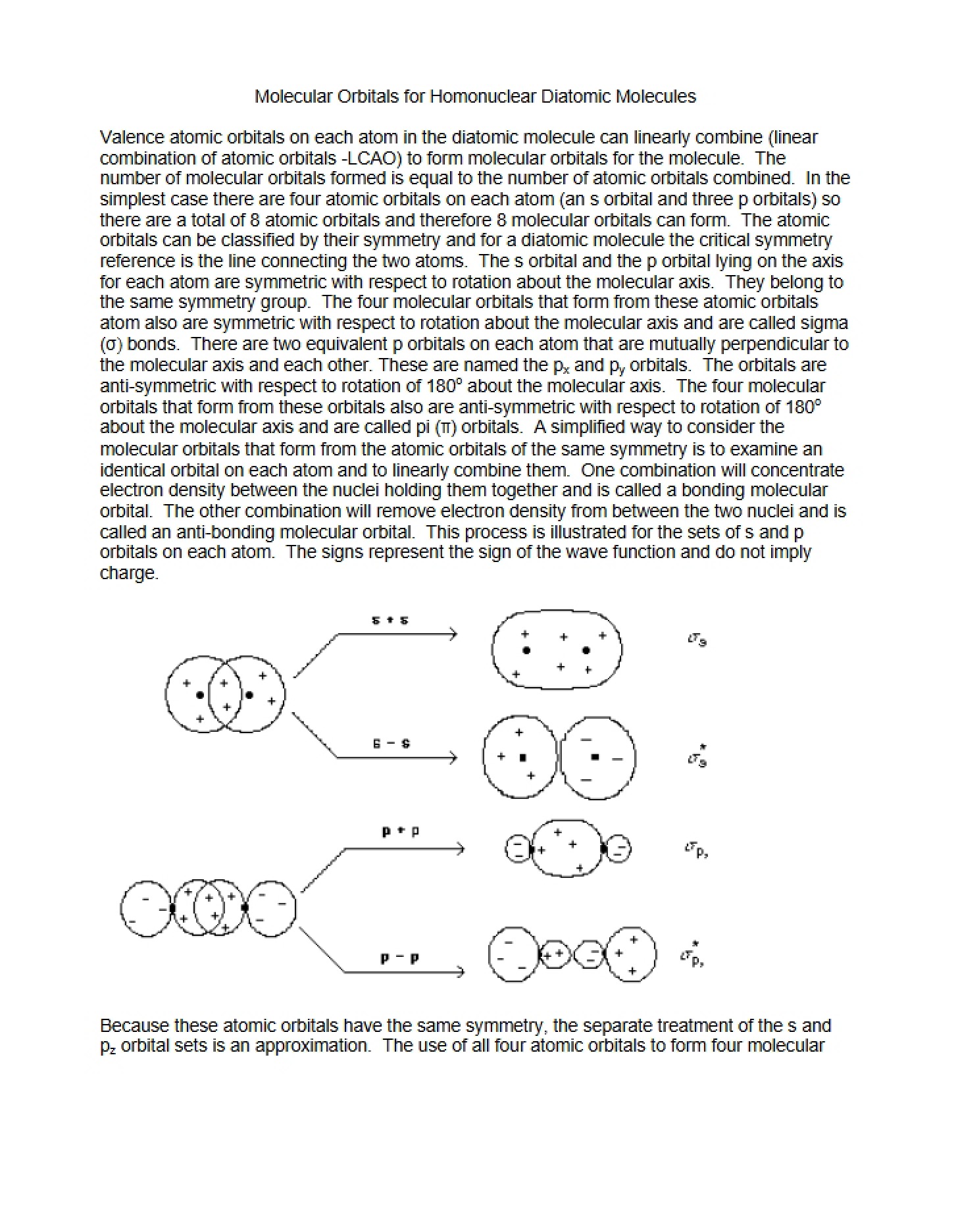
* Formation of sigma (σ) and pi (π) bonding and antibonding molecular orbitals
* Correlation diagrams and their interpretation
* Relationship between molecular orbital theory and Lewis structures
* Predicting magnetic properties based on molecular orbital configurations
What This Document Provides
* A step-by-step outline of the LCAO procedure.
* Detailed discussion of factors influencing atomic orbital interactions.
* Visual representations illustrating the combination of atomic orbitals into molecular orbitals.
* Exploration of how correlation diagrams relate to bond order and molecular properties.
* Insights into the electronic configurations of diatomic molecules.
* A framework for understanding the connection between theoretical calculations and experimental observations.