What This Document Is
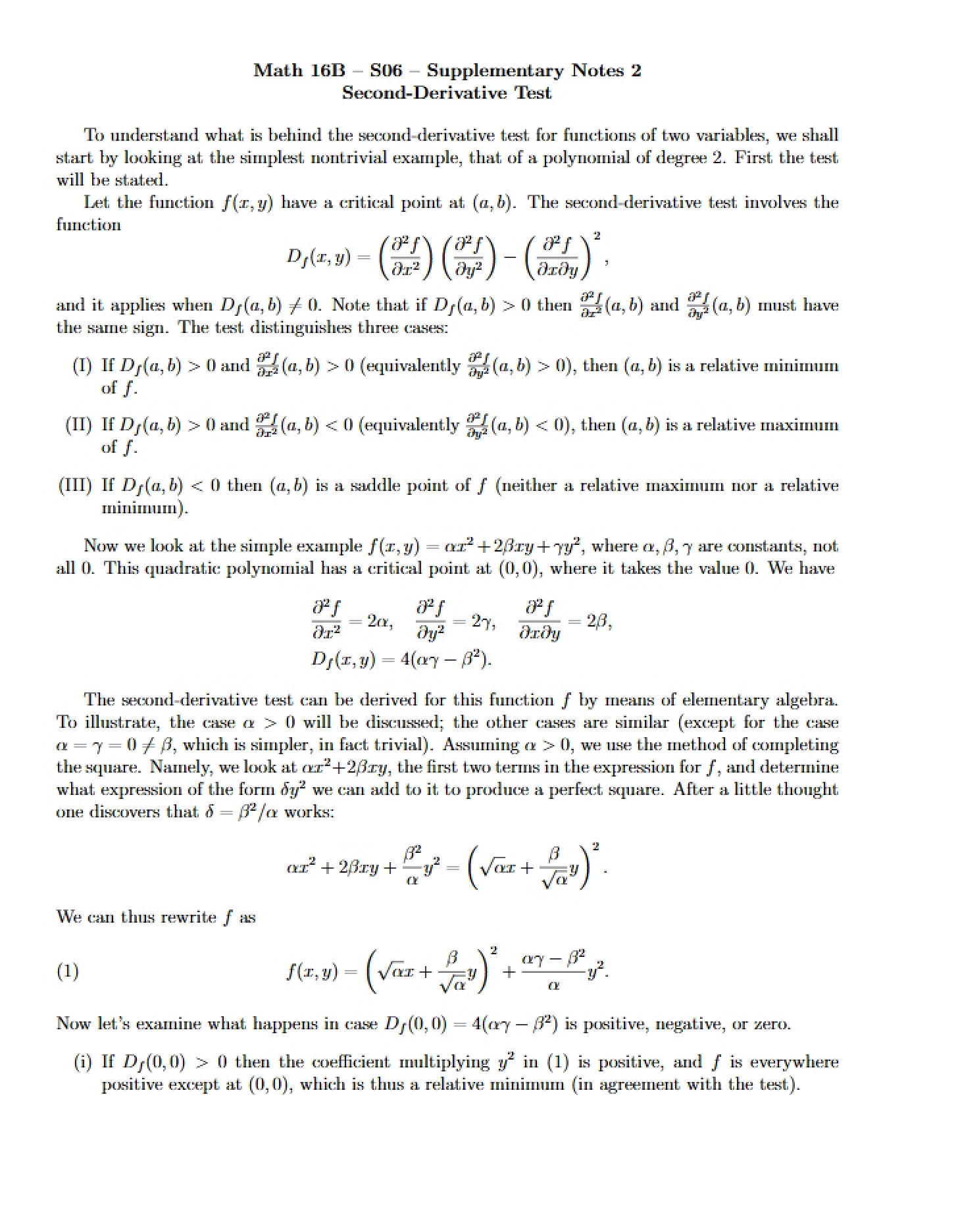
This is a supplementary notes resource designed to deepen your understanding of concepts covered in Math 16B: Analytic Geometry and Calculus at UC Berkeley. Specifically, it focuses on the theoretical underpinnings and practical application of a crucial technique for analyzing functions of multiple variables – the second-derivative test. It builds upon previously introduced concepts related to critical points and function approximation.
Why This Document Matters
This resource is invaluable for students who want a more rigorous understanding of *why* the second-derivative test works, not just *how* to apply it. It’s particularly helpful when you’re encountering difficulties visualizing or intuitively grasping the conditions that determine relative maxima, minima, and saddle points in multivariable calculus. Use this supplement alongside your lecture notes and textbook when you need a more detailed exploration of this important topic, or when preparing for assessments.
Topics Covered
* The theoretical basis of the second-derivative test for functions of two variables.
* The role of the discriminant (D) in classifying critical points.
* Relationships between second partial derivatives and the nature of critical points.
* Polynomial functions as a foundational example for understanding the test.
* Local linear and second-order approximations of functions.
* The connection between critical points and second-degree polynomial representations.
What This Document Provides
* A detailed examination of a quadratic polynomial example to illustrate the second-derivative test.
* A discussion of how the test can be derived through algebraic manipulation.
* An exploration of the behavior of functions near critical points using approximation techniques.
* A framework for understanding the conditions under which a critical point represents a relative maximum, relative minimum, or a saddle point.
* A bridge between theoretical concepts and practical application of multivariable calculus techniques.