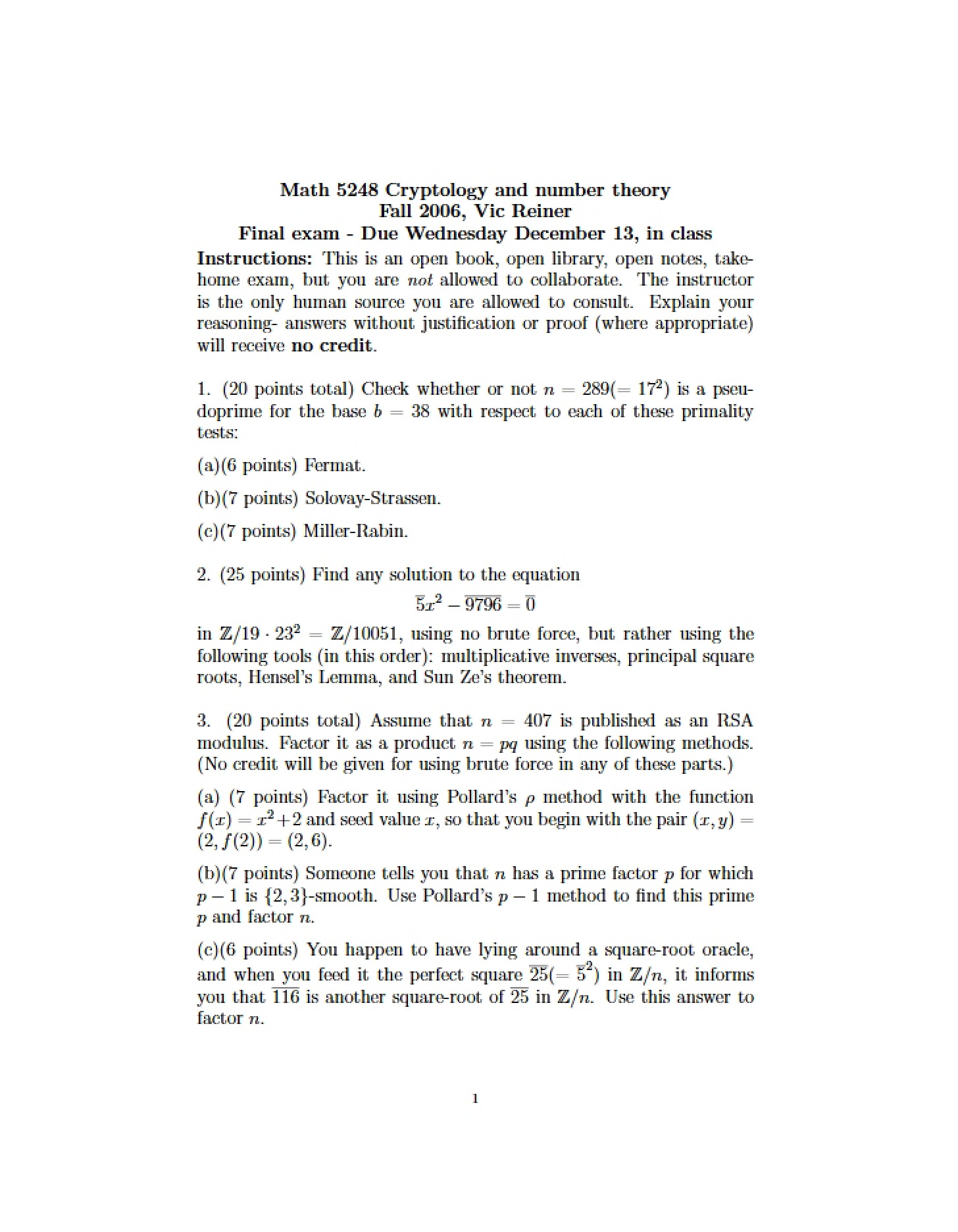
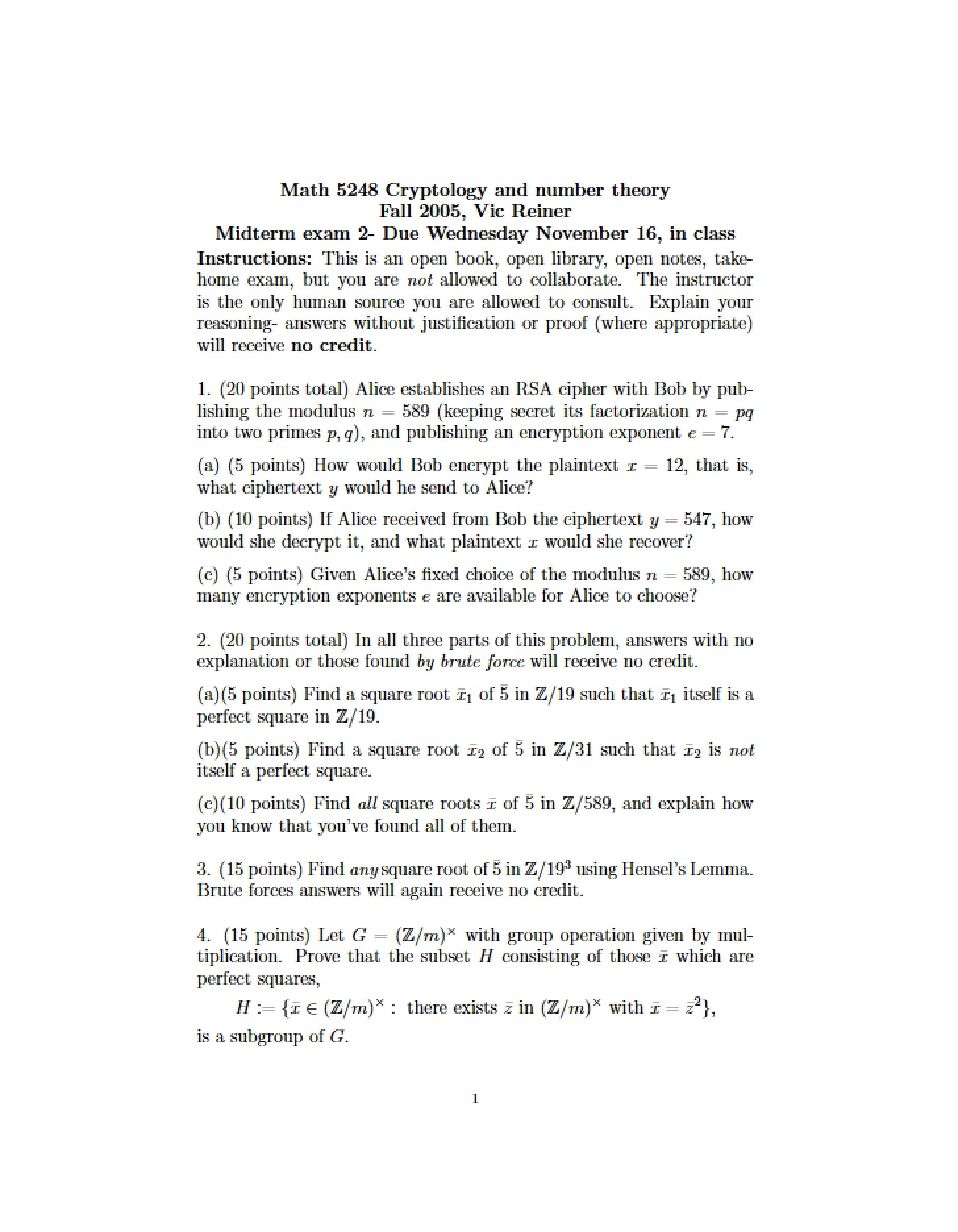
What This Document Is
This document is a past midterm examination from MATH 5248: Cryptology and Number Theory, offered at the University of Minnesota Twin Cities. It’s designed to assess understanding of core principles within these interconnected fields. The exam focuses on applying theoretical knowledge to problem-solving, requiring both computational skills and rigorous mathematical justification. It’s a take-home exam, but emphasizes independent work and understanding of foundational concepts.
Why This Document Matters
This resource is invaluable for students currently enrolled in a similar Cryptology and Number Theory course, or those preparing for related examinations. It provides a realistic assessment of the types of questions and the level of difficulty expected. Working through similar problems (available with full access) can significantly improve your comprehension and exam performance. It’s particularly useful for identifying areas where your understanding needs strengthening and for practicing the application of theorems and techniques. It’s best used *after* initial study of course materials, as a way to test and solidify your knowledge.
Common Limitations or Challenges
This document presents a single past exam. While representative of the course’s assessment style, it doesn’t encompass the entirety of potential exam content. It focuses on specific topics covered during a particular semester and shouldn’t be considered a comprehensive study guide. Furthermore, the solutions and detailed workings are not included here; access to those requires a separate purchase. This exam assumes a solid foundation in abstract algebra and modular arithmetic.
What This Document Provides
* A set of challenging problems relating to RSA cryptography.
* Questions designed to test understanding of Fermat’s Little Theorem and its generalizations.
* Problems involving modular square roots and Hensel’s Lemma.
* Exercises exploring the properties of square roots of elements in Z/pqr.
* Questions related to group theory and the order of elements in multiplicative groups of integers modulo a prime.
* Insight into the expected format and rigor of assessments in an advanced Cryptology and Number Theory course.