What This Document Is
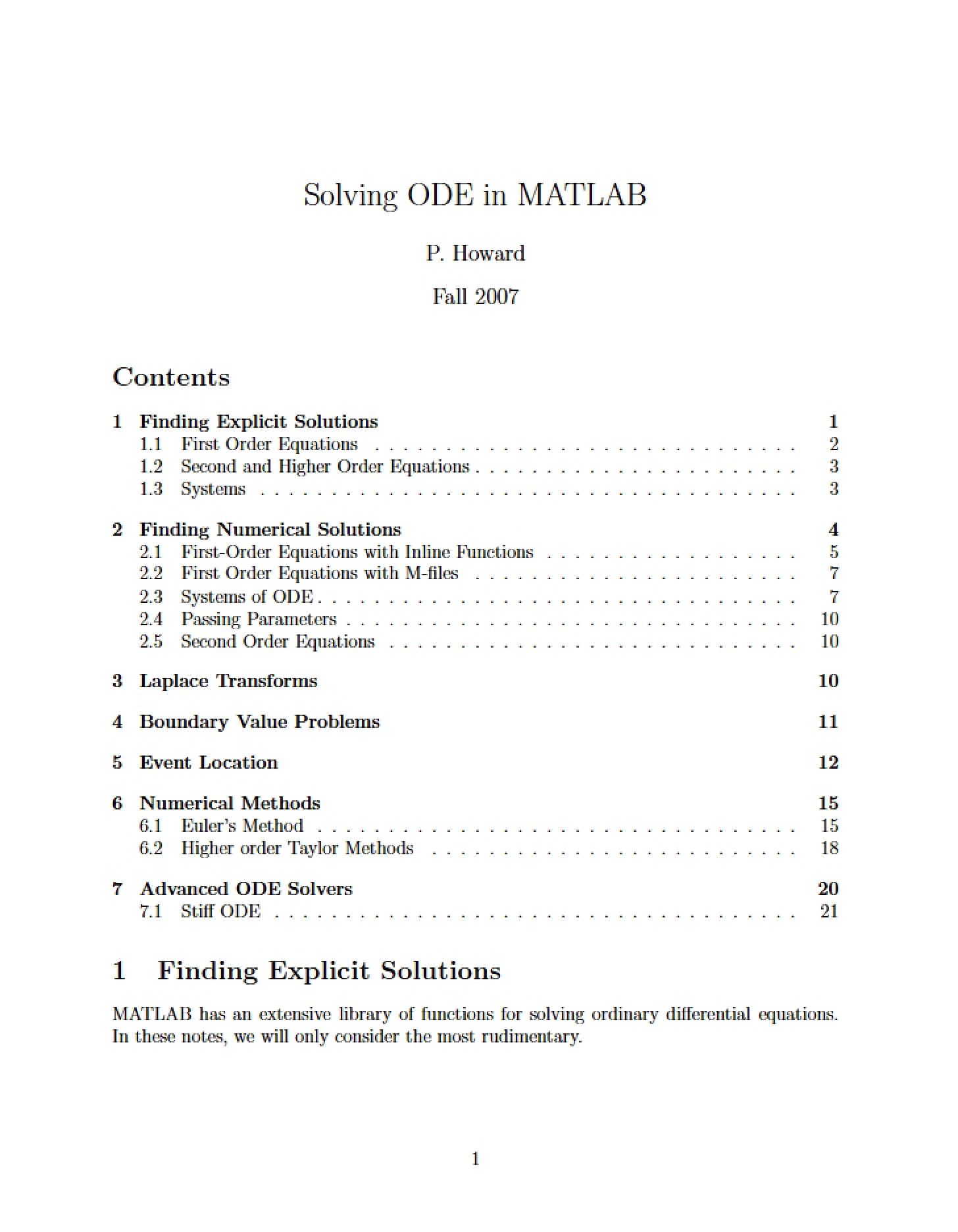
This is a focused set of instructional notes centered around solving ordinary differential equations (ODEs) using MATLAB. It delves into both symbolic and numerical techniques for tackling these equations, progressing from foundational concepts to more advanced methods. The material appears to be geared towards an intermediate-level understanding, building upon a basic familiarity with differential equations and MATLAB programming. It explores methods applicable to first and second-order equations, systems of equations, and boundary value problems.
Why This Document Matters
This resource is ideal for engineering and physics students, particularly those enrolled in courses requiring computational solutions to differential equations. It’s beneficial for anyone needing to implement ODE solvers in MATLAB for modeling physical systems, analyzing dynamic behavior, or performing simulations. Students preparing for exams or tackling projects involving ODEs will find this a valuable reference. It’s most useful when you’ve already grasped the theoretical foundations of ODEs and are looking to translate those concepts into practical MATLAB code.
Common Limitations or Challenges
This material focuses specifically on *how* to approach ODE solutions within MATLAB. It does not provide a comprehensive review of the underlying mathematical theory of differential equations themselves. It also doesn’t cover every possible ODE solver available in MATLAB, concentrating on a selection of core techniques. While it touches on advanced solvers, it doesn’t aim to be an exhaustive guide to all available options or their nuanced performance characteristics.
What This Document Provides
* An exploration of using MATLAB’s symbolic capabilities to find explicit solutions to ODEs.
* Detailed guidance on implementing numerical methods for solving first and second-order ODEs.
* Techniques for defining ODEs within MATLAB, both directly and using external M-files.
* Discussion of applying Laplace transforms in the context of ODE solutions.
* An introduction to handling boundary value problems.
* Coverage of numerical methods like Taylor series approaches.
* Insights into utilizing more sophisticated ODE solvers available within MATLAB.