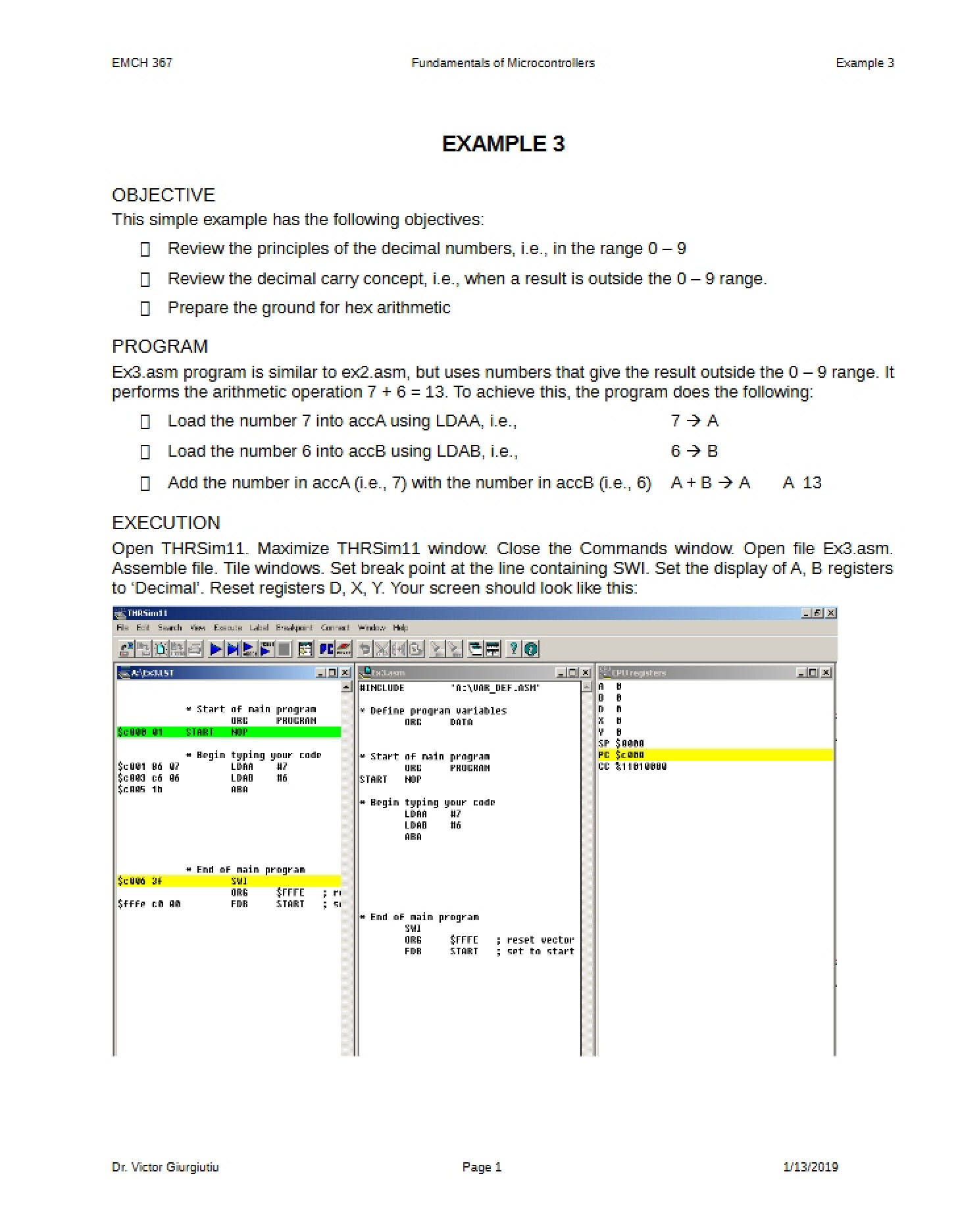
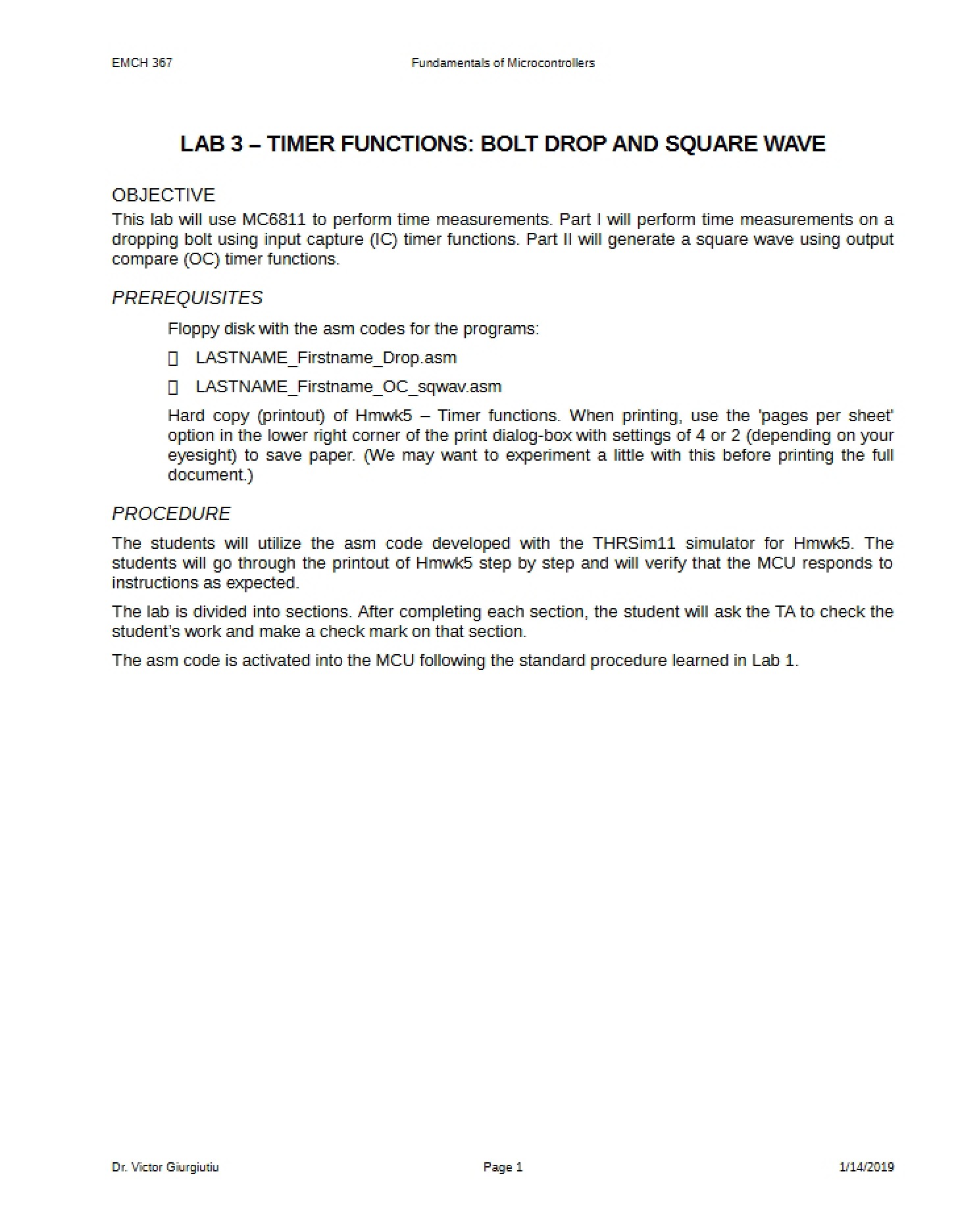
What This Document Is
This document is a laboratory exercise designed for students enrolled in an undergraduate Microcontrollers course (EMCH 367) at the University of South Carolina. Specifically, Lab Two focuses on the practical application of parallel and serial communication principles within the context of the MC68HC11 microcontroller. It builds upon foundational microcontroller concepts and aims to bridge theoretical knowledge with hands-on experimentation. The lab explores how data is transmitted and received using different communication methods, and how to interpret the signals involved.
Why This Document Matters
This lab is crucial for mechanical engineering students who need to understand how microcontrollers interact with the physical world. Proficiency in parallel and serial communication is essential for interfacing with sensors, actuators, and other devices commonly found in automated systems. Students will benefit from this lab by solidifying their understanding of digital logic, data representation, and the practical considerations of microcontroller-based system design. It’s particularly useful when preparing to implement more complex embedded systems projects. This resource is best utilized *during* the lab session and as a reference for completing associated homework assignments.
Common Limitations or Challenges
This document provides a structured laboratory experience, but it does not offer a comprehensive introduction to microcontroller theory. It assumes a basic understanding of digital electronics, assembly language programming, and the MC68HC11 architecture. The lab focuses on specific communication techniques and does not cover all possible microcontroller peripherals or communication protocols. It also requires access to specific hardware (MC68HC11 microcontroller, 4-button 4-LED box, oscilloscope) and software (THRSim11 simulator) which are not included within this resource.
What This Document Provides
* A detailed outline of the lab’s objectives, centered around parallel and serial communication.
* A list of prerequisite materials, including specific assembly code files needed for the experiments.
* A step-by-step procedure for conducting experiments involving parallel port manipulation and signal observation.
* Warm-up exercises designed to reinforce understanding of parallel port behavior and voltage level interpretation.
* Guidance on utilizing an oscilloscope to analyze communication signals.
* Exploration of key concepts like Baud rate, ASCII code, and the principles of echo communication.
* A structured format for TA verification of completed lab sections.