What This Document Is
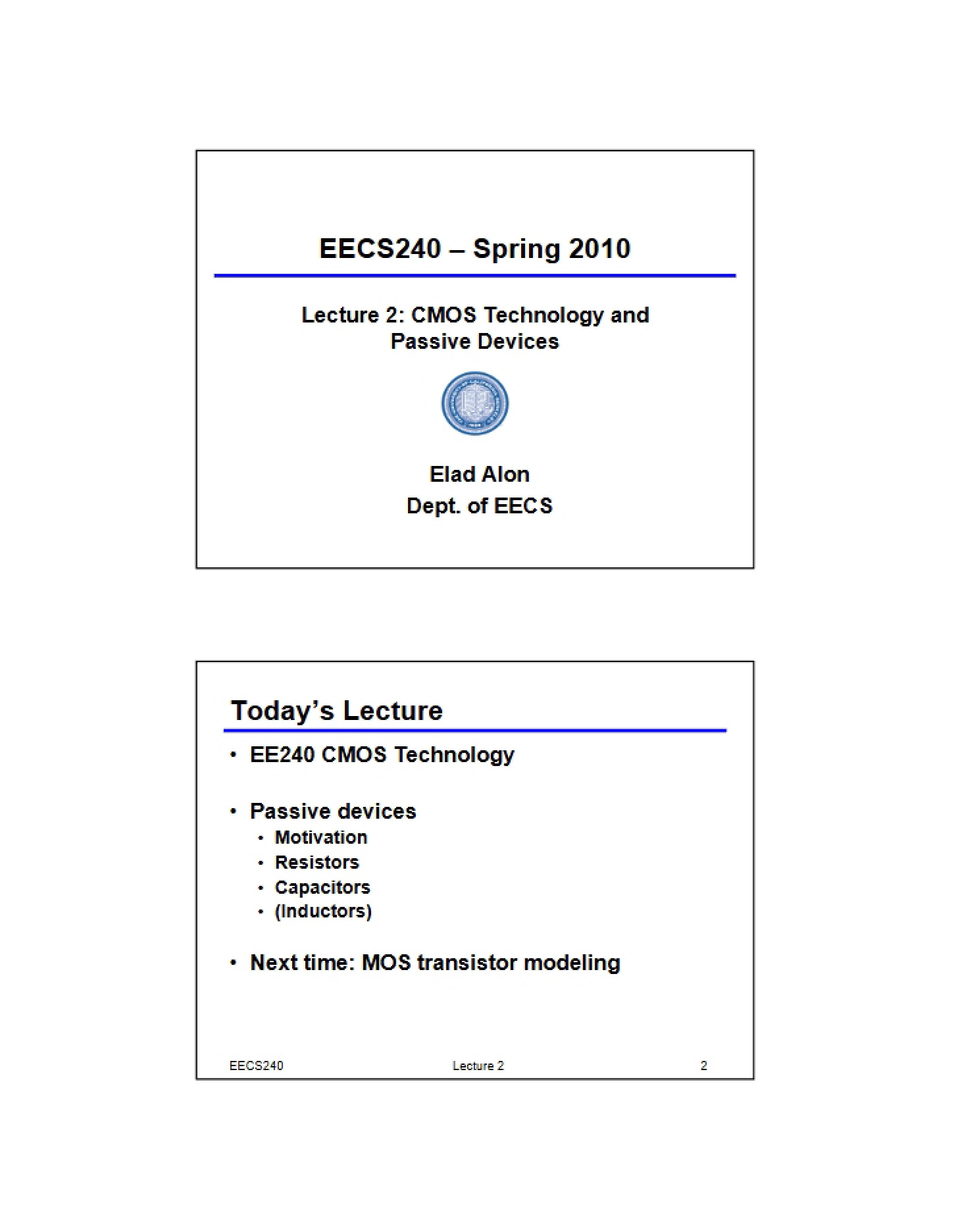
This document provides a focused exploration of passive devices and CMOS technology, a core component of the ELENG 240A Linear Integrated Circuits course at UC Berkeley. It delves into the fundamental building blocks used in analog and mixed-signal circuit design, examining both the theoretical underpinnings and practical considerations for implementation within a standard CMOS process. This material is designed to build a strong foundation for understanding more complex circuit topologies covered later in the course.
Why This Document Matters
This resource is invaluable for students enrolled in advanced analog circuit design courses, particularly those utilizing CMOS technology. It’s especially helpful when you’re beginning to analyze and design circuits that rely heavily on the characteristics of resistors, capacitors, and the nuances of CMOS fabrication. Professionals seeking a refresher on these foundational concepts will also find it beneficial. Access to the full content will empower you to confidently tackle design challenges and optimize circuit performance.
Topics Covered
* CMOS Process Overview and Cross-Sectional Analysis
* Characteristics and limitations of Resistors in CMOS
* Implementation techniques for Capacitors in integrated circuits
* Detailed examination of resistor non-idealities (temperature and voltage coefficients)
* Layout considerations for minimizing mismatch in passive devices
* Utilization of MOSFETs as resistor elements
* Analysis of capacitor structures and their associated challenges
* Advanced capacitor options like MIM capacitors
What This Document Provides
* A comprehensive overview of available process options and their impact on passive device characteristics.
* Insights into the trade-offs involved in selecting different passive device implementations.
* Discussion of systematic variations and matching techniques for improved circuit performance.
* Exploration of layout strategies to mitigate parasitic effects and enhance device reliability.
* A foundational understanding of the behavior of passive components within the context of CMOS integrated circuits.