What This Document Is
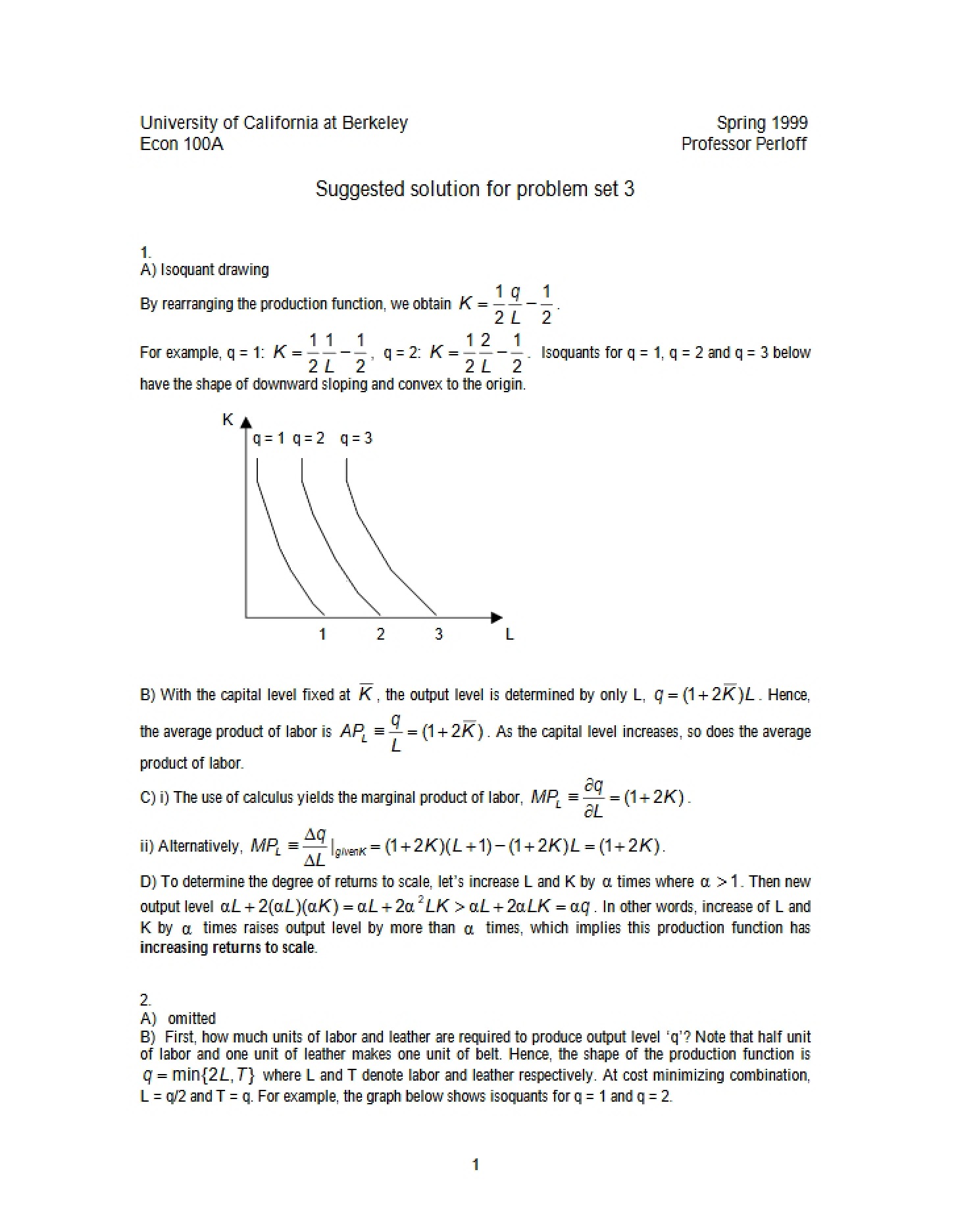
This is a problem set designed to reinforce core concepts from an introductory economics course, specifically Environmental Economics and Policy (EEP 100) at the University of California, Berkeley. It’s a practical exercise intended to test your understanding of foundational mathematical techniques applied to economic modeling. The set focuses on applying calculus and related methods to solve problems commonly encountered in economic analysis.
Why This Document Matters
This problem set is ideal for students currently enrolled in an introductory economics course, particularly those needing to strengthen their analytical and problem-solving skills. It’s most beneficial when used alongside lecture notes and textbook readings as a way to actively apply learned concepts. Working through these types of problems will build a stronger foundation for more advanced coursework in economics and related fields. Successfully completing this assignment demonstrates a grasp of essential mathematical tools used throughout the study of economics.
Topics Covered
* Single and Multi-Variable Differentiation
* Partial Derivatives and Implicit Differentiation
* Total Differentials
* Optimization Techniques (Maxima and Minima)
* Concavity and Points of Inflection
* Applied Optimization Problems (e.g., maximizing area, minimizing distance)
* Revenue and Cost Analysis
* Profit Maximization
* Demand and Supply Modeling
What This Document Provides
* A series of analytical problems requiring the application of calculus.
* Exercises focused on finding derivatives and applying them to economic scenarios.
* Opportunities to practice optimization techniques to solve for maximum or minimum values.
* Problems involving the analysis of functions to determine concavity and inflection points.
* Scenarios requiring the application of economic principles to real-world manufacturing and production contexts.
* A set of questions designed to assess understanding of revenue, cost, and profit relationships.