What This Document Is
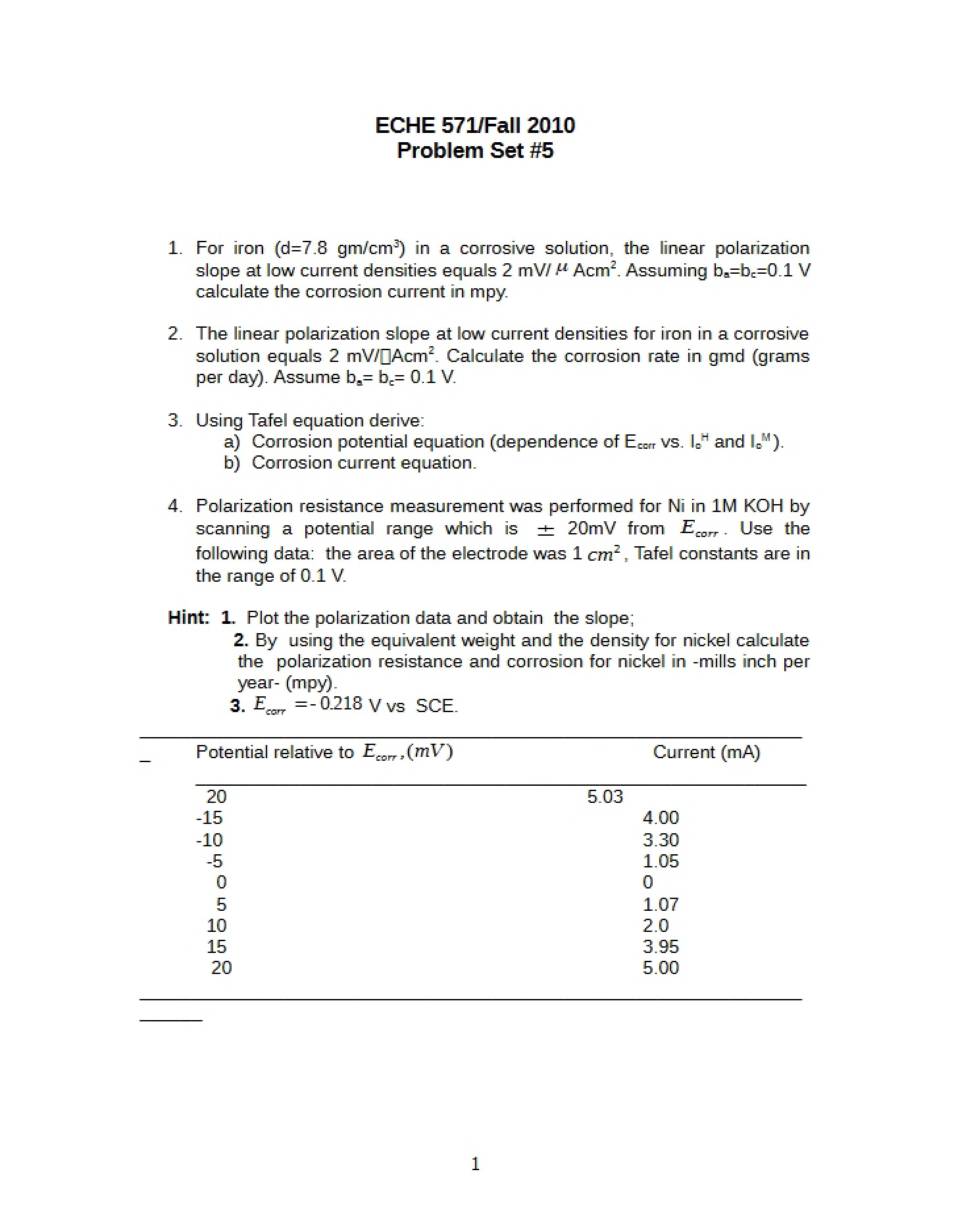
This is a problem set designed to reinforce your understanding of advanced corrosion engineering principles, specifically within the context of the ECHE 571 course at the University of South Carolina. It focuses on applying theoretical knowledge to practical scenarios involving metallic corrosion, passivation, and inhibition. The set presents a series of challenging problems requiring in-depth analysis and calculations related to electrochemical principles and materials science.
Why This Document Matters
This problem set is invaluable for students seeking to master the complexities of corrosion control and prevention. It’s particularly useful for those preparing for exams, working on related projects, or aiming to build a strong foundation for future work in industries dealing with material degradation – such as oil & gas, chemical processing, or marine engineering. Successfully working through these problems will demonstrate a practical grasp of concepts discussed in lectures and readings, solidifying your ability to predict and mitigate corrosion in real-world applications. It’s best utilized *after* a thorough review of the course materials on passivation, pitting corrosion, and electrochemical kinetics.
Common Limitations or Challenges
This document presents problems *without* fully worked-out solutions. It’s designed to test your problem-solving skills and requires independent application of the course’s theoretical framework. It does not provide introductory explanations of core concepts; a solid understanding of electrochemical principles, thermodynamics, and materials science is assumed. Furthermore, it focuses on specific scenarios and may not cover all possible corrosion phenomena.
What This Document Provides
* Problems centered around determining corrosion behavior in coupled metallic systems.
* Calculations involving the free energy of formation of passive films on various metals.
* Exercises focused on the prevention of pitting corrosion through the use of inhibitors.
* Tasks requiring the determination of Flade potentials under varying conditions.
* Problems relating to the electrochemical parameters of active-passive alloys and their corrosion resistance.
* Applications of equations relating pH, current density, and dissolved oxygen in passivity.
* Opportunities to apply concepts of anodic polarization and concentration polarization.