What This Document Is
This is a comprehensive exploration of Redundant Arrays of Independent Disks (RAID) systems, a crucial topic within the field of fault-tolerant computing. It delves into the principles behind designing reliable storage solutions, examining the trade-offs between performance, cost, and data protection. The material originates from foundational research in the area and provides a detailed look at the evolution and considerations for implementing these systems.
Why This Document Matters
This resource is ideal for students in computer science, particularly those enrolled in courses on operating systems, distributed systems, or storage architecture. It’s also valuable for IT professionals seeking a deeper understanding of data storage reliability and performance optimization. If you're facing challenges in designing robust data storage solutions, or need to understand the underlying principles of RAID technology, this material will provide a solid foundation.
Topics Covered
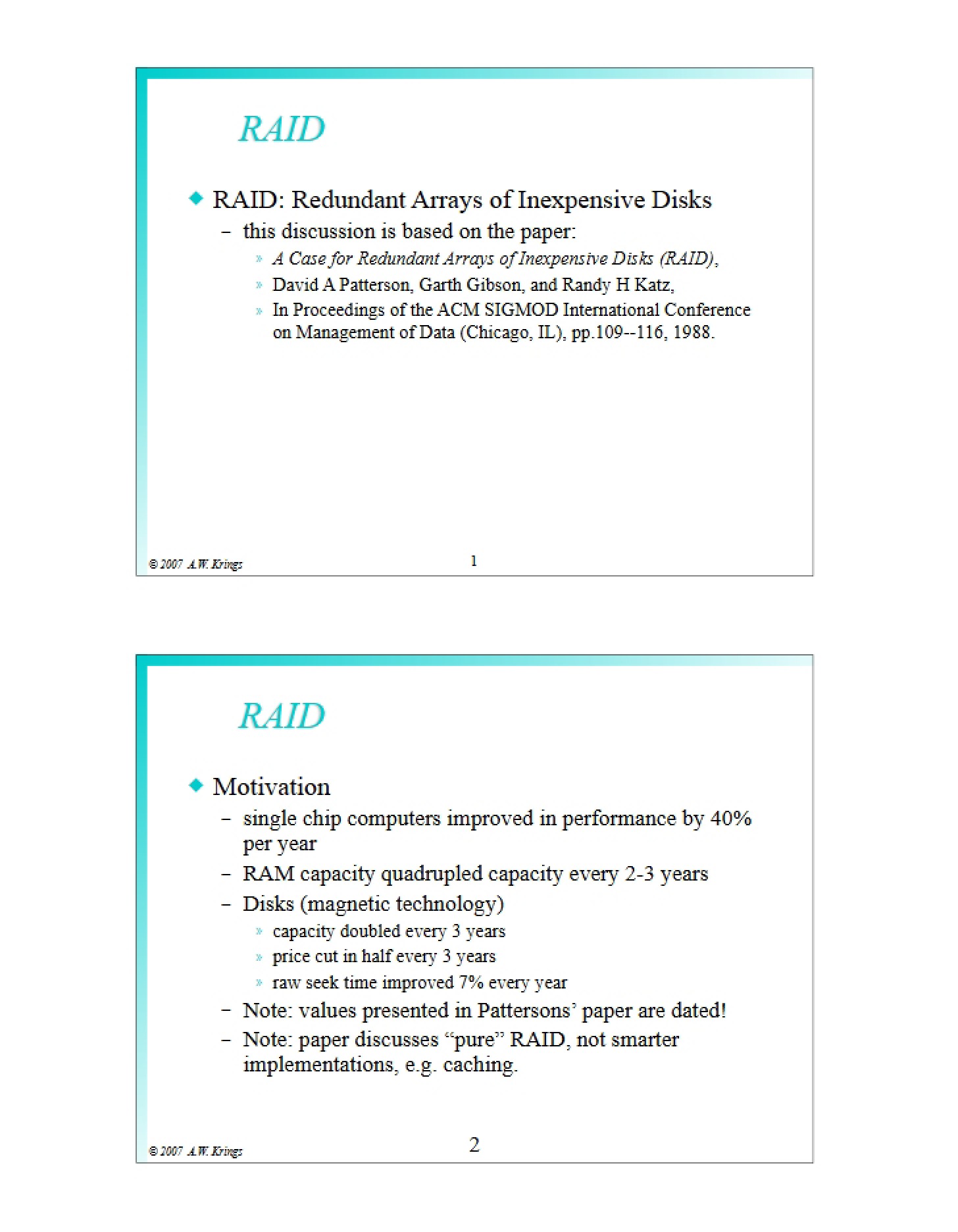
* Historical context and motivation for RAID development
* The impact of hardware performance trends on storage system design
* Amdahl’s Law and its relevance to I/O performance
* Reliability metrics and their application to disk arrays
* Detailed analysis of various RAID levels and their characteristics
* Considerations for different target system configurations (supercomputers, transaction processing)
* Performance analysis of different RAID levels under various workloads
What This Document Provides
* A foundational understanding of RAID concepts and terminology.
* A comparative analysis of different RAID levels, highlighting their strengths and weaknesses.
* Insights into the trade-offs involved in choosing the appropriate RAID configuration for specific applications.
* A historical perspective on the development of RAID technology.
* A framework for evaluating the reliability and performance of disk arrays.
* Detailed characteristics and performance metrics for RAID Level 1 and Level 2.