What This Document Is
This is a detailed exploration of signal reconstruction and sampling techniques, a core component of systems and signals analysis. It delves into the mathematical foundations underpinning how continuous signals are converted into discrete representations and then accurately recreated. This material is designed for students studying electrical engineering and related fields, specifically those enrolled in a rigorous course on systems and signals.
Why This Document Matters
This resource is invaluable for students seeking a deeper understanding of the fundamental principles governing signal processing. It’s particularly helpful when tackling assignments and exams that require applying these concepts to real-world scenarios. If you’re struggling to grasp the relationship between continuous and discrete signals, or need a solid foundation for more advanced topics like digital signal processing, this document will provide a comprehensive overview. It’s best utilized alongside lectures and problem sets to reinforce learning.
Topics Covered
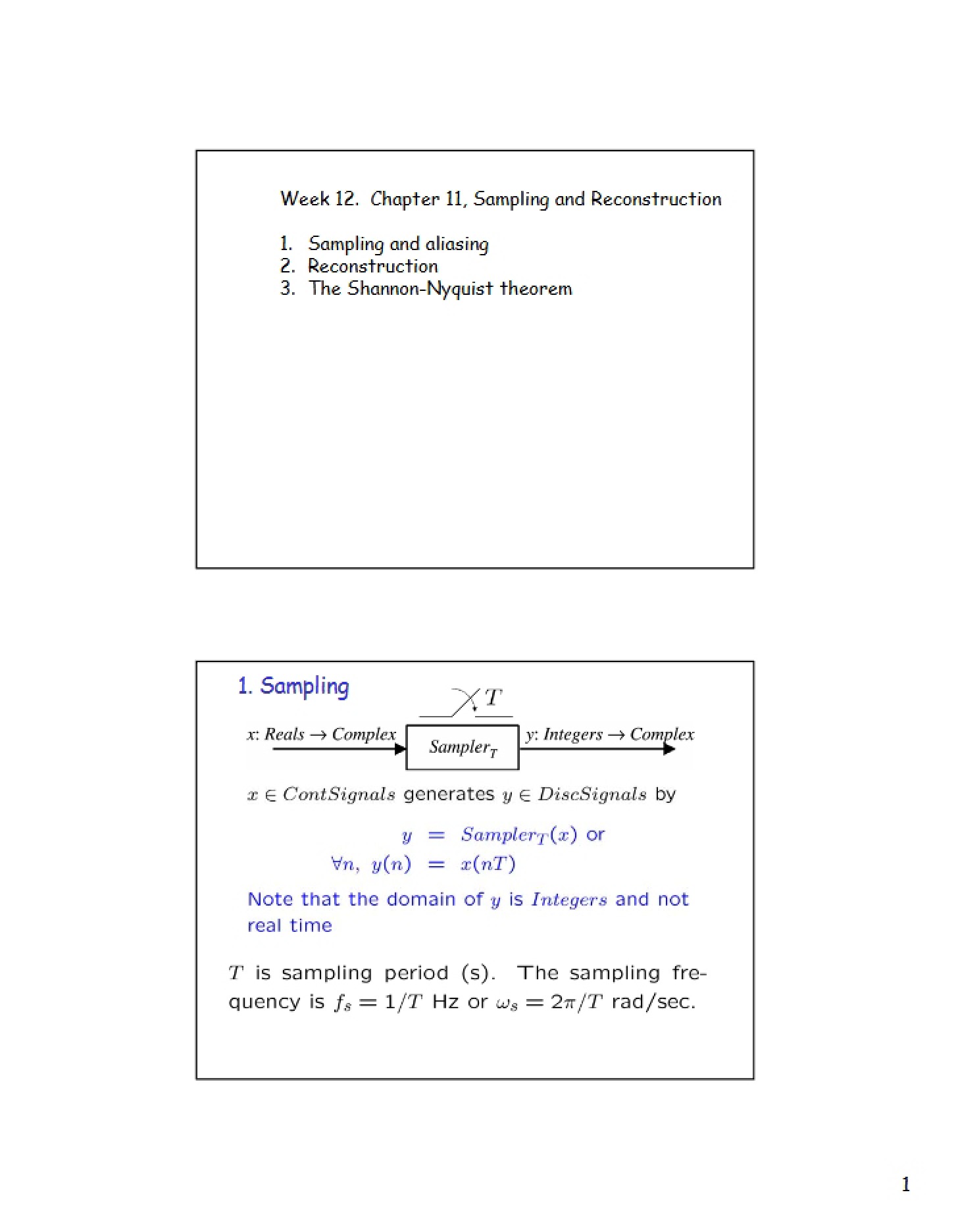
* The core principles of sampling and its potential pitfalls.
* Detailed examination of aliasing and its implications.
* Methods for accurately reconstructing signals from their sampled versions.
* The critical role of the Shannon-Nyquist theorem in determining optimal sampling rates.
* Analysis of reconstruction filters and their impact on signal fidelity.
* Frequency domain representations of sampling and reconstruction processes.
What This Document Provides
* A formal treatment of sampling as a mathematical operation.
* A thorough investigation of the relationship between signal frequency and sampling rate.
* Illustrative examples demonstrating the effects of different sampling frequencies.
* A framework for understanding the trade-offs involved in signal reconstruction.
* A foundation for analyzing the frequency response of systems involved in sampling and reconstruction.
* Connections between continuous-time and discrete-time signal representations.