What This Document Is
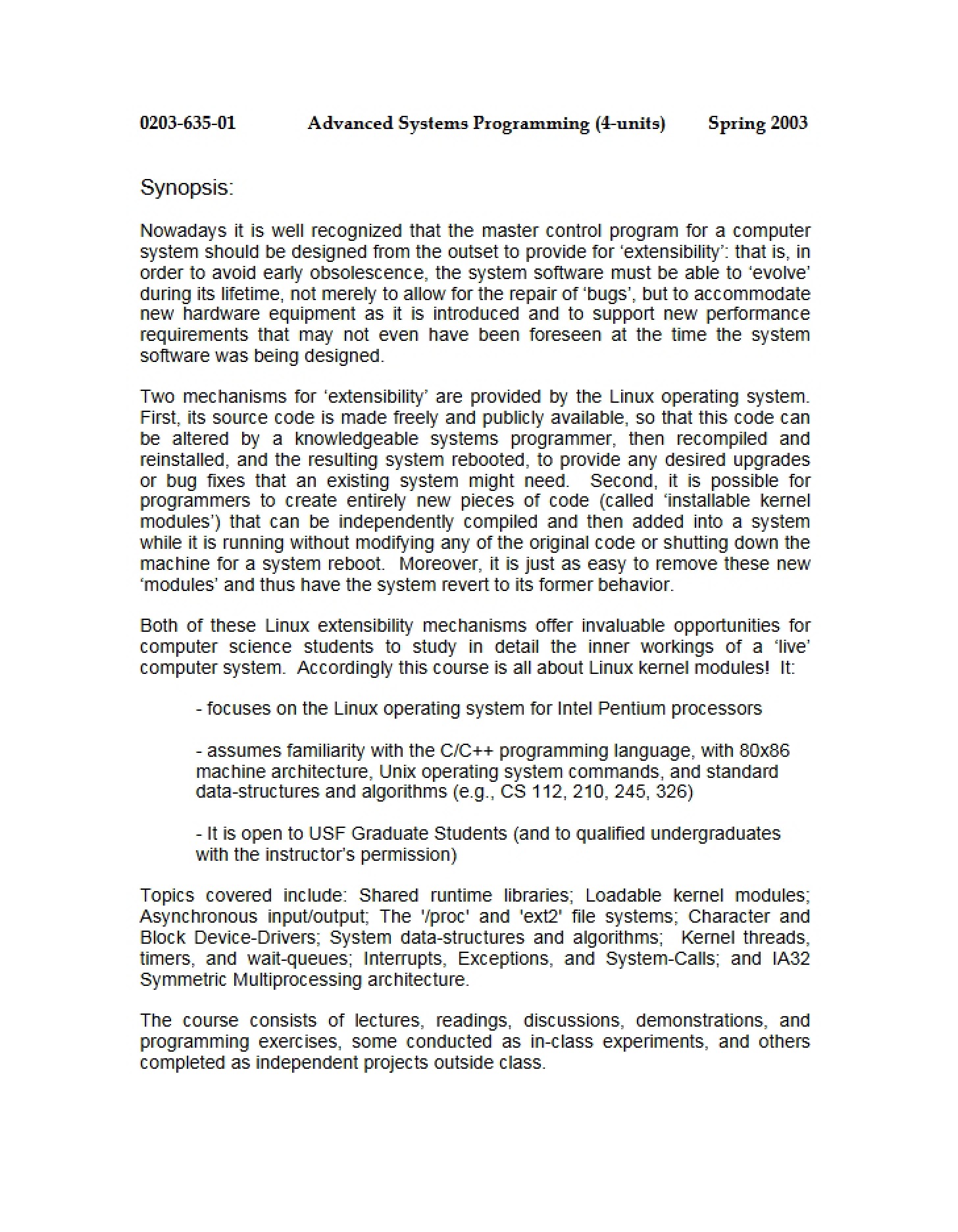
These are detailed lecture notes from CS 635: Advanced Systems Programming at the University of San Francisco. The material focuses on practical kernel module programming, specifically applied to the control of Super VGA graphics devices. It delves into the low-level interactions between software and hardware, exploring how to manipulate graphics hardware through kernel-level code. The notes cover the architecture of SVGA cards, the role of the CRT controller and memory sequencer, and the challenges of hardware incompatibility.
Why This Document Matters
This resource is invaluable for students seeking a deep understanding of systems programming concepts beyond the typical user-space application development. It’s particularly beneficial for those interested in device drivers, embedded systems, or graphics programming. If you’re struggling to bridge the gap between theoretical knowledge and real-world hardware interaction, or preparing to tackle projects involving direct hardware control, these notes will provide a solid foundation. They are most useful when studied *in conjunction* with course lectures and hands-on lab exercises.
Common Limitations or Challenges
These notes are a record of lecture material and assume a foundational understanding of C programming, operating system principles, and computer architecture. They do *not* provide a comprehensive introduction to these prerequisite topics. Furthermore, the specifics of hardware configurations can vary, so the notes focus on the particular SVGA chip used in the University’s lab environment as a case study. The notes also do not offer a complete, ready-to-run driver solution; rather, they present the underlying concepts and building blocks.
What This Document Provides
* An exploration of the internal workings of Super VGA graphics cards.
* Detailed information on accessing and manipulating SVGA registers through I/O ports.
* Discussion of the CRT Controller and Memory Sequencer’s roles in display operation.
* Insights into identifying PCI devices using vendor and device IDs.
* A class demonstration example utilizing a pseudo-file interface within the `/proc` filesystem.
* Guidance on utilizing `ioremap()` for memory access.
* A suggested class exercise involving offscreen video RAM manipulation.