What This Document Is
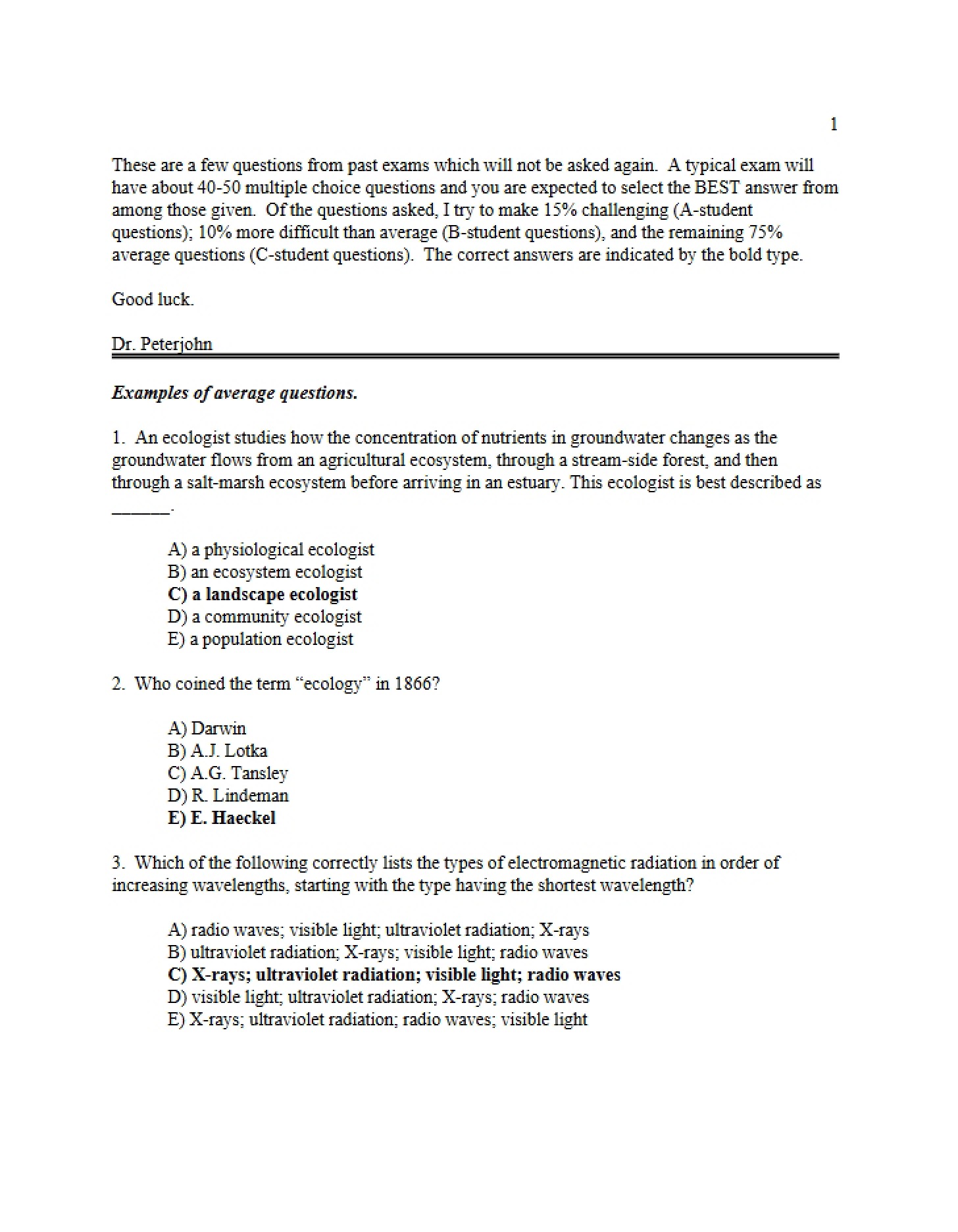
This resource is a collection of sample questions designed to help students prepare for assessments in BIOL 221: Ecology and Evolution at West Virginia University. It’s formatted like a practice exam, featuring multiple-choice questions covering a range of topics within the course. The questions are categorized by difficulty level, mirroring the distribution expected on actual exams. This material is intended to be a self-assessment tool, allowing students to gauge their understanding of core ecological and evolutionary principles.
Why This Document Matters
Students enrolled in Ecology and Evolution will find this particularly useful when reviewing for quizzes and exams. It’s ideal for identifying knowledge gaps and reinforcing key concepts. Utilizing these sample questions can help refine test-taking strategies and build confidence before formal evaluations. This resource is best used *after* engaging with course lectures, readings, and other learning materials – it’s designed to complement, not replace, those foundational elements. Students aiming for a strong grasp of ecological processes and evolutionary theory will benefit from working through these examples.
Common Limitations or Challenges
This document presents a selection of past exam questions, but it does *not* represent the entirety of potential exam content. The scope of topics covered is representative, but not exhaustive. Furthermore, while questions are categorized by difficulty, mastering these examples doesn’t guarantee success on the actual exam, which may include novel question types or focus on different aspects of the material. Detailed explanations or worked solutions are not included within this resource.
What This Document Provides
* A variety of multiple-choice questions spanning core concepts in Ecology and Evolution.
* Questions categorized to reflect the expected difficulty distribution on course exams.
* Examples relating to biogeochemical cycles, plant adaptations, population dynamics, and ecosystem processes.
* Scenarios involving quantitative reasoning and application of ecological principles.
* Questions designed to test understanding of relationships between organisms and their environment.