What This Document Is
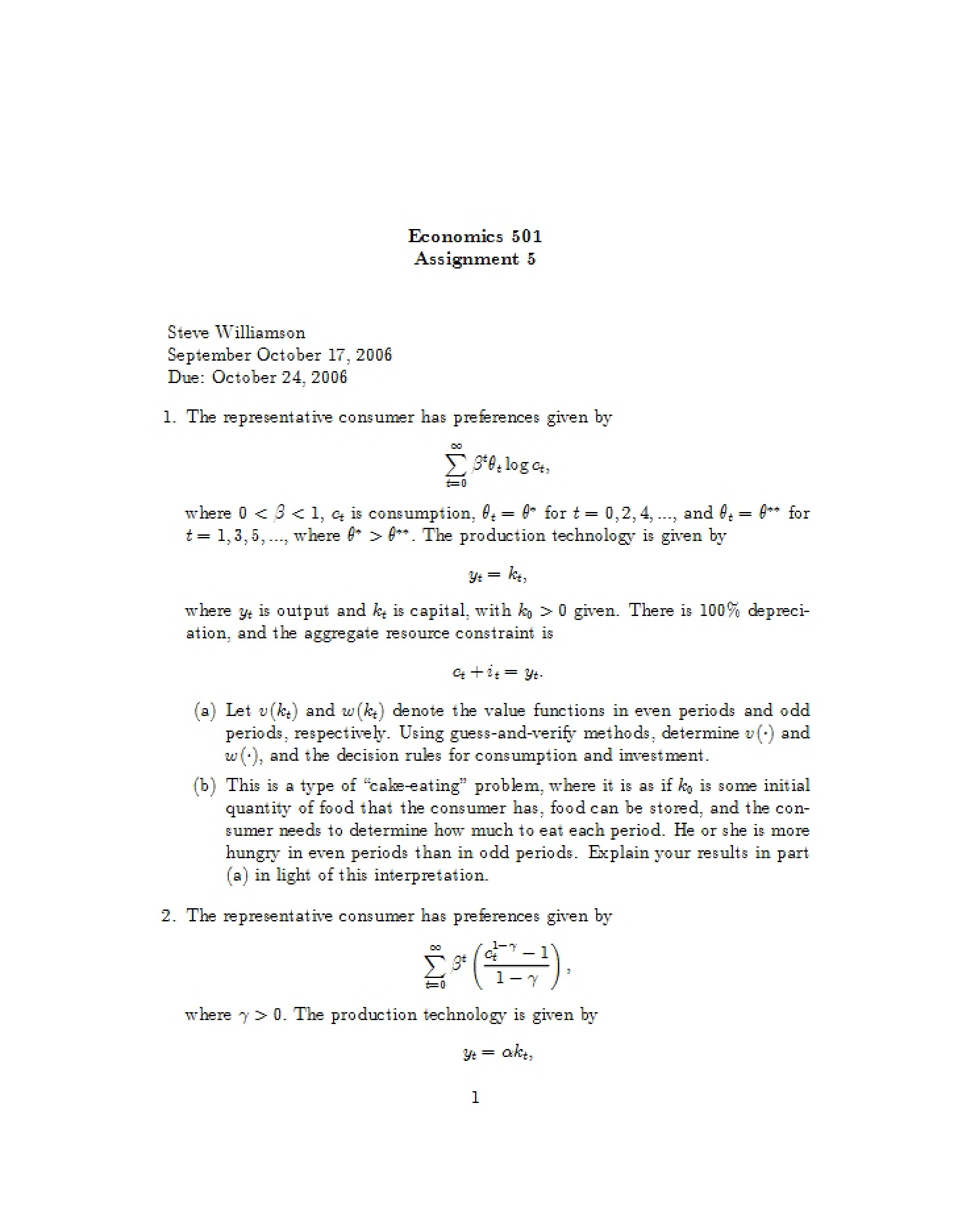
This is a homework assignment for an introductory Macroeconomics I course (ECON 501) at Washington University in St. Louis. It focuses on applying economic modeling techniques to analyze the impact of government policies and technological changes on consumer behavior and overall economic outcomes. The assignment centers around representative agent models, a core tool in macroeconomic analysis, and requires students to demonstrate an understanding of utility maximization, production functions, and market equilibrium.
Why This Document Matters
This assignment is designed for students enrolled in a first-semester graduate-level macroeconomics course. It’s particularly valuable for those seeking to solidify their understanding of how economic agents respond to shifts in policy – like government spending – and changes in productivity. Successfully completing this assignment will build a strong foundation for more advanced macroeconomic coursework and research. It’s best used as a practice tool *after* reviewing relevant lecture notes and textbook chapters on consumer theory, production, and government intervention.
Common Limitations or Challenges
This assignment presents theoretical problems requiring analytical skills. It does *not* provide step-by-step solutions or worked examples. Students will need a solid grasp of the underlying economic principles and mathematical techniques to independently derive the required results. The assignment assumes familiarity with concepts like utility functions, budget constraints, and production possibilities frontiers. It also doesn’t offer explanations of the core concepts themselves – it expects you to *apply* them.
What This Document Provides
* Two distinct problem sets exploring representative agent models.
* Scenarios involving government spending and its effects on consumption, leisure, and output.
* Analysis of the impact of productivity changes in both market and home production sectors.
* Opportunities to differentiate between income and substitution effects in consumer decision-making.
* A framework for understanding how changes in economic parameters affect labor supply and resource allocation.