What This Document Is
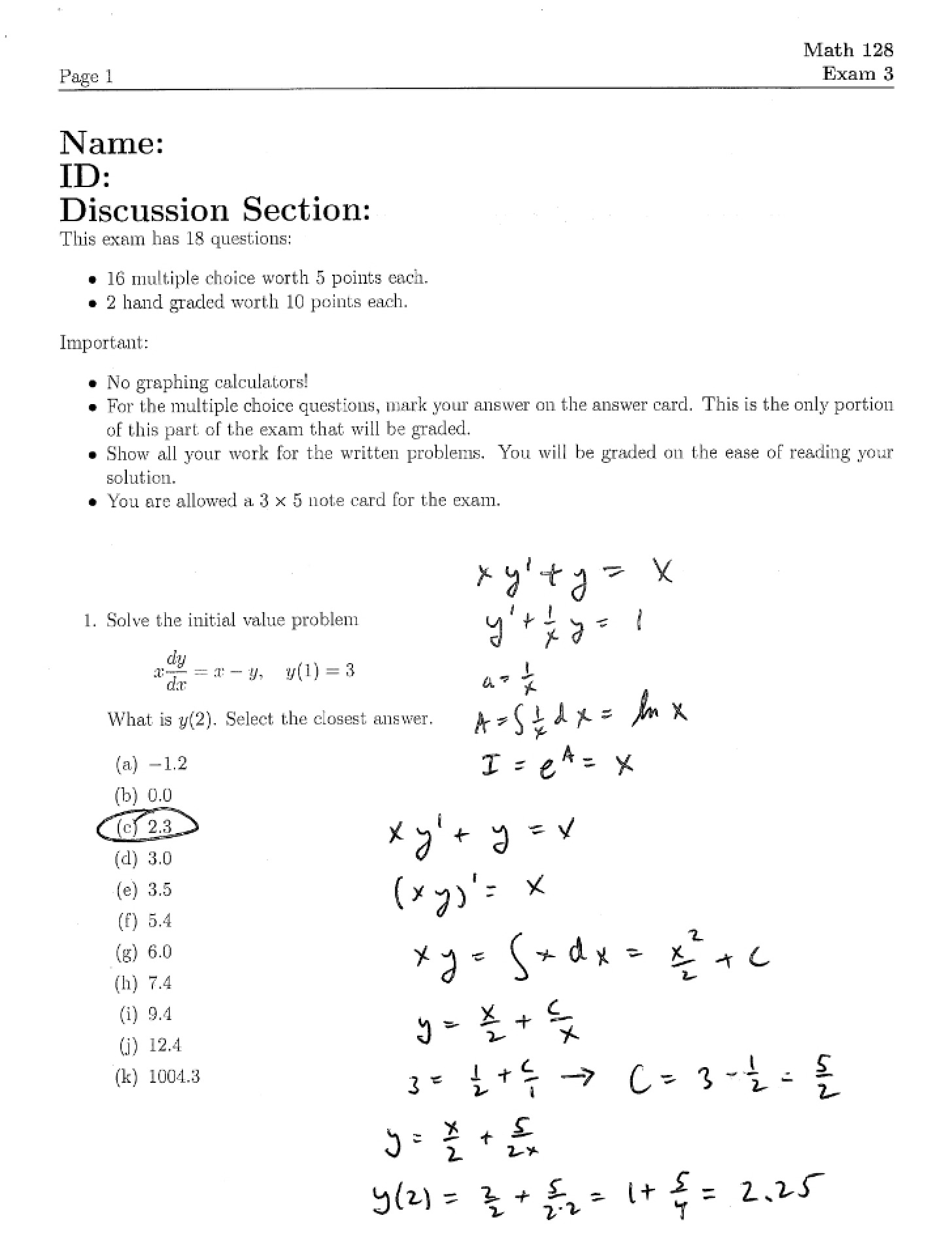
This is a past intermediate examination for Math 128, Calculus II, at Washington University in St. Louis, administered in Spring 2009. It’s designed to assess a student’s understanding of core concepts covered in the second portion of the course, building upon the foundations established in Calculus I. The exam focuses on a range of topics within differential equations and related applications. It combines multiple-choice questions with more in-depth, hand-graded problems requiring detailed solutions.
Why This Document Matters
This resource is invaluable for students currently enrolled in Calculus II, or those preparing to take the course. It’s particularly useful for self-assessment, identifying areas of strength and weakness, and familiarizing yourself with the typical format and difficulty level of exams at Washington University in St. Louis. Studying past exams is a proven method for improving test-taking strategies and building confidence. It can also be helpful for instructors looking for examples of assessment questions.
Common Limitations or Challenges
While this exam provides a strong indication of the course’s expectations, it represents a specific instance in time. The exact content and emphasis may vary in subsequent semesters. This document does *not* include detailed explanations of the solutions, nor does it offer step-by-step guidance on how to approach each problem. It is a test, not a tutorial. Access to the full document is required to view the complete questions and solutions.
What This Document Provides
* A complete, previously administered Calculus II midterm exam.
* A mix of multiple-choice and hand-graded problems.
* Questions covering topics such as separable differential equations.
* Problems relating to integrating factors and linear differential equations.
* Applications of differential equations to real-world scenarios, like population modeling and mixing problems.
* Practice with Euler’s method for approximating solutions.
* Questions involving continuous compounding and withdrawal rates.
* Insight into the expected problem-solving skills for the course.