What This Document Is
This material provides a foundational exploration of axiomatic systems, a core concept in rigorous mathematical reasoning. Specifically, it delves into the structure and components that define these systems, using incidence geometry as a primary illustrative example. It’s designed to build a strong understanding of how mathematical theories are constructed and validated through a formal, logical framework. This section forms part of the broader Geometry (MATH 2360Q) course at the University of Connecticut.
Why This Document Matters
This resource is invaluable for students seeking a deeper comprehension of the underlying principles of geometry and mathematical proof. It’s particularly helpful for those who want to move beyond simply *applying* geometric principles to understanding *why* those principles are true. It’s best utilized when first encountering axiomatic systems, or when needing a refresher on the fundamental building blocks of mathematical logic. Accessing the full material will provide a solid base for more advanced geometric studies.
Topics Covered
* The core components of an axiomatic system
* Undefined and defined terms in mathematical contexts
* The role and characteristics of axioms (or postulates)
* The relationship between axioms, theorems, and proofs
* The concepts of consistency and independence within an axiomatic system
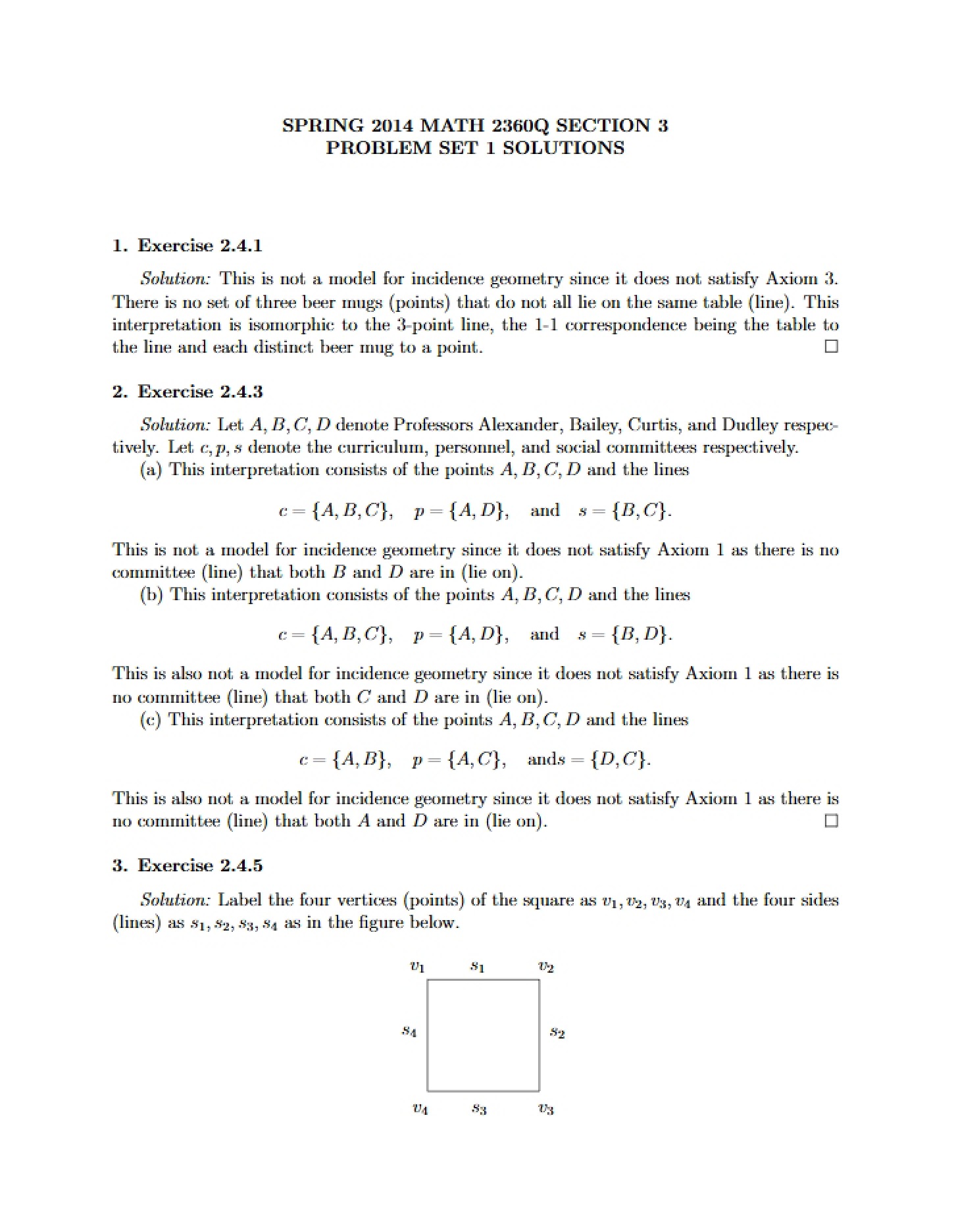
* Interpretations and models of axiomatic systems
* A practical example illustrating an axiomatic system outside of traditional geometry
What This Document Provides
* A clear explanation of the structure of an axiomatic system.
* A detailed examination of the different elements that comprise an axiomatic system.
* An illustrative example to demonstrate how an axiomatic system functions in practice.
* A foundation for understanding the logical basis of mathematical proofs.
* A framework for evaluating the validity and reliability of mathematical theories.