What This Document Is
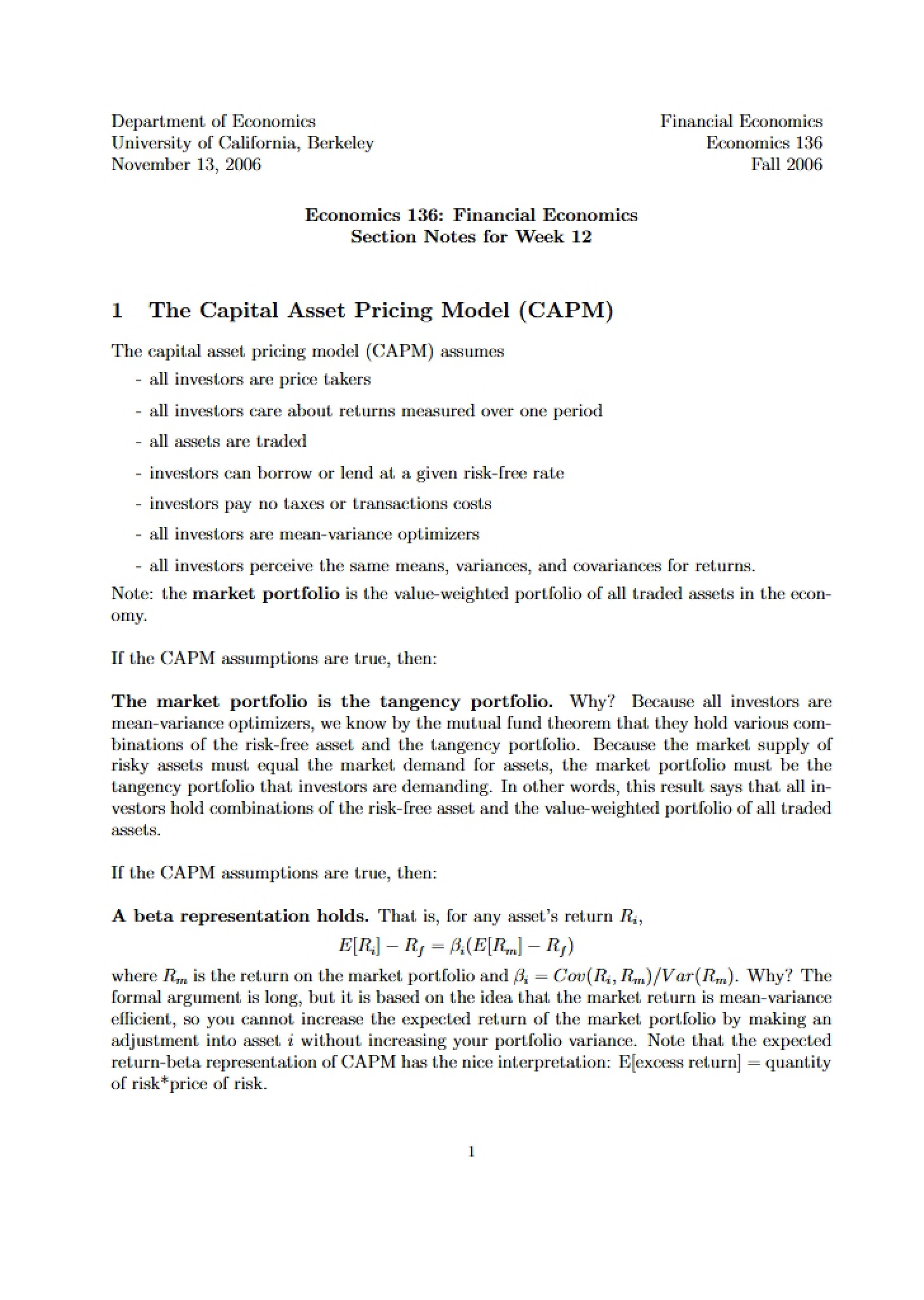
These are section review notes from an introductory Financial Economics course (ECON 136) at the University of California, Berkeley. This material is designed to reinforce core concepts discussed in lectures and provide a foundational understanding of key principles within the field. It focuses on building a strong analytical toolkit essential for success in more advanced financial studies. The notes represent a focused review of material covered during a specific week of the course.
Why This Document Matters
Students enrolled in Financial Economics, or those preparing for related coursework, will find these notes particularly valuable. They are ideal for reviewing challenging topics, solidifying understanding before assessments, or as a reference while working through problem sets. Individuals seeking a structured overview of fundamental financial concepts will also benefit from exploring the material contained within. Access to these notes can significantly enhance comprehension and improve performance in this demanding subject area.
Topics Covered
* Foundational principles of probability and statistics as applied to financial markets.
* The concept of random variables and their role in modeling asset returns.
* Understanding probability distribution functions and their application in finance.
* Calculating and interpreting expected values of financial variables.
* The relationship between possible states of the world and their associated probabilities.
* Application of probabilistic concepts to real-world financial scenarios.
What This Document Provides
* A detailed exploration of core concepts related to probability and statistical analysis.
* A framework for understanding how randomness is incorporated into financial modeling.
* Illustrative examples demonstrating the application of theoretical concepts.
* A structured presentation of key definitions and terminology.
* A focused review of material designed to complement lecture content.
* A solid base for further study in financial economics.