What This Document Is
This document contains lecture materials from Session 21 of CHEM 156, Physical Biochemistry, at the University of California, Los Angeles. It focuses on the fundamental principles governing the speeds at which chemical reactions occur – a field known as chemical kinetics. The lecture explores how various factors influence reaction rates and how these rates can be mathematically described and experimentally determined. It builds a foundation for understanding the complexities of biochemical reactions.
Why This Document Matters
This material is essential for students in physical biochemistry and related fields who need a strong grasp of reaction dynamics. It’s particularly helpful when studying enzyme mechanisms, metabolic pathways, and the quantitative aspects of biological processes. Reviewing these concepts before tackling more complex biochemical systems, or when preparing for assessments, will significantly enhance understanding. Access to the full content will allow for a deeper dive into the mathematical and theoretical underpinnings of reaction rates.
Topics Covered
* Differential and empirical rate laws
* Determining reaction orders through experimental methods (initial rates)
* Integrated rate laws for different reaction orders (first and second order)
* Reaction half-life and its implications
* Stoichiometry versus reaction mechanisms
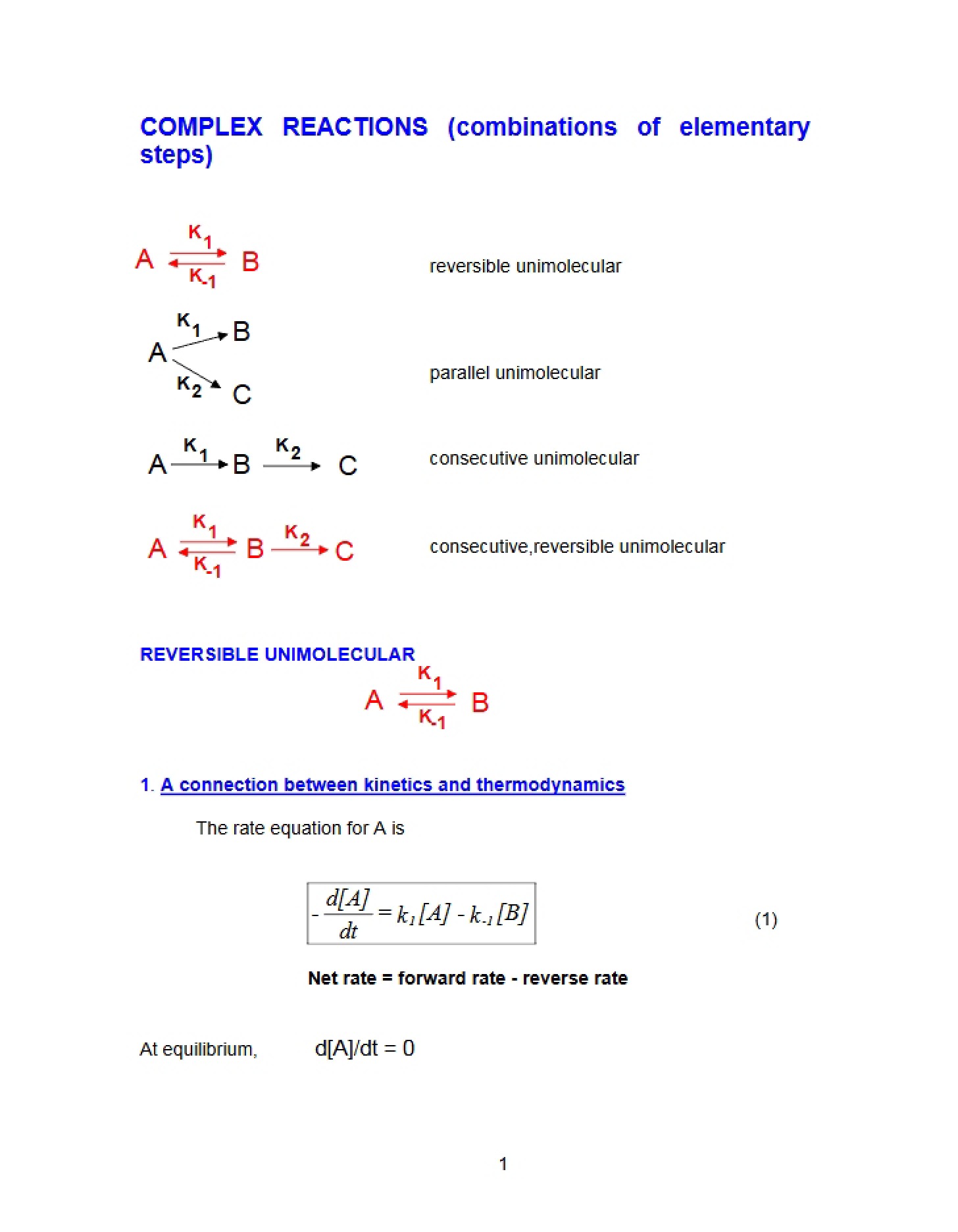
* Elementary reaction steps and molecularity
* The relationship between reaction rates and molecular collisions
What This Document Provides
* A detailed exploration of how to express reaction rates mathematically.
* Methods for experimentally determining the rate law for a given reaction.
* A framework for understanding the connection between rate constants and temperature.
* An introduction to the concept of reaction mechanisms and how they differ from stoichiometric equations.
* Definitions and explanations of key terms like molecularity and elementary steps.
* A foundation for analyzing the kinetics of complex biochemical reactions.