What This Document Is
This material represents a focused session within a graduate-level computer science course exploring the foundations of intelligent systems. Specifically, it delves into the core mechanisms by which computers can perform logical reasoning – a critical component of building systems capable of problem-solving and decision-making. The session examines various approaches to representing knowledge and utilizing it to arrive at conclusions, mirroring human thought processes. It builds upon prior concepts in knowledge representation and search algorithms.
Why This Document Matters
Students enrolled in advanced computer science programs, particularly those specializing in areas like machine learning, robotics, or knowledge systems, will find this session invaluable. It’s also beneficial for anyone seeking a deeper understanding of how logical inference is implemented in computational models. This material is most useful when studying knowledge representation, automated reasoning, and the theoretical underpinnings of intelligent agents. It serves as a strong foundation for more complex topics in the field.
Common Limitations or Challenges
This session focuses on the *principles* of logical reasoning systems. It does not provide a comprehensive coding tutorial or a step-by-step guide to building a complete reasoning engine. While it touches upon implementation considerations, it doesn’t offer ready-to-use code libraries or detailed software engineering advice. Furthermore, it assumes a pre-existing understanding of formal logic and basic programming concepts. It’s designed to enhance understanding, not to be a standalone learning resource.
What This Document Provides
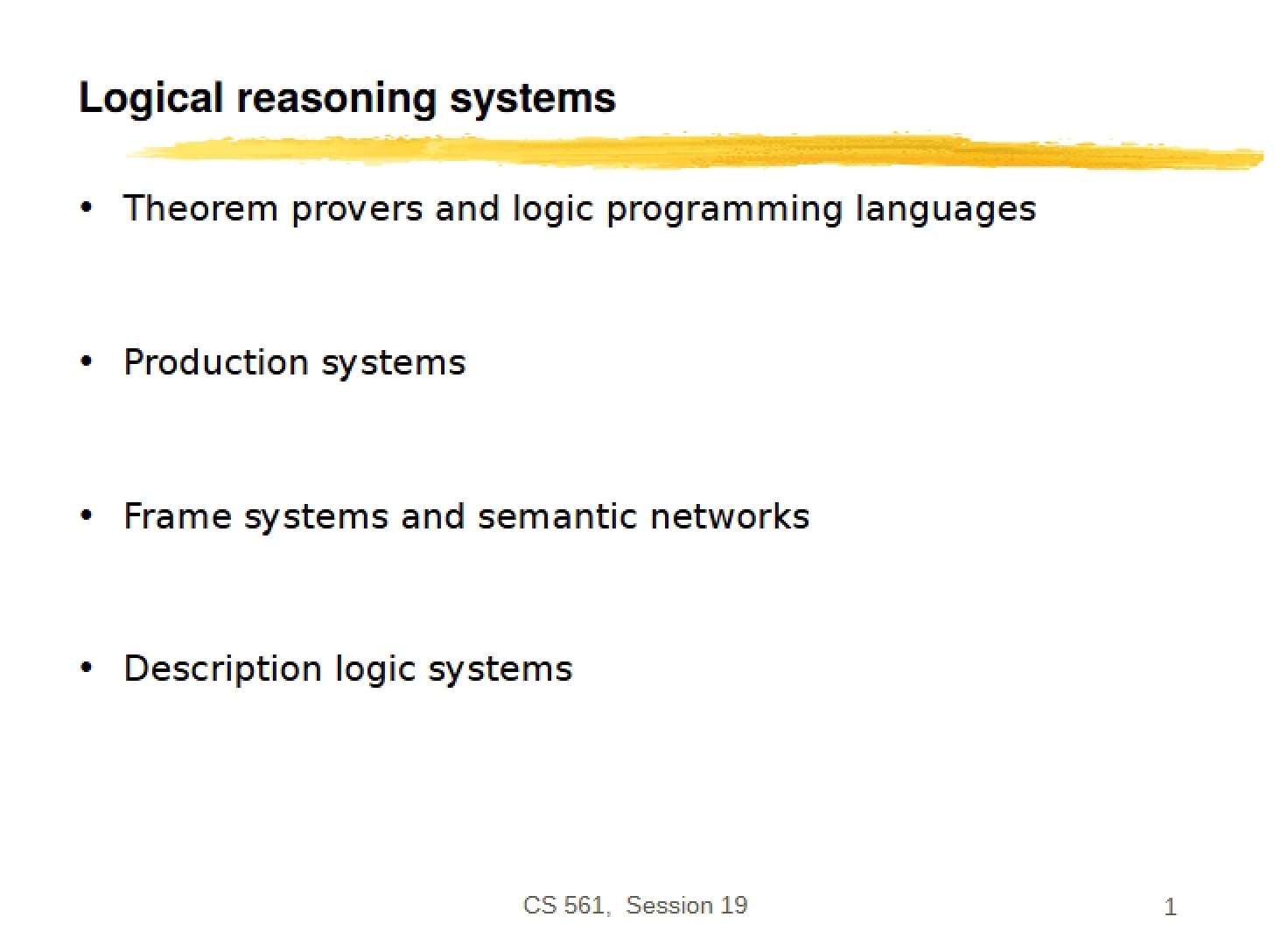
* An overview of different types of logical reasoning systems, including theorem provers, production systems, and description logic.
* A discussion of fundamental tasks associated with knowledge-based systems, such as adding facts, querying information, and updating knowledge bases.
* Exploration of techniques for efficiently indexing and retrieving information from large knowledge bases.
* Insights into the computational complexity of reasoning tasks and strategies for optimization.
* An introduction to the unification algorithm, a key process in logical inference.
* A comparative look at logic programming versus traditional programming paradigms.