What This Document Is
These are session notes from an advanced undergraduate course on Microelectromechanical Systems (MEMS) at the University of California, Berkeley (EE247A). Specifically, this installment focuses on the intricacies of Analog-to-Digital Conversion (ADC) techniques, with a deep dive into oversampled ADCs. These notes represent a detailed record of a lecture, intended to supplement textbook learning and provide a focused exploration of key concepts.
Why This Document Matters
This resource is invaluable for students currently enrolled in, or planning to take, an advanced MEMS course. It’s particularly helpful for those seeking a more thorough understanding of ADC design principles and their practical implementation. These notes are best utilized during exam preparation, when reviewing complex topics, or as a reference while working on related projects. Understanding these concepts is crucial for anyone designing or analyzing systems that interface with the physical world through sensor data.
Topics Covered
* Detailed analysis of oversampled ADC architectures
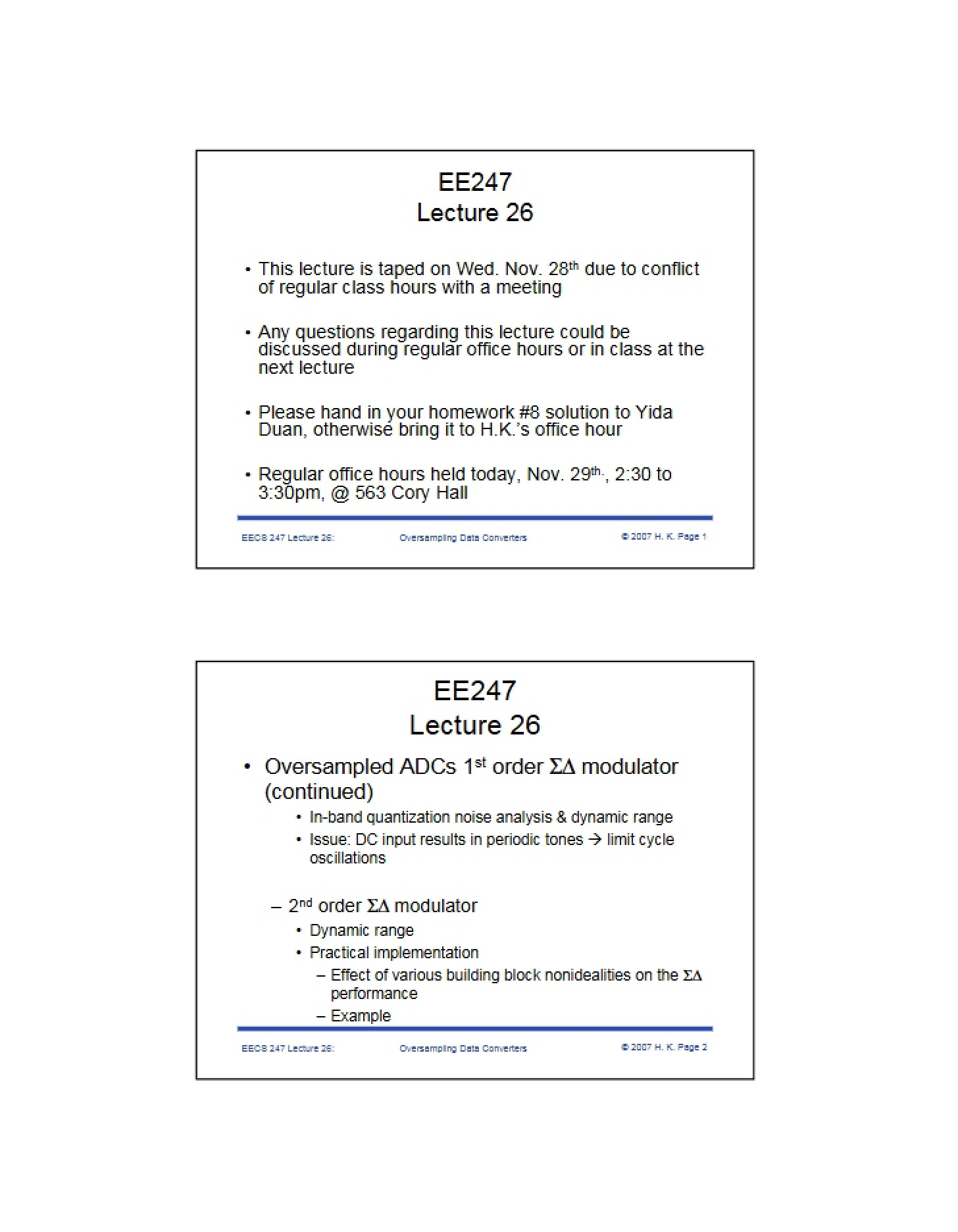
* Second-order and higher-order sigma-delta modulator designs
* Impact of non-ideal component characteristics on ADC performance
* Practical considerations for implementing switched-capacitor circuits
* Analysis of limit cycle tones and their mitigation
* Signal handling capabilities of integrators
* Noise analysis in ADC systems
What This Document Provides
* A comprehensive overview of advanced ADC concepts, building upon foundational knowledge.
* In-depth exploration of modulator performance factors.
* Discussion of design trade-offs related to component selection and circuit topology.
* References to seminal research papers in the field of sigma-delta modulation.
* Insights into the challenges and solutions associated with real-world ADC implementation.