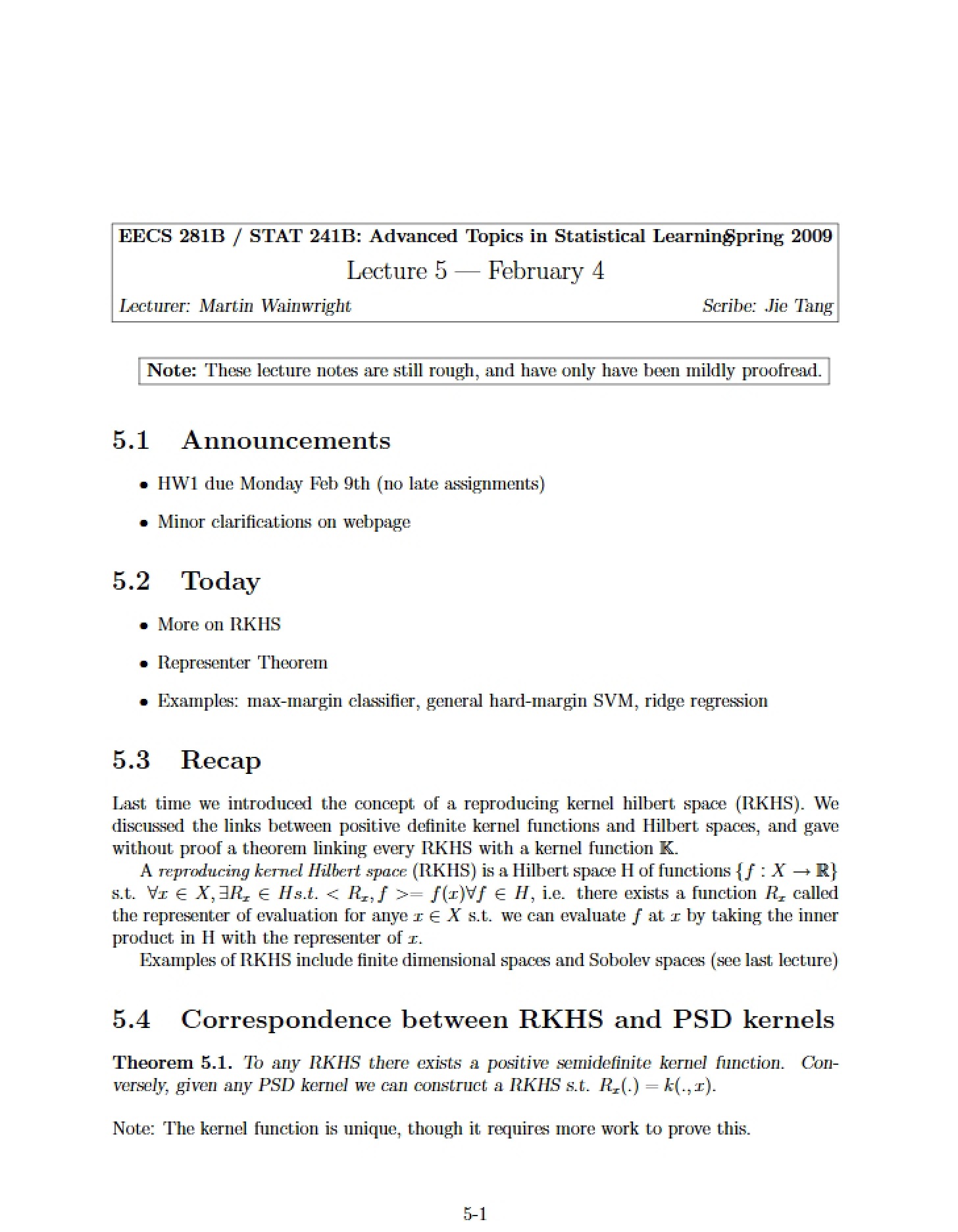
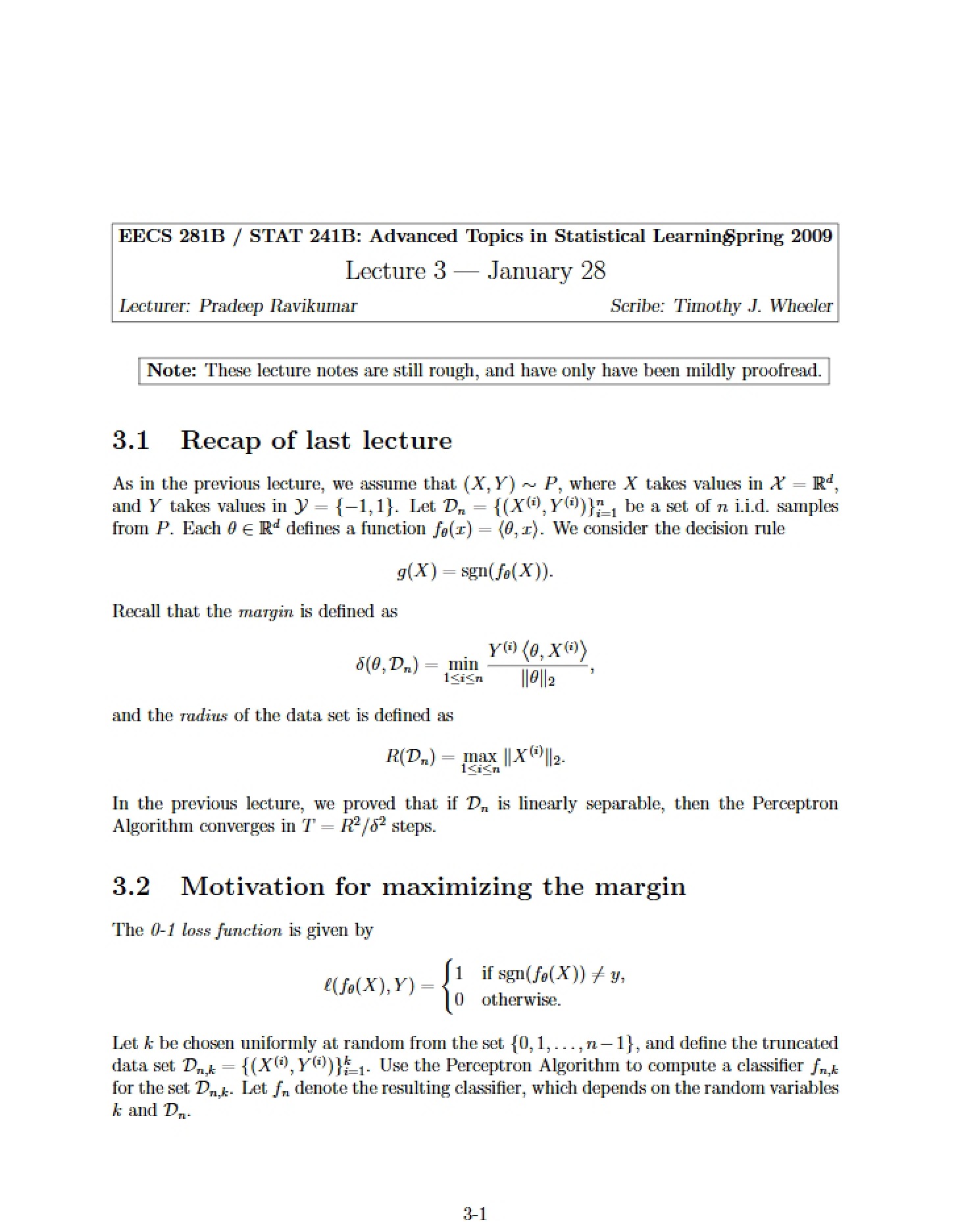
What This Document Is
This document contains lecture notes from STAT 241B / EECS 281B: Advanced Statistical Learning at UC Berkeley, specifically covering the seventh lecture of the Spring 2009 course. It delves into advanced mathematical and statistical concepts related to learning and decision-making processes. The notes represent the instructor’s presentation and a student’s transcription, offering a detailed record of the lecture’s core ideas. Please note these are presented as rough, lightly proofread notes.
Why This Document Matters
These lecture notes are invaluable for students enrolled in advanced statistical learning courses, particularly those focusing on the theoretical underpinnings of machine learning. They are most beneficial when used in conjunction with course attendance and assigned homework. Individuals seeking a deeper understanding of kernel methods, dimensionality reduction techniques, and the mathematical foundations of statistical learning will find this resource particularly helpful. Accessing the full content will allow for a comprehensive grasp of these complex topics.
Topics Covered
* Mercer’s characterization of kernel functions
* Kernel Principal Component Analysis (Kernel PCA) as a dimensionality reduction technique
* Positive semidefinite kernels and their properties
* Hilbert spaces and linear operators
* Integral equations related to kernel methods
* Feature maps and their connection to kernel functions
* A recap of classical Principal Component Analysis (PCA)
* Noisy subspace generative models in PCA
What This Document Provides
* A detailed exploration of Mercer’s theorem and its implications.
* Mathematical formulations and notations used in advanced statistical learning.
* A discussion of eigenfunctions and their role in kernel methods.
* An introduction to the concept of feature maps and their relationship to kernel functions.
* A foundational review of classical PCA to contextualize Kernel PCA.
* A framework for understanding covariance and correlation matrices in high-dimensional data.
* Theoretical groundwork for understanding the assumptions behind certain statistical models.