What This Document Is
This document represents the lecture notes from the sixth session of Modern Physics and Advanced Electrical Laboratory (PHYSICS 111) at the University of California, Berkeley. It focuses on the practical application and theoretical underpinnings of Junction Field-Effect Transistors (JFETs) and their role in circuit design. The material builds upon previous discussions of fundamental semiconductor devices and introduces more advanced concepts related to amplification and signal processing.
Why This Document Matters
These lecture notes are essential for students enrolled in PHYSICS 111 seeking a deeper understanding of JFET characteristics and applications. It’s particularly valuable when combined with laboratory exercises, offering context and theoretical reinforcement for experimental observations. Students preparing for assessments or needing a concise review of JFET-based circuit analysis will find this resource beneficial. It bridges the gap between theoretical concepts and real-world implementation of these crucial electronic components.
Topics Covered
* JFET characterization and parameter extraction
* JFET operation as a voltage-controlled resistor
* Voltage amplifier fundamentals, including gain calculations
* Source follower configurations and power gain analysis
* Differential amplifier principles and common-mode rejection
* Circuit analysis techniques for determining common-mode and differential gain
* The role of JFETs in Very Large Scale Integration (VLSI) circuit fabrication
What This Document Provides
* A detailed exploration of JFET behavior in various circuit configurations.
* Conceptual explanations of voltage and power gain in amplifier circuits.
* A discussion of the advantages of differential amplifiers in noise reduction.
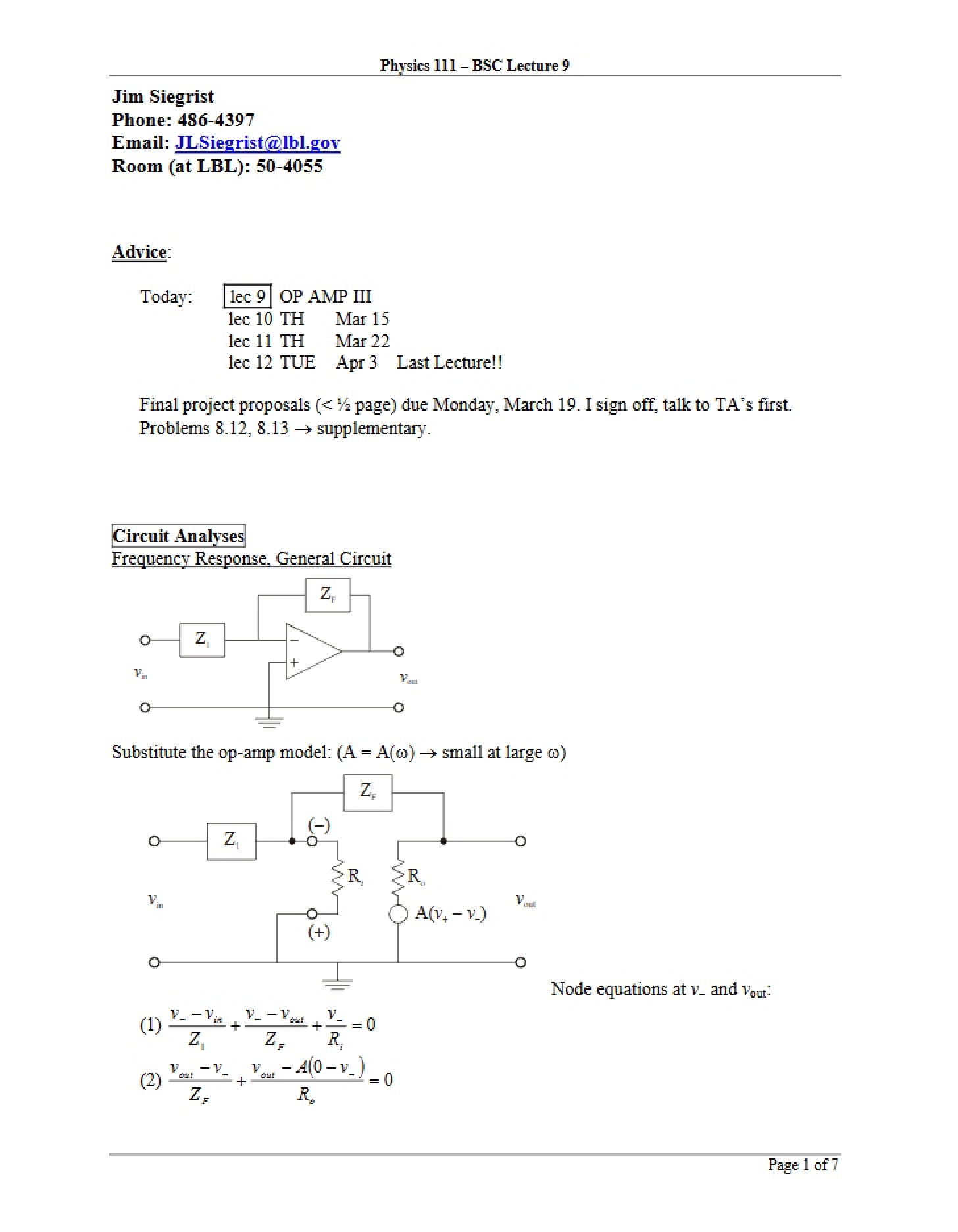
* Circuit diagrams illustrating key concepts and analysis techniques.
* Connections between device characteristics and practical circuit performance.
* Insights into the importance of device characterization in semiconductor manufacturing.