What This Document Is
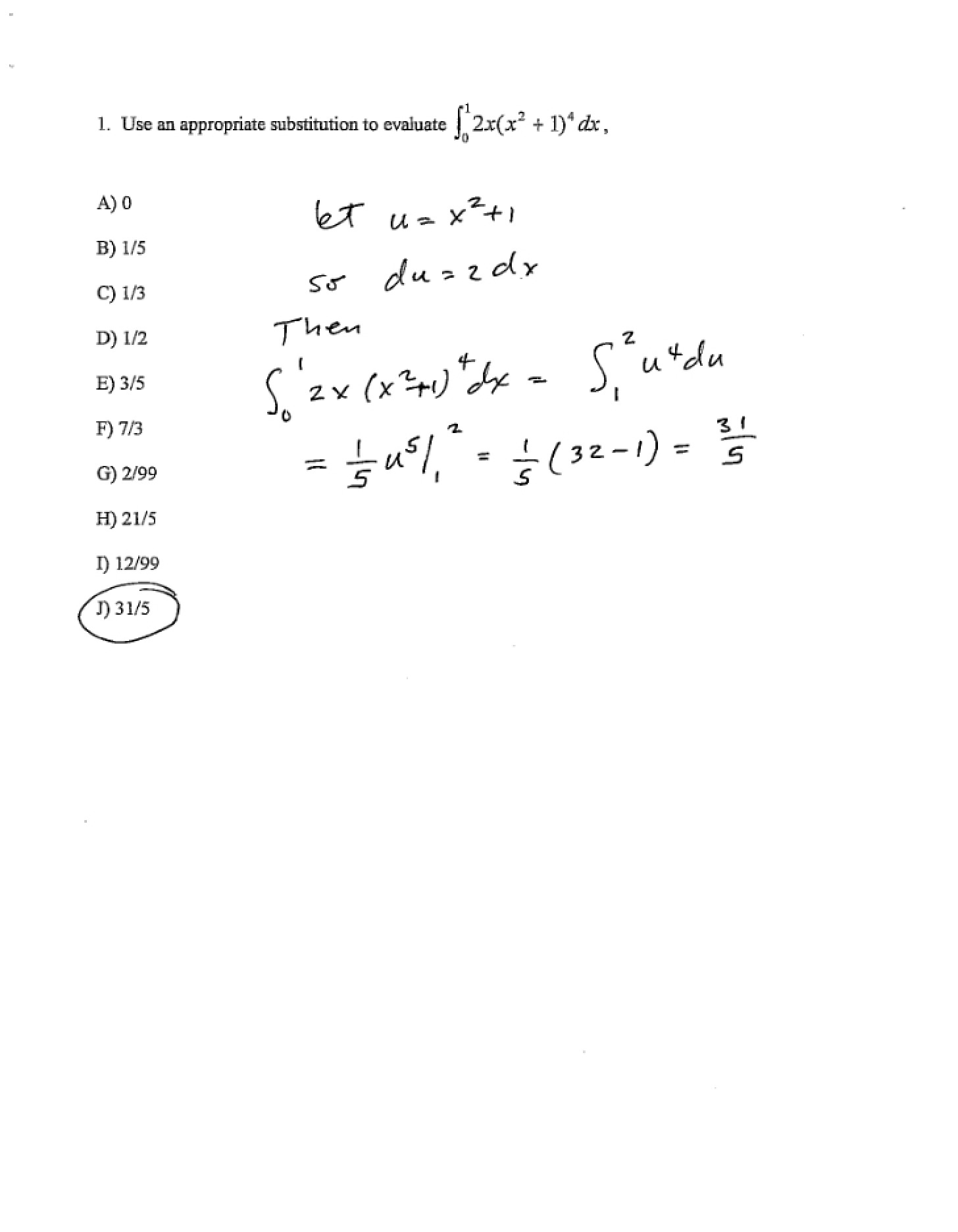
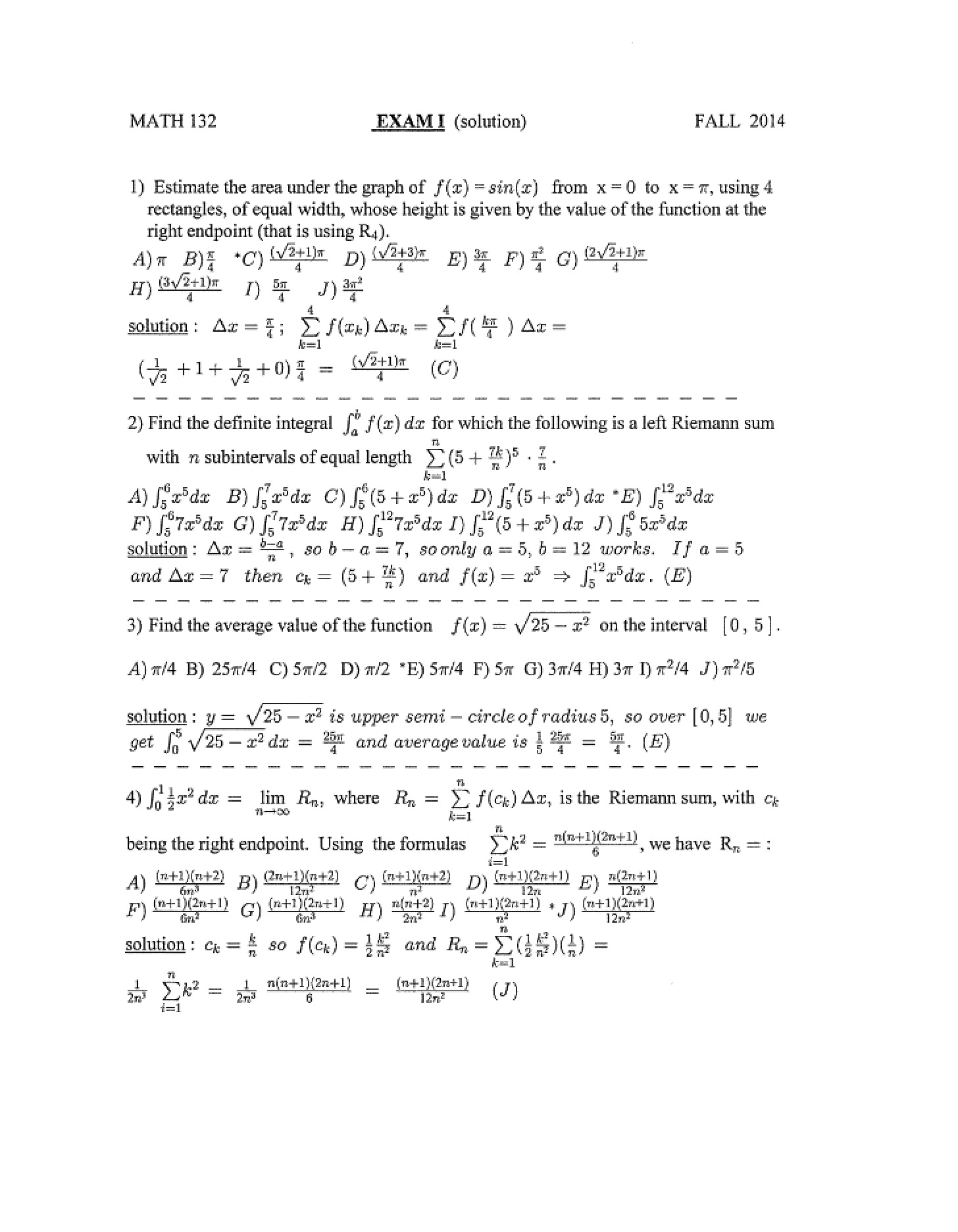
This document contains worked solutions for a Calculus II (MATH 132) exam administered at Washington University in St. Louis during the Fall 2007 semester. It’s a detailed breakdown of the problems presented on Exam 2, covering a range of topics central to the course at that point in the term. The material focuses on applying calculus principles to solve specific problems, demonstrating a step-by-step approach to arriving at correct answers.
Why This Document Matters
This resource is invaluable for students who have already attempted the exam and are looking to understand where they went wrong, or for those preparing for a similar assessment. It’s particularly helpful for identifying common errors and solidifying understanding of core concepts like integration techniques, derivatives of various functions, applications of exponential functions, and problem-solving strategies related to radioactive decay and population growth models. Students currently studying these topics can use it as a benchmark to assess their own problem-solving abilities.
Common Limitations or Challenges
This document *does not* include the original exam questions themselves. It solely provides the solutions, meaning it’s most effective when used in conjunction with a copy of the original exam. It also doesn’t offer extensive conceptual explanations *before* the solutions; it assumes a base level of understanding of the calculus concepts involved. It represents a specific instance of an exam from Fall 2007, and while the core concepts remain consistent, the exact problems and their phrasing may differ in subsequent exams.
What This Document Provides
* Detailed breakdowns of solutions to a variety of Calculus II problems.
* Illustrative examples covering topics such as integration by parts and logarithmic integration.
* Applications of derivative rules to different function types, including trigonometric and algebraic functions.
* Solutions to problems involving modeling real-world phenomena with exponential functions (radioactive decay, population growth).
* Worked solutions for problems requiring the determination of limits and constants within defined mathematical contexts.
* Demonstration of techniques for solving problems related to arcsecant functions and their derivatives.