What This Document Is
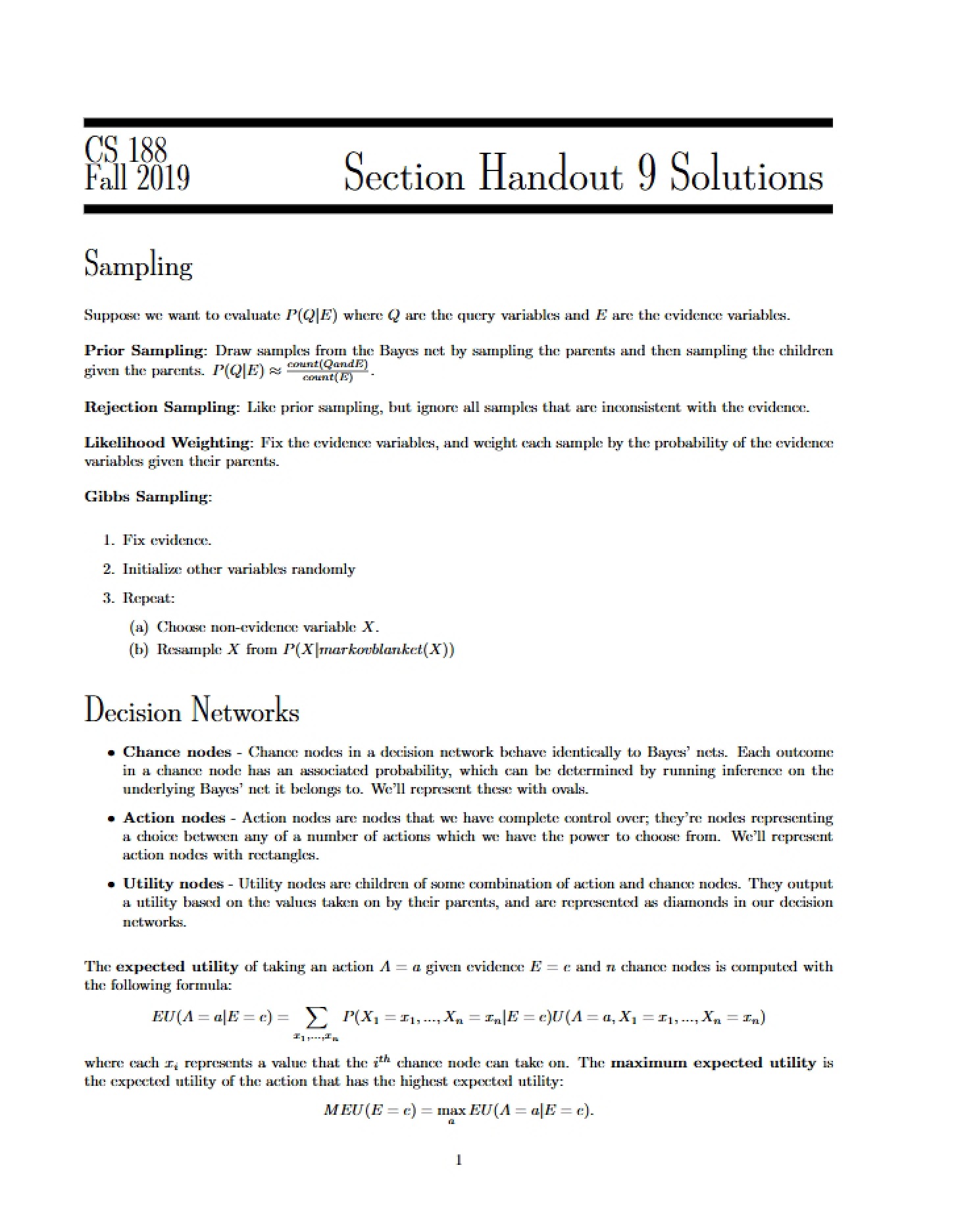
This study guide offers detailed solutions to a practice handout focused on probability and Bayesian Networks, a core component of computer science. Specifically, it addresses concepts taught within the CS 188 course at the University of California, Berkeley. It’s designed to reinforce understanding of probabilistic reasoning and its application to real-world scenarios. This resource is intended to be used *in conjunction with* the original handout material.
Why This Document Matters
Students enrolled in introductory computer science courses, particularly those covering artificial intelligence, machine learning, or probabilistic models, will find this guide exceptionally helpful. It’s ideal for checking your work after attempting the problems independently, clarifying areas of confusion, and solidifying your grasp of complex concepts. This is particularly useful when preparing for quizzes or exams that assess your ability to apply probabilistic principles.
Topics Covered
* Probability Distributions (Joint and Marginal)
* Conditional Independence and Bayesian Networks
* Bayes’ Net Representation and its relationship to joint probability distributions
* Markov Blankets and their role in simplifying probabilistic calculations
* Applying Bayesian Networks to real-world problem scenarios (e.g., car safety features)
* Calculating probabilities from Bayesian Networks given various evidence
* Understanding the impact of gene variations on disease manifestation
What This Document Provides
* Detailed walkthroughs addressing problems related to Bayes’ Net structure and independence relationships.
* Explanations of how to express joint probability distributions as products of conditional probabilities.
* Illustrative examples demonstrating probability calculations within Bayesian Networks.
* A framework for analyzing the relationships between variables in a probabilistic model.
* A resource for understanding how to apply probabilistic reasoning to practical applications.