What This Document Is
This is a past exam from a General Chemistry (CHEM 105) course at the University of Southern California, specifically Exam 1 from the Spring 2012 semester. It’s a comprehensive assessment designed to evaluate understanding of foundational chemistry concepts typically covered in the early stages of a first-year chemistry curriculum. The exam focuses on core principles and problem-solving skills.
Why This Document Matters
This resource is invaluable for students currently enrolled in, or preparing to take, a similar General Chemistry course. It’s particularly useful for understanding the *style* and *scope* of questions asked by this instructor (Dr. Bertolini). Working through practice exams is a proven method for identifying knowledge gaps, improving test-taking strategies, and building confidence. It’s best utilized *after* you’ve engaged with course materials – lectures, textbooks, and homework – to gauge your preparedness. Students aiming to excel in CHEM 105, or those seeking to reinforce their understanding of fundamental chemical principles, will find this a beneficial study tool.
Common Limitations or Challenges
While this exam provides a realistic assessment experience, it’s important to remember that course content and instructor emphasis can vary. This is a *past* exam, and while core concepts remain consistent, specific topics or the weighting of those topics may differ in current iterations of the course. This resource does not include explanations of the correct answers or step-by-step solutions; it is purely an assessment tool. It also assumes a baseline level of familiarity with general chemistry principles.
What This Document Provides
* A full-length exam mirroring the format and difficulty of assessments used in USC’s CHEM 105a course.
* A variety of problem types covering topics such as chemical formulas and nomenclature.
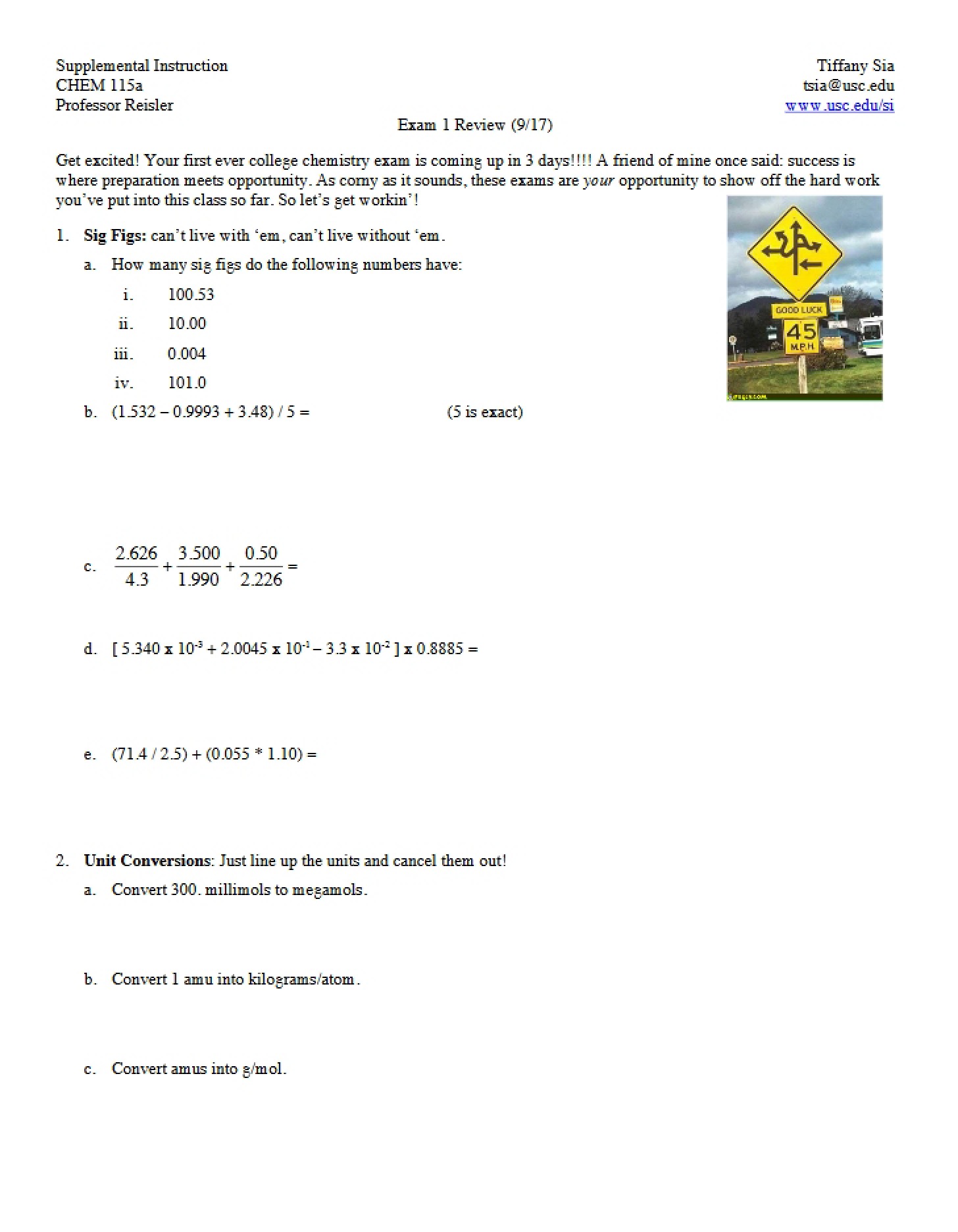
* Questions requiring application of significant figure rules in measurements.
* Problems related to periodic trends and elemental identification.
* Stoichiometry and mass calculations involving chemical reactions.
* Isotopic abundance calculations.
* Empirical formula determination from combustion analysis data.
* Clear instructions regarding exam procedures and permitted materials.