What This Document Is
This is a detailed set of lecture materials focusing on transient stability within the field of Power System Analysis. Developed for an advanced undergraduate course at the University of Illinois at Urbana-Champaign (ECE 476), it explores the dynamic behavior of power systems following disturbances. The material delves into the complexities of maintaining grid stability when faced with sudden changes in system conditions. It builds upon foundational power system concepts and applies them to real-world scenarios.
Why This Document Matters
This resource is invaluable for electrical engineering students specializing in power systems, as well as practicing engineers seeking a deeper understanding of power grid dynamics. It’s particularly useful when studying for exams, completing assignments, or preparing for professional certifications related to power system operation and planning. Understanding transient stability is crucial for ensuring reliable and secure power delivery, and this material provides a strong theoretical foundation for tackling related challenges.
Topics Covered
* Time scales relevant to power system disturbances
* Modeling of generators, including classical and more advanced representations
* Mechanical and electrical dynamics of power system components
* The swing equation and its application to stability analysis
* Analysis of power system response to sudden generation loss
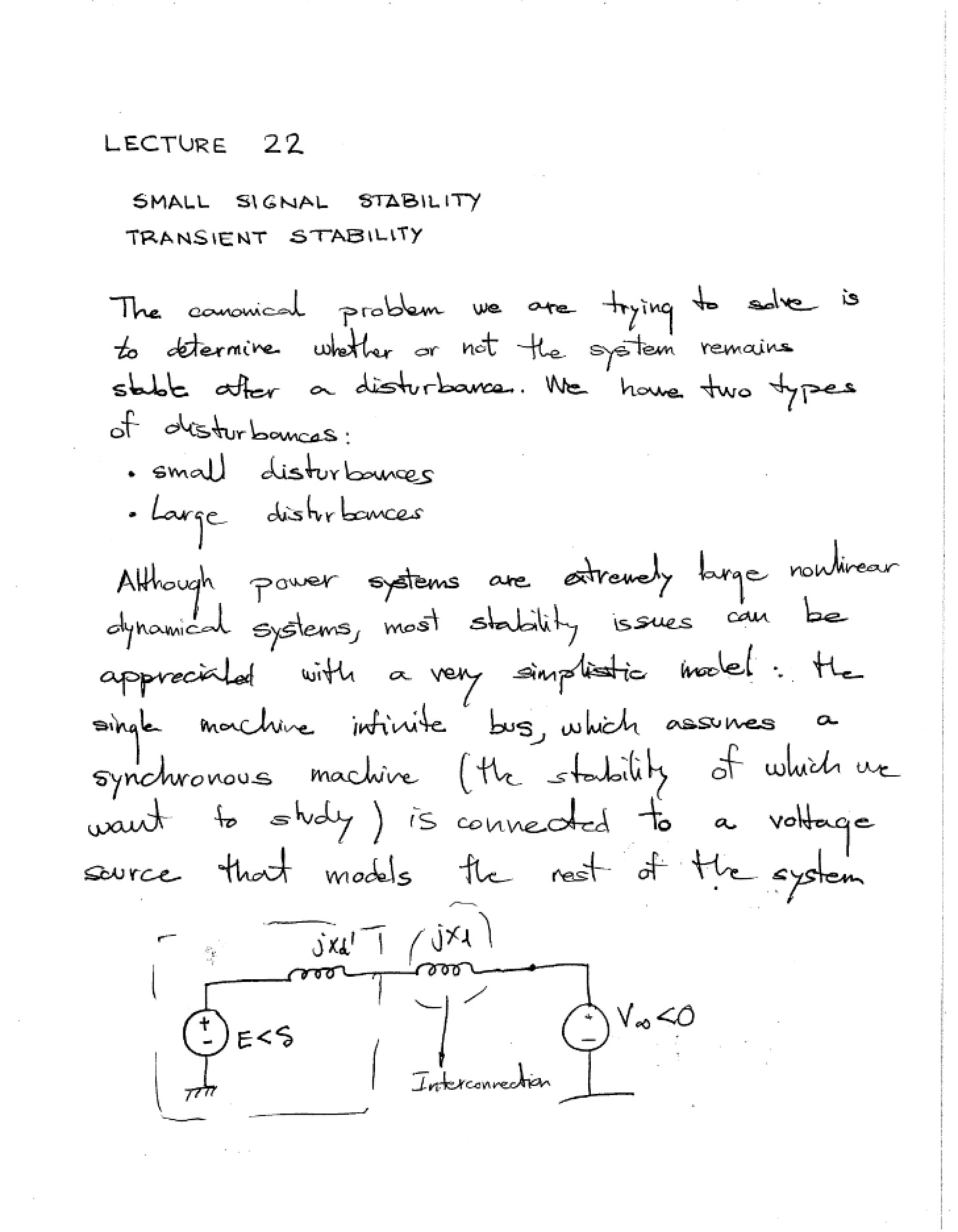
* The Single Machine Infinite Bus (SMIB) system as a foundational model
* Identification of equilibrium points and their significance
* System states: pre-fault, faulted, and post-fault conditions
What This Document Provides
* A comprehensive overview of the theoretical underpinnings of transient stability.
* Detailed explanations of generator modeling techniques.
* Mathematical formulations describing the dynamic behavior of power system components.
* Illustrative examples demonstrating the impact of disturbances on system frequency.
* A framework for analyzing system response to various contingencies.
* Connections to relevant industry standards and practices.
* Homework assignments to reinforce learning and application of concepts.