What This Document Is
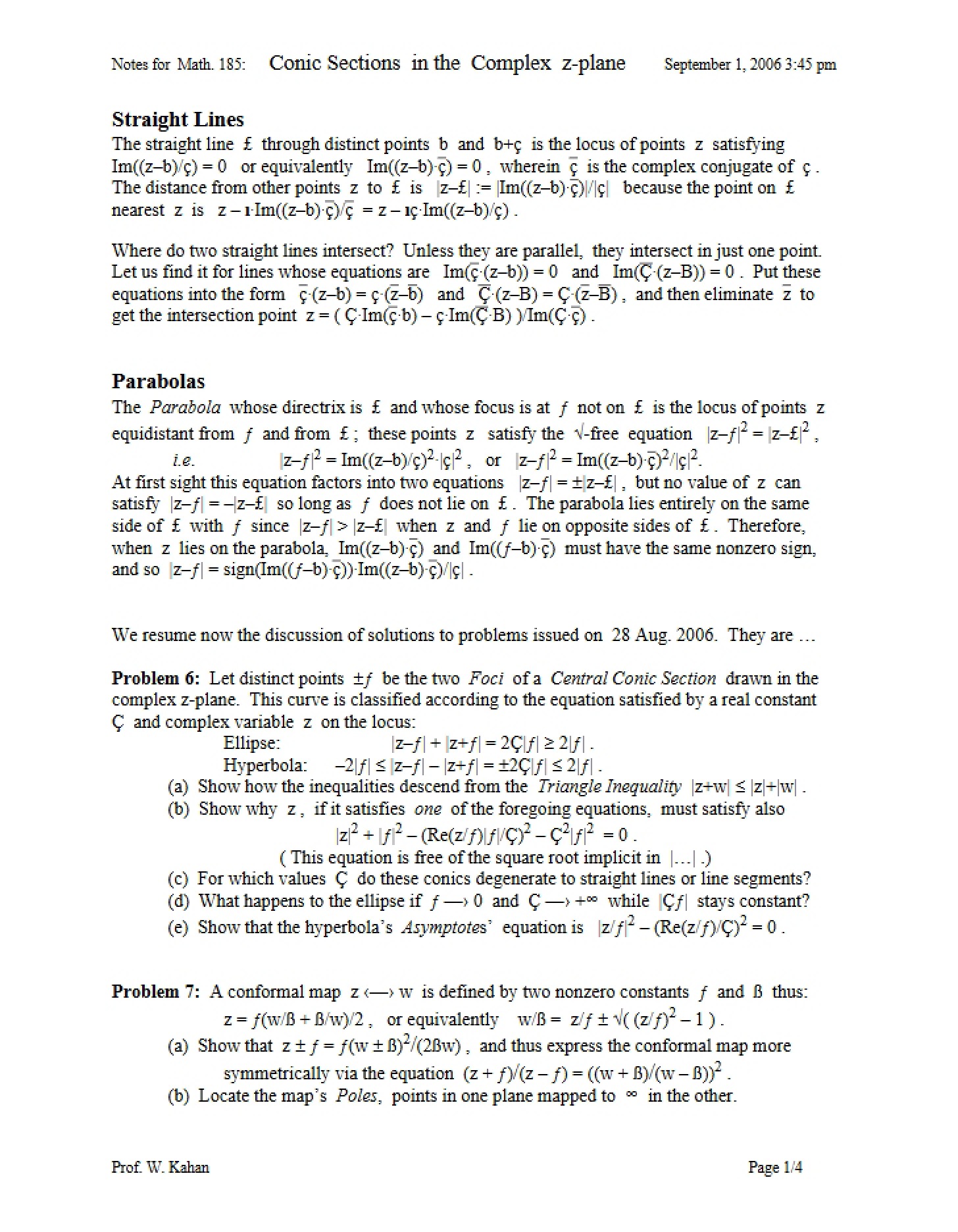
This study guide delves into the fascinating world of complex analysis, specifically focusing on the geometric properties of points in the complex plane. It explores conditions for determining when points are collinear and, more importantly, when they are concyclic – meaning they lie on the same circle. This material builds upon foundational concepts from complex analysis and extends them into geometric problem-solving. The guide presents a series of problems and their associated solutions, designed to deepen understanding of these core principles.
Why This Document Matters
This resource is ideal for students enrolled in a rigorous complex analysis course, such as MATH 185 at UC Berkeley. It’s particularly beneficial for those who want to strengthen their ability to apply complex numbers to geometric scenarios. Use this guide to supplement your lecture notes, textbook readings, and homework assignments. It’s a valuable tool for preparing for exams and solidifying your grasp of challenging concepts related to geometric arrangements of complex numbers.
Topics Covered
* Collinearity of points in a linear space
* Conditions for concyclic points in Euclidean space
* Geometric interpretations of complex number equations
* Relationships between distances and collinearity
* Vector representations of points and displacements
* Applications of triangle inequalities in complex geometry
What This Document Provides
* Detailed explorations of problems related to collinear and concyclic points.
* Step-by-step reasoning behind the solutions to complex geometric problems.
* Connections between algebraic equations and geometric configurations.
* Insights into the application of linear dependence to determine collinearity.
* A framework for analyzing the relationships between distances and point arrangements.
* References to related materials for further study.