What This Document Is
This is the official syllabus for EE 120: Signals and Systems, a core course within the Electrical Engineering and Computer Sciences curriculum at the University of California, Berkeley. It serves as a comprehensive guide outlining the course structure, expectations, and logistical details for students enrolled in the semester-long offering. It details the foundational knowledge expected of students and the skills they will develop throughout the course.
Why This Document Matters
This syllabus is essential for any student considering enrollment in EE 120, as well as those already registered. It clarifies prerequisites, ensuring students have the necessary background for success. It’s also crucial for understanding the course’s grading components, schedule, and policies. Reviewing this document *before* the course begins will help you prepare effectively and maximize your learning experience. It’s a valuable reference throughout the semester to stay informed about important dates and requirements.
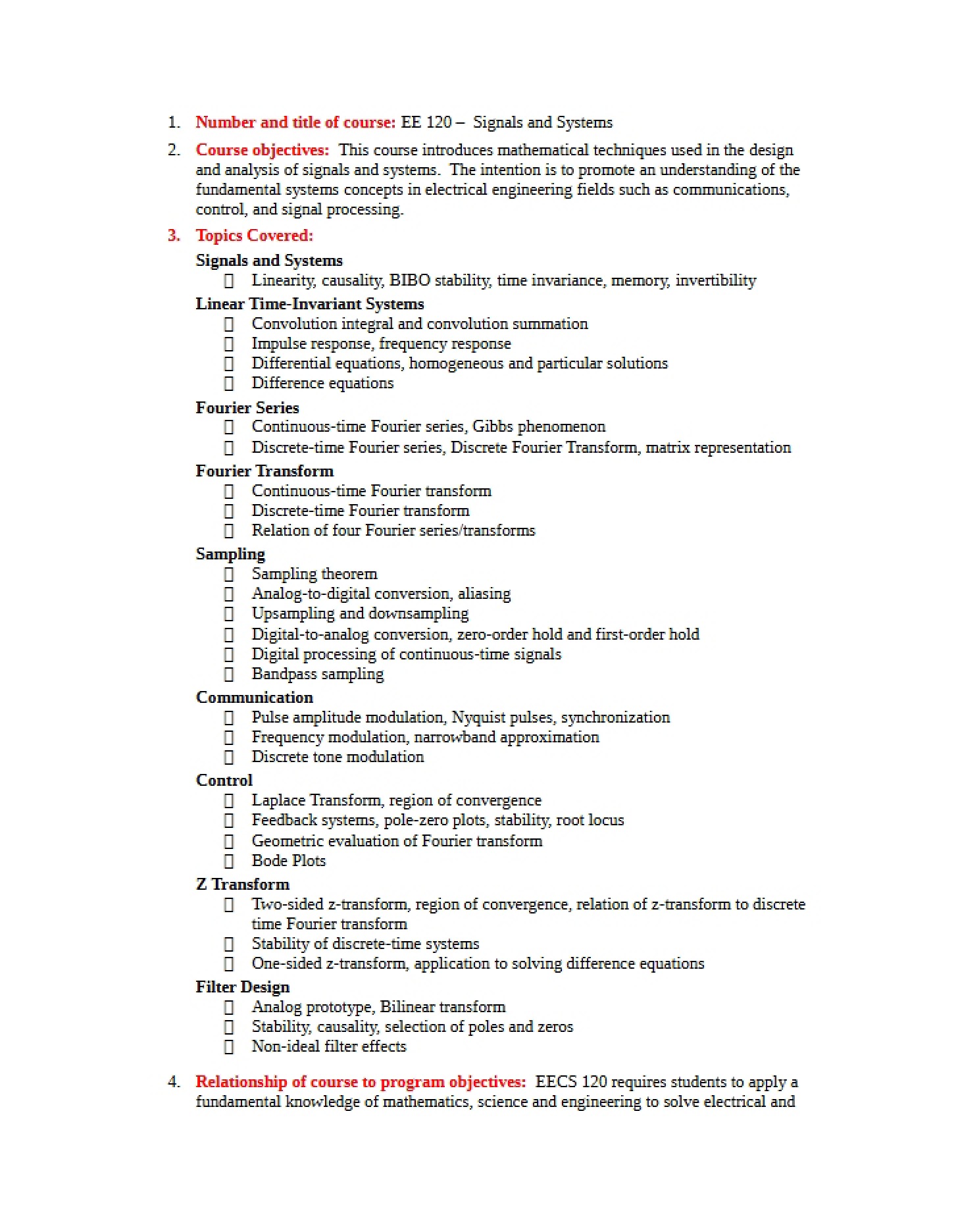
Topics Covered
* Foundational mathematical concepts relevant to signals and systems analysis.
* Core principles of continuous-time and discrete-time signal representation.
* System properties and classifications.
* Frequency domain analysis techniques.
* Signal transformations, including Fourier, Laplace, and Z transforms.
* Concepts of stability and system response.
* Applications of signals and systems to areas like filtering and control systems.
* The role of collaborative learning and problem-solving.
What This Document Provides
* A clear outline of course prerequisites and recommended background materials.
* Details regarding lecture schedules, discussion sections, and instructor availability.
* A breakdown of the weighting of various course components (problem sets, quizzes, exams).
* A list of required and recommended textbooks for further study.
* Information on how the course aligns with ABET program outcomes for engineering students.
* Insight into the course’s pedagogical approach, emphasizing conceptual understanding and efficient problem-solving.