What This Document Is
This document provides a focused exploration of system redundancy, a core principle within the field of fault-tolerant systems. It’s designed as a learning resource for students and professionals seeking a deeper understanding of how to build reliable and resilient systems capable of operating correctly even when failures occur. The material delves into various redundancy techniques and their application in mitigating the impact of faults. It originates from CS 449/549 Fault-Tolerant Systems at the University of Idaho.
Why This Document Matters
This resource is invaluable for students enrolled in courses on fault tolerance, distributed systems, or reliable computing. It’s also beneficial for engineers and system architects involved in designing and implementing critical infrastructure, safety-critical systems, or any application where downtime is unacceptable. Understanding the concepts presented here is crucial for building systems that can withstand unexpected errors and maintain operational integrity. If you are looking to solidify your understanding of redundancy strategies and their practical implications, this material will be a strong foundation.
Topics Covered
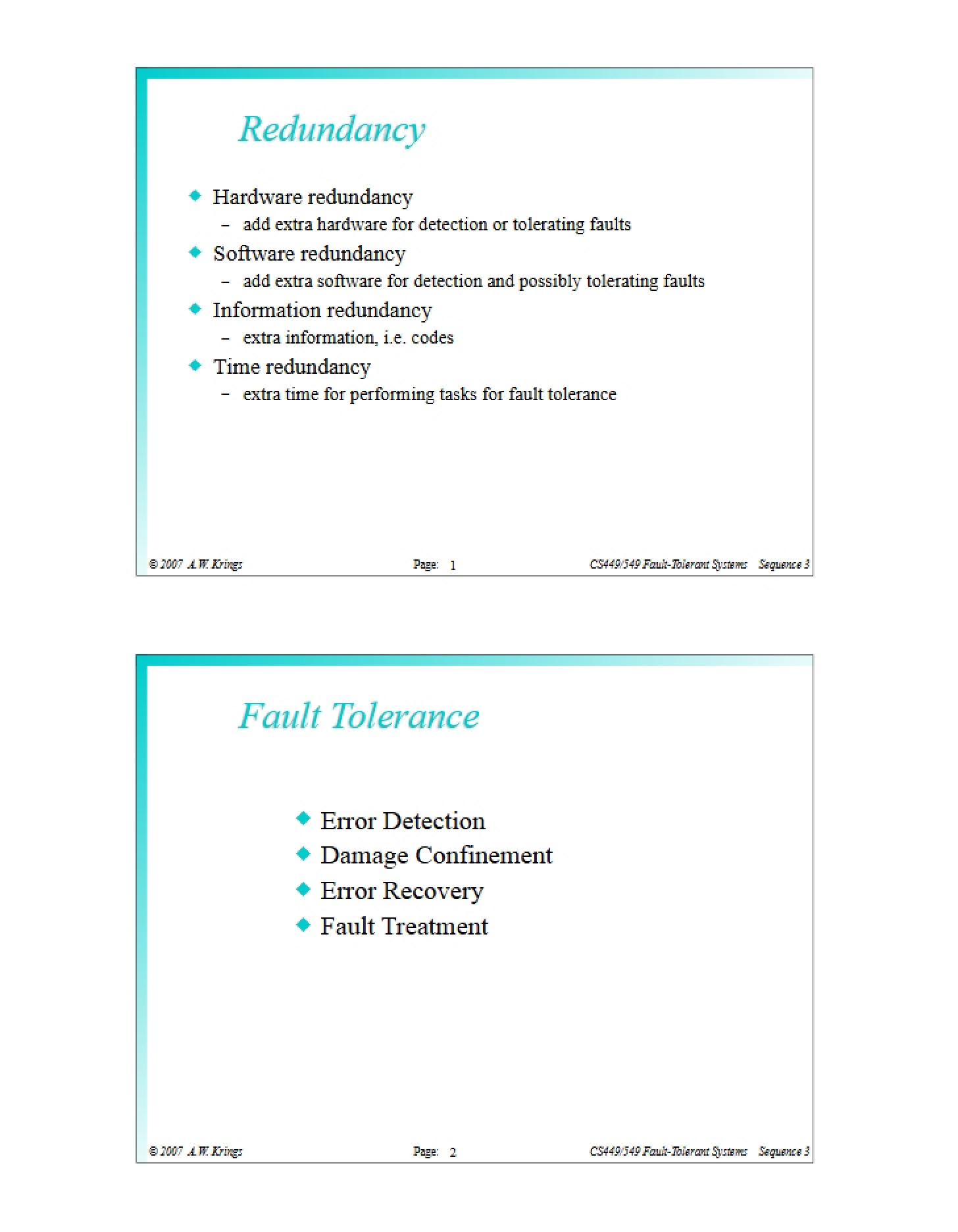
* Different types of redundancy: hardware, software, information, and time redundancy.
* The phases of fault tolerance: error detection, damage confinement, error recovery, and fault treatment.
* Strategies for error detection, including ideal and acceptable checks, and diagnostics.
* Methods for confining errors and preventing their propagation.
* Approaches to error recovery, such as backward and forward recovery.
* Hardware redundancy techniques: passive, active, and hybrid approaches.
* N-Modular Redundancy (NMR) and Triple Modular Redundancy (TMR) concepts.
* Fault coverage metrics and their significance.
* Advanced concepts like voter replication and flux summing.
What This Document Provides
* A structured overview of redundancy principles.
* Detailed examination of various fault tolerance techniques.
* Conceptual explanations of hardware redundancy implementations.
* Discussions on the trade-offs associated with different redundancy strategies.
* Insights into the challenges of building highly reliable systems.
* A framework for evaluating a system’s ability to handle faults.
* A foundation for further study in the field of fault-tolerant computing.