What This Document Is
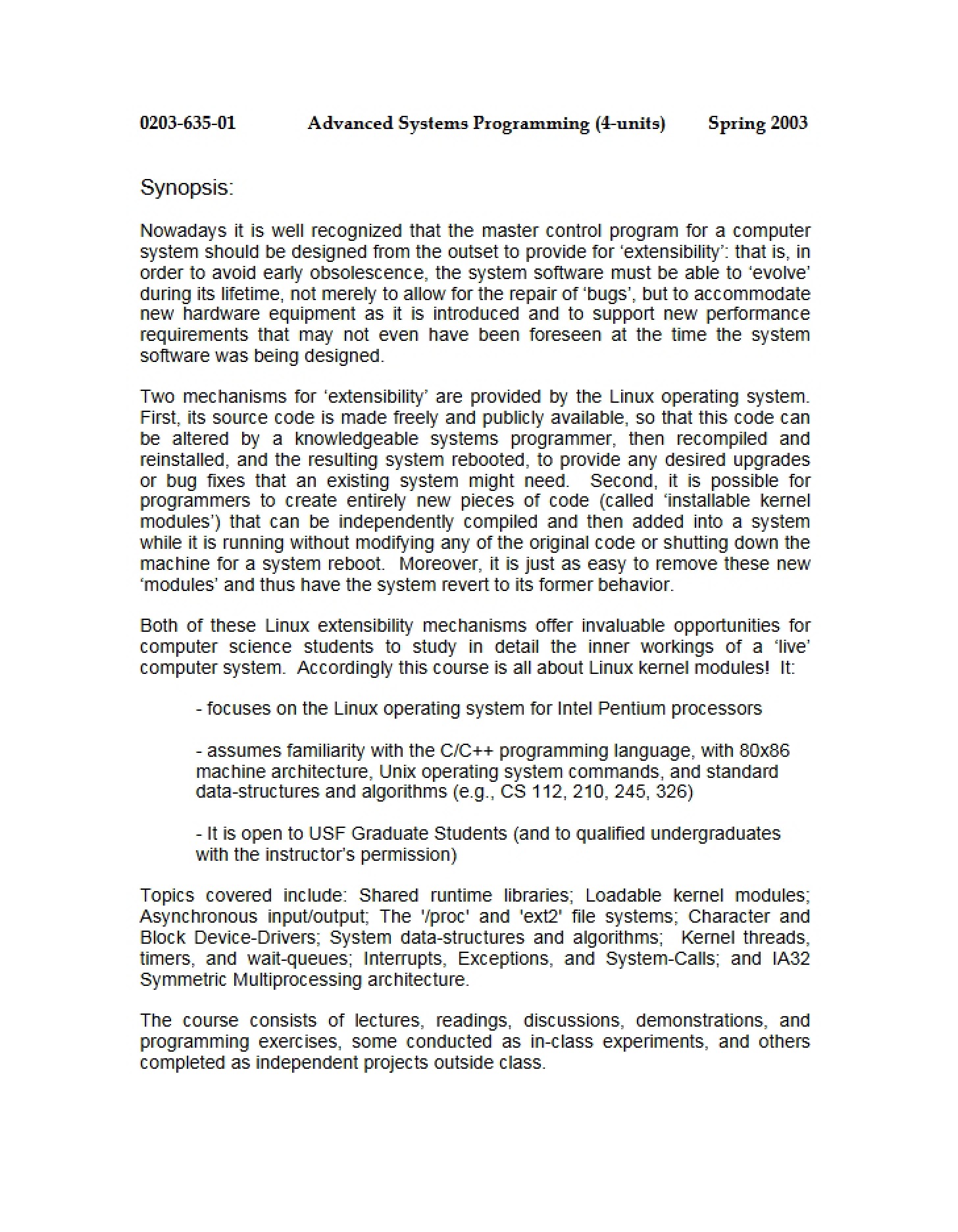
This material represents course notes for an advanced-level Systems Programming course (CS 635) at the University of San Francisco. It focuses on the core principles and practical techniques involved in extending and modifying operating system kernels, specifically within a Linux environment. The content appears to be structured as a set of lecture notes, covering essential concepts for students aiming to develop a deep understanding of OS internals. It delves into the mechanisms that allow for dynamic modification and expansion of kernel functionality.
Why This Document Matters
This resource is invaluable for students pursuing advanced studies in computer science, particularly those specializing in operating systems, kernel development, or embedded systems. It’s beneficial for anyone needing to understand how to interact with and customize the Linux kernel. It would be most useful during coursework involving kernel module development, system-level programming assignments, or research projects requiring low-level OS access. Professionals working on device drivers or system administration may also find the foundational concepts helpful.
Common Limitations or Challenges
This material is designed as a companion to a full course of study and does *not* provide a complete, self-contained introduction to systems programming. It assumes a pre-existing understanding of C programming and fundamental operating system concepts. It does not offer pre-built code solutions or a step-by-step tutorial for specific tasks; rather, it focuses on the underlying principles. It also relies on access to a Linux development environment for practical application of the concepts.
What This Document Provides
* An overview of the importance of OS extensibility and the challenges of maintaining a modern operating system.
* Discussion of different approaches to extending kernel functionality.
* Information regarding tools and commands used for managing kernel modules.
* Explanation of the structure and essential components of a Linux kernel module.
* Guidance on the compilation process for kernel modules, including considerations for different kernel versions.
* Details on specialized tools designed to streamline the module development workflow.
* Instructor contact information and course textbook references.